


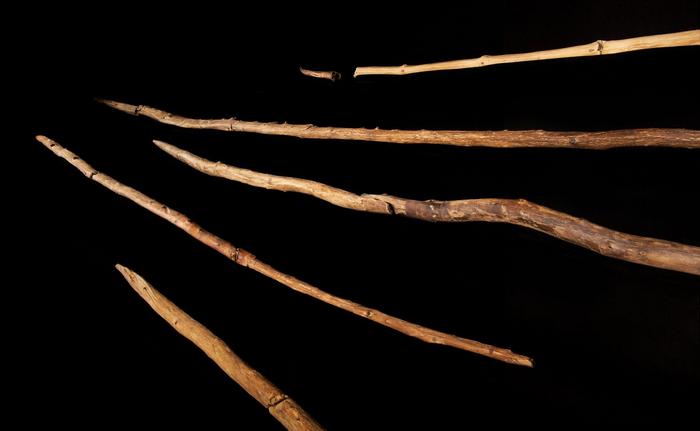
During archaeological excavations in the Schöningen open-cast coal mine in 1994, the discovery of the oldest, remarkably well-preserved hunting weapons known to humanity caused an international sensation. Spears and a double-pointed throwing stick were found lying between animal bones about ten meters below the surface in deposits at a former lakeshore. In the years that followed, extensive excavations have gradually yielded numerous wooden objects from a layer dating from the end of a warm interglacial period 300,000 years ago. The findings suggested a hunting ground on the lakeshore. An interdisciplinary research team from the Universities of Göttingen and Reading (UK), and the Lower Saxony State Office for Cultural Heritage (NLD) has now examined all the wood objects for the first time. State-of-the-art imaging techniques such as 3D microscopy and micro-CT scanners have produced surprising results. The research was published in PNAS.

Credit: Volker Minkus/MINKUSIMAGES, NLD
During archaeological excavations in the Schöningen open-cast coal mine in 1994, the discovery of the oldest, remarkably well-preserved hunting weapons known to humanity caused an international sensation. Spears and a double-pointed throwing stick were found lying between animal bones about ten meters below the surface in deposits at a former lakeshore. In the years that followed, extensive excavations have gradually yielded numerous wooden objects from a layer dating from the end of a warm interglacial period 300,000 years ago. The findings suggested a hunting ground on the lakeshore. An interdisciplinary research team from the Universities of Göttingen and Reading (UK), and the Lower Saxony State Office for Cultural Heritage (NLD) has now examined all the wood objects for the first time. State-of-the-art imaging techniques such as 3D microscopy and micro-CT scanners have produced surprising results. The research was published in PNAS.
This is the first time that researchers have been able to demonstrate new ways of handling and working the wood, such as the “splitting technique”. Small pieces of split wood were sharpened, for example to use them in processing hunted animals. First author Dr Dirk Leder from NLD says: “There is evidence of much more extensive and varied processing of spruce and pine wood than previously thought. Selected logs were shaped into spears and throwing sticks and brought to the site, while broken tools were repaired and recycled on site.” At least 20 spears and throwing sticks had been left behind on the former lakeshore. This doubles the number of known wooden weapons at the site. Dr Tim Koddenberg from the University of Göttingen explains: “The extraordinary state of preservation of the Schöningen wood has enabled us, for the first time, to document and identify the woodworking techniques in detail thanks to state-of-the-art microscopy methods.”
The wide range of woodworking techniques used, as well as the various weapons and tools of early humans, show the outstanding importance of wood as a raw material, which is almost never preserved from this period. The Schöningen finds bear witness to extensive experience in woodworking, technical know-how and sophisticated work processes. Project leader Professor Thomas Terberger, who works at the NLD and the University of Göttingen, states: “Wood was a crucial raw material for human evolution, but it is only in Schöningen that it has survived from the Palaeolithic period in such quality”. Schöningen is therefore part of the internationally outstanding cultural heritage of early humans. Only recently, the site was included in the nomination list for UNESCO World Heritage Site at the request of the state of Lower Saxony.
The study was funded by the German Research Foundation (DFG) and the Ministry of Science and Culture of Lower Saxony.
Original publication: Dirk Leder et al. The wooden artifacts from Schöningen’s Spear Horizon and their place in human evolution. Proceedings of the National Academy of Sciences (2024). DOI: 10.1073/pnas.2320484121
Contact:
Professor Thomas Terberger
Lower Saxony State Office for Cultural Heritage
Scharnhorststraße1, 30175 Hanover
and
University of Göttingen
Department of Prehistory and Early History
Nikolausberger Weg 15, 37073 Göttingen
Email: thomas.terberger@phil.uni-goettingen.de
https://www.uni-goettingen.de/en/570533.html
Dr Tim Koddenberg
University of Göttingen
Department of Wood Biology and Wood Products
Büsgenweg 4, 37077 Göttingen
Email: tim.koddenberg@uni-goettingen.de
During archaeological excavations in the Schöningen open-cast coal mine in 1994, the discovery of the oldest, remarkably well-preserved hunting weapons known to humanity caused an international sensation. Spears and a double-pointed throwing stick were found lying between animal bones about ten meters below the surface in deposits at a former lakeshore. In the years that followed, extensive excavations have gradually yielded numerous wooden objects from a layer dating from the end of a warm interglacial period 300,000 years ago. The findings suggested a hunting ground on the lakeshore. An interdisciplinary research team from the Universities of Göttingen and Reading (UK), and the Lower Saxony State Office for Cultural Heritage (NLD) has now examined all the wood objects for the first time. State-of-the-art imaging techniques such as 3D microscopy and micro-CT scanners have produced surprising results. The research was published in PNAS.
This is the first time that researchers have been able to demonstrate new ways of handling and working the wood, such as the “splitting technique”. Small pieces of split wood were sharpened, for example to use them in processing hunted animals. First author Dr Dirk Leder from NLD says: “There is evidence of much more extensive and varied processing of spruce and pine wood than previously thought. Selected logs were shaped into spears and throwing sticks and brought to the site, while broken tools were repaired and recycled on site.” At least 20 spears and throwing sticks had been left behind on the former lakeshore. This doubles the number of known wooden weapons at the site. Dr Tim Koddenberg from the University of Göttingen explains: “The extraordinary state of preservation of the Schöningen wood has enabled us, for the first time, to document and identify the woodworking techniques in detail thanks to state-of-the-art microscopy methods.”
The wide range of woodworking techniques used, as well as the various weapons and tools of early humans, show the outstanding importance of wood as a raw material, which is almost never preserved from this period. The Schöningen finds bear witness to extensive experience in woodworking, technical know-how and sophisticated work processes. Project leader Professor Thomas Terberger, who works at the NLD and the University of Göttingen, states: “Wood was a crucial raw material for human evolution, but it is only in Schöningen that it has survived from the Palaeolithic period in such quality”. Schöningen is therefore part of the internationally outstanding cultural heritage of early humans. Only recently, the site was included in the nomination list for UNESCO World Heritage Site at the request of the state of Lower Saxony.
The study was funded by the German Research Foundation (DFG) and the Ministry of Science and Culture of Lower Saxony.
Original publication: Dirk Leder et al. The wooden artifacts from Schöningen’s Spear Horizon and their place in human evolution. Proceedings of the National Academy of Sciences (2024). DOI: 10.1073/pnas.2320484121
Contact:
Professor Thomas Terberger
Lower Saxony State Office for Cultural Heritage
Scharnhorststraße1, 30175 Hanover
and
University of Göttingen
Department of Prehistory and Early History
Nikolausberger Weg 15, 37073 Göttingen
Email: thomas.terberger@phil.uni-goettingen.de
https://www.uni-goettingen.de/en/570533.html
Dr Tim Koddenberg
University of Göttingen
Department of Wood Biology and Wood Products
Büsgenweg 4, 37077 Göttingen
Email: tim.koddenberg@uni-goettingen.de
Journal
Proceedings of the National Academy of Sciences
Method of Research
Observational study
Subject of Research
Not applicable
Article Title
The wooden artifacts from Schöningen’s Spear Horizon and their place in human evolution.
Article Publication Date
1-Apr-2024
Cite Scienmag News
Courtney Benton. (April 4, 2024). Finds at Schöningen show wood was crucial raw material 300,000 years ago. Scienmag. https://scienmag.com/finds-at-schoningen-show-wood-was-crucial-raw-material-300000-years-ago/
Courtney Benton. "Finds at Schöningen show wood was crucial raw material 300,000 years ago." Scienmag, 4 April 2024, https://scienmag.com/finds-at-schoningen-show-wood-was-crucial-raw-material-300000-years-ago/. Accessed 3 September 2026.
Courtney Benton. "Finds at Schöningen show wood was crucial raw material 300,000 years ago." Scienmag. April 4, 2024. https://scienmag.com/finds-at-schoningen-show-wood-was-crucial-raw-material-300000-years-ago/

