


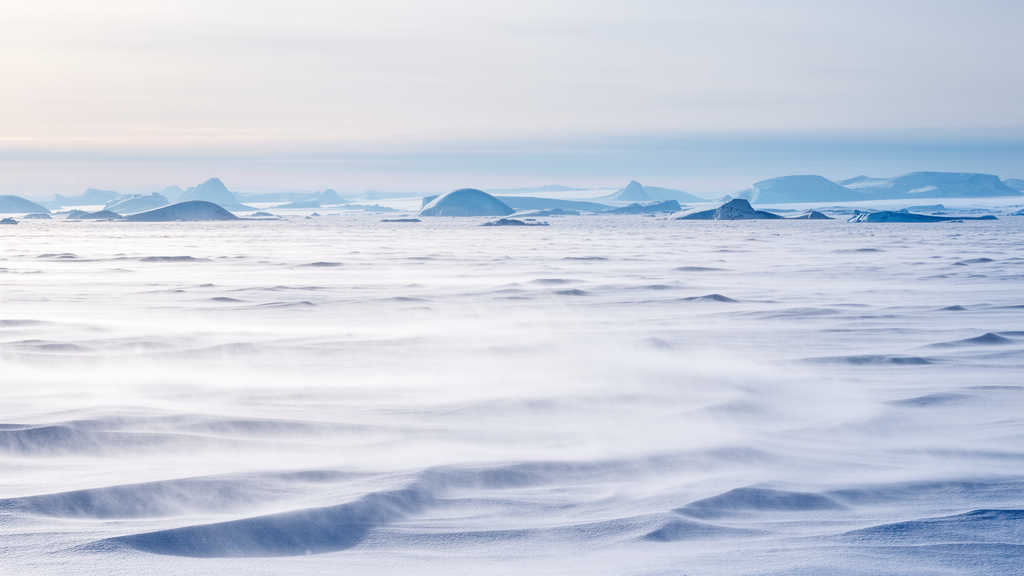
On the Greenland Ice Sheet, the fiercest storms do more than scatter snow across the ice. When strong winds lift snow crystals into the air, the suspended particles quietly rewrite the exchange of energy between the ice and the atmosphere. A new study published in The Cryosphere by Samuel M. Tax of Utrecht University and colleagues shows, for the first time in a regional climate model for Greenland, that this airborne snow acts simultaneously like a thermal blanket and a dimming mirror: it traps heat radiating from the surface while screening out a fraction of incoming sunlight. The finding matters because the Greenland Ice Sheet has become one of the largest single contributors to global sea level rise, and every watt per square metre of miscounted energy translates into uncertainty about how fast its ice will melt.
The team worked at a site called S10, an automatic weather station perched at 1,850 metres elevation in the lower accumulation zone, roughly 140 kilometres from the ice sheet’s western margin. S10 sits along the Kangerlussuaq transect, a well-instrumented line of stations running inland from the west coast, and it experiences blowing snow on about 16 percent of days. That frequency, combined with a rare treasure trove of direct measurements, made it the natural laboratory for the question. In September and October 2012, researchers from the Institute for Marine and Atmospheric Research Utrecht deployed a snow particle counter, a laser-based instrument that counts and sizes individual snow grains hurtling past at about one metre above the surface, alongside an 8-metre tower carrying a sonic anemometer to measure the turbulent stress that lifts the snow in the first place.
The physics of blowing snow is deceptively intricate. Once the friction velocity of the wind exceeds a threshold set by the density and texture of the surface snow, grains begin to saltate, bouncing along the ground in a shallow layer a few centimetres thick. Above that, turbulence suspends smaller particles into the boundary layer, where they can drift hundreds of metres upward and, in Antarctica, hundreds of kilometres horizontally. Suspended grains are superb sublimators: the swirling air around each crystal strips away water vapour, cooling the air and humidifying it at the same time. This sublimation is, alongside wind erosion, the only process that removes mass from the interior of the Greenland Ice Sheet, which makes it a first-order term in the surface mass balance that climate models must get right.
What had been missing for Greenland was the direct radiative fingerprint of all that airborne ice. Earlier work in Antarctica had hinted at it. Observations at Japan’s Mizuho Station in the 1980s showed that drifting snow reduced net longwave cooling at the surface, and later studies in the Canadian High Arctic measured downwelling longwave fluxes increasing by up to 36 watts per square metre during blowing snow events over rough terrain. Satellite analyses even detected the signature of blowing snow in outgoing longwave radiation at the top of the atmosphere over East Antarctica in winter. Models such as the Modèle Atmosphérique Régional had begun to include these effects for the southern continent, but the regional climate model used most widely for Greenland, RACMO2.4p1, still treated blowing snow as radiatively invisible.
Tax and his colleagues closed that gap with an elegant piece of computational plumbing. The model’s blowing snow routine, based on the double-moment bulk scheme PIEKTUK-D, already calculates the mixing ratio of suspended snow, the size of the particles, and how far the layer extends above the surface. The model’s radiation scheme, ecRad-1.4.1, describes how ice clouds absorb and scatter light. The researchers simply represented the blowing snow layer as a low-level ice cloud, feeding the snow mixing ratio, an effective particle radius, and a cloud fraction into the radiation code. When the blowing snow mixing ratio exceeded a threshold of one millionth of a kilogram per kilogram of air, the layer was treated as fully cloud-covered. They then ran three experiments: a baseline with no radiative effect of blowing snow, one that included it only above the lowest model level about 10 metres up, and one that folded the entire near-surface snow layer into the radiation calculation.
The results were unambiguous. During blowing snow events at S10, representing the airborne snow as an ice cloud increased downwelling longwave radiation at the surface by an average of 5.8 watts per square metre, with peaks reaching 50 watts per square metre under clear skies. At the same time, downwelling shortwave radiation fell by an average of 1.2 watts per square metre as the suspended grains scattered sunlight. The longwave effect dominated, so the net radiation at the surface increased. In the case study of a particularly strong event in October 2012, when the vertically integrated horizontal snow transport reached 0.4 kilograms per metre per second, the blowing snow layer extended to roughly 175 metres altitude and drove shortwave heating rates in the near-surface air up to 35 kelvin per day, while suppressing longwave cooling at rates approaching 150 kelvin per day, values far exceeding those of ordinary clouds because the snow is concentrated in such a shallow layer.
Crucially, the improvements were not merely theoretical. When the researchers compared the coupled simulations against five and a half years of radiation measurements from the automatic weather stations at S10 and its neighbour KAN_U, operated by Utrecht University and the Danish PROMICE programme, the agreement with observed downwelling longwave radiation improved markedly, particularly during clear-sky blowing snow events when the background atmospheric emissivity is at its lowest. The root mean square error of the simulated surface radiation balance during blowing snow events dropped by 3.4 watts per square metre, and the bias shrank by 4.6 watts per square metre, because the gain in longwave accuracy outweighed a slight deterioration in the already well-simulated shortwave fluxes. For a model whose longwave radiation has long been a known weak point over ice sheets, this is a meaningful correction.
The study also exposed honest limitations. The blowing snow routine captured the timing of events well but underestimated peak horizontal transport fluxes by 69 to 79 percent during the short summer observational window, a deficiency also seen over Antarctica and likely tied to how the model handles the availability of loose surface snow, its compaction in summer, and the interaction between falling snow and wind-blown snow. The researchers also had to make judgement calls with the laser data, excluding two events contaminated by concurrent snowfall and discarding an anomalous peak in the largest particle size class that they attributed to precipitation rather than transport. And the ice optics parameterisation borrowed from cirrus cloud physics was designed for high-altitude clouds, not near-surface snow, an assumption the authors flag for further testing.
Why should anyone beyond the modelling community care? Because the surface energy balance is the ledger that determines melt. At the cold, high elevation of S10, an extra few watts per square metre will not trigger melting, but closer to the warm, low-lying margins of the ice sheet, where most runoff is generated, the same radiative warming could tip the balance during summer. The authors expect the effect to be larger near the margins and note that in coastal Greenland, more frequent cloud cover will partly mask the direct signal, while secondary interactions between blowing snow and low-level clouds could amplify it. Over Antarctica, where blowing snow layers are thicker and more extensive, the radiative impact is likely to be greater still. Getting these processes into models is therefore a prerequisite for trustworthy projections of both ice sheets.
The broader lesson is a familiar one in polar science: the boundary layer, that thin skin of air hugging the ice, keeps surprising us with processes that continental-scale models have long ignored. A cloud of snow you can barely see through, lasting a few hours, turns out to bend the radiation budget in measurable ways. Tax and his colleagues recommend that climate models couple their blowing snow and radiation schemes directly, and their offline code and datasets are publicly available for other groups to build on. As the Arctic warms and the Greenland Ice Sheet sheds hundreds of gigatonnes of ice each year, accounting for every blanket and every mirror in the system is no longer optional. It is the difference between a forecast and a guess.
Subject of Research: Radiative effects of blowing snow on the surface energy balance of the Greenland Ice Sheet
Article Title: Impact of blowing snow on the surface radiation balance near the western margin of the Greenland Ice Sheet
Article References: Tax, S. M., van Tiggelen, M., Feenstra, T. N., Smeets, P. C. J. P., Gadde, S. N., van Dalum, C. T., van de Berg, W. J., & van den Broeke, M. R. (2026). Impact of blowing snow on the surface radiation balance near the western margin of the Greenland Ice Sheet. The Cryosphere, 20(10), 5609-5627. https://doi.org/10.5194/tc-20-5609-2026
Image Credits: AI Generated
Keywords: Greenland Ice Sheet, blowing snow, surface radiation balance, surface mass balance, RACMO2.4p1, regional climate modelling, sublimation, longwave radiation, shortwave radiation, boundary layer, sea level rise, The Cryosphere
Cite Scienmag News
Sloane Callahan. (October 8, 2026). Blowing snow acts as a blanket and mirror over the Greenland Ice Sheet. Scienmag. https://scienmag.com/blowing-snow-acts-as-a-blanket-and-mirror-over-the-greenland-ice-sheet/
Sloane Callahan. "Blowing snow acts as a blanket and mirror over the Greenland Ice Sheet." Scienmag, 8 October 2026, https://scienmag.com/blowing-snow-acts-as-a-blanket-and-mirror-over-the-greenland-ice-sheet/. Accessed 8 October 2026.
Sloane Callahan. "Blowing snow acts as a blanket and mirror over the Greenland Ice Sheet." Scienmag. October 8, 2026. https://scienmag.com/blowing-snow-acts-as-a-blanket-and-mirror-over-the-greenland-ice-sheet/


