


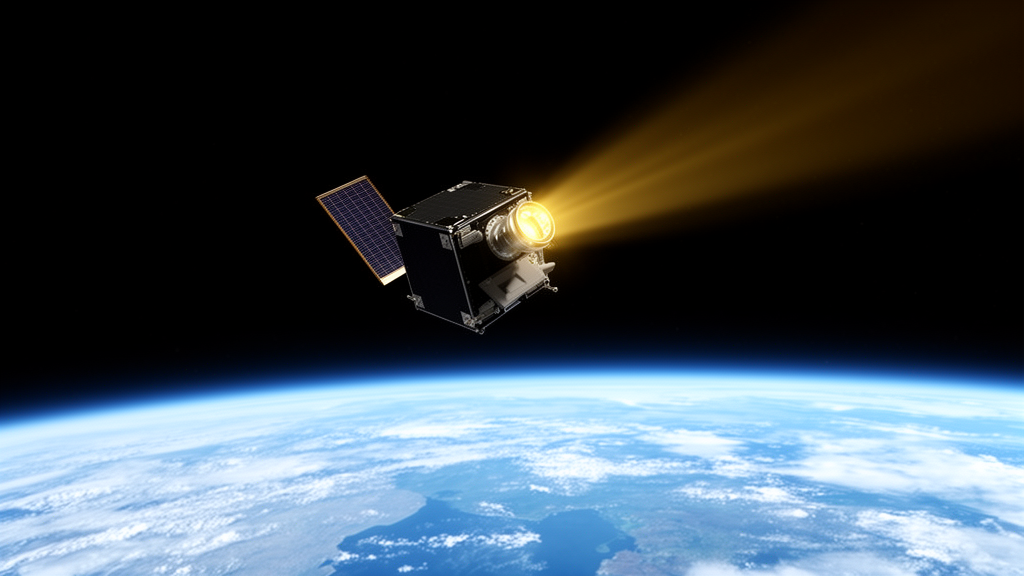
A shoebox-sized satellite built to stare at the Sun has quietly pulled off a second act that could help safeguard one of climate science’s most precious records. The Compact Total Irradiance Monitor, or CTIM, was a 6U CubeSat developed at the Laboratory for Atmospheric and Space Physics in Boulder, Colorado, under NASA’s In-Space Validation of Earth Science Technologies program. Its official job was to measure total solar irradiance, the total energy output of the Sun, which it did with an uncertainty of just 0.017 percent from its launch in July 2022 until the end of its mission in December 2023. But during the dark portions of each orbit, when Earth blocked its view of the Sun, mission scientists pointed the instrument straight down at the planet. In doing so, they captured more than 28,000 observations of Earth’s outgoing longwave radiation, the heat energy the planet emits to space, and opened an unexpected window onto the planet’s energy budget.
That window matters because Earth’s radiation budget is arguably the single most important number in climate science. It describes the balance between the solar energy Earth absorbs and the thermal energy it radiates back to space. When the planet absorbs more than it emits, global mean surface temperature rises; when the reverse occurs, it falls. Both the Intergovernmental Panel on Climate Change and the most recent Earth science Decadal Survey designate these observations as essential for determining the current energy imbalance and predicting future climate, and the Global Climate Observing System classifies the radiation budget as an Essential Climate Variable. Because the climate system responds over decadal to centennial timescales, only continuous, accurate monitoring from space can reveal the mechanisms driving climate shifts and inform mitigation strategies.
The gold standard for such monitoring is the Clouds and the Earth’s Radiant Energy System, or CERES, a suite of scanning broadband radiometers that has maintained the longest continuous record of Earth’s radiative energy, stretching from 2000 to the present. Six CERES instruments flying on four satellites, Terra, Aqua, Suomi-NPP, and NOAA-20, have collectively delivered more than 26 years of measurements of reflected solar and emitted longwave radiation. Yet the record faces a looming threat. The CERES instruments on Terra and Aqua are scheduled to end science operations in 2027, and S-NPP potentially in 2026. NASA’s first Earth Venture Continuity mission, Libera, is set to launch in late 2027 with a five-year prime mission, but no missions are planned beyond it. According to a recent analysis cited in the study, the probability of a gap in the radiation budget record reaches 33 percent by 2028 and climbs to 60 percent by 2035, even assuming Libera remains operational. Worse, bridging a gap produces errors roughly four times larger than those arising when successive missions overlap.
Against that backdrop, the CTIM team saw an opportunity. Because the CubeSat was designed for solar irradiance, its electrical substitution radiometers, equipped with vertically aligned carbon nanotube absorbers that absorb more than 99.9 percent of incident radiation from the ultraviolet through the infrared, were calibrated in irradiance rather than radiance. During orbital eclipse, the spacecraft was pointed at Earth’s nadir, collecting calibrated irradiance measurements that the team converted to mean radiance using the instrument’s precisely characterized angular response, which reached zero at 23 degrees off-axis. At a median orbital altitude of 453 kilometers, that translated into a footprint roughly 484 kilometers in diameter, enormous compared with the 20-kilometer nadir footprints of the CERES scanners, but well suited to averaging broad scenes of outgoing thermal emission.
To find out whether these opportunistic measurements could stand shoulder to shoulder with the established record, the researchers compared CTIM’s nighttime longwave radiances with coincident observations from CERES instruments aboard Terra, Aqua, and NOAA-20. They built a four-step matching algorithm that selected CERES footprints within 242 kilometers of each CTIM footprint centroid and within 20 minutes of each CTIM observation, restricted to viewing zenith angles of 20 degrees or less to match CTIM’s near-nadir geometry, and required at least 400 CERES samples per match. The procedure yielded 541 matches containing 261,010 individual CERES footprints. Supplemental CERES observations filled gaps within each CTIM footprint, and the team weighted every CERES radiance by the CTIM spatial response function and by the viewing-angle-dependent growth of the CERES footprint area.
One subtlety demanded extra care. When a scanning radiometer views Earth at oblique angles, the observed radiance typically decreases because radiation travels a longer path through the cooler upper atmosphere, an effect known as limb darkening. Since CERES footprints extended up to nearly 30 degrees off nadir within the CTIM footprint, the team ran 700 radiative transfer simulations with the MODTRAN code, varying viewing angle, surface emissivity, surface temperature, and atmospheric profile across tropical, mid-latitude summer, and mid-latitude winter conditions. The resulting lookup tables provided limb-darkening adjustment factors that were applied to the 17.6 percent of CERES footprints meeting a strict clear-sky criterion of at least 95 percent clear fraction, ensuring that off-nadir radiances were consistent with CTIM’s nadir-viewing geometry.
The verdict was striking. Across all 541 matches, the mean relative difference between CTIM and CERES longwave radiances was −1.19 percent, with a bootstrapped 95 percent confidence interval of ±0.35 percent and a standard deviation of 4.16 percent. A linear regression produced a coefficient of determination of 0.948 and a root mean square error of 3.02 watts per square meter per steradian, indicating a strong relationship between the two instruments. Individually, Terra yielded a relative difference of −1.18 ± 0.45 percent over 238 matches, Aqua −1.21 ± 1.08 percent over 109 matches, and NOAA-20 −1.18 ± 0.53 percent over 194 matches, all well within the respective instrument uncertainties. CTIM’s own radiance uncertainty budget, dominated by solid-angle uncertainty, totaled 1.65 to 1.80 percent, while CERES longwave calibration uncertainty is about 0.75 percent. The agreement demonstrates that a solar instrument never designed for Earth observation can nonetheless deliver scientifically credible measurements of the planet’s thermal emission.
The residual spread in the comparison told its own story. When the team stratified scenes by cloud cover, clear-sky matches showed a standard deviation of only 1.17 percent, compared with 4.26 percent for cloudy scenes, and the largest spreads of all appeared in the tropical latitude bins straddling the equator, where persistent deep convective clouds of the inter-tropical convergence zone create highly heterogeneous scenes. Because the CERES scanners view clouds along oblique paths while CTIM looks straight down, the two instruments sample cloud layers along meaningfully different path lengths, introducing sensitivity to cloud optical depth and vertical structure. Even CTIM’s gridded global map of 15 months of nighttime observations reproduced familiar features of the longwave radiation field, including the characteristic minimum over the tropics where high, cold cloud tops suppress thermal emission, qualitatively mirroring 17 years of CERES climatology.
The implications reach well beyond a single technology demonstration. CubeSats offer low launch costs, flexible deployment, and redundancy that large flagship missions cannot match; three independent CubeSats with a three-year survival probability of 63 percent each collectively achieve a 95 percent success probability. A growing family of small-satellite missions, including RAVAN, NASA’s polar-orbiting PREFIRE pair, the French Uvsq-Sat constellation and its successor Uvsq-Sat NG, and the proposed BABAR-ERI concept, is already charting the path. The CTIM results suggest a particularly elegant strategy: future total solar irradiance instruments could be intentionally designed with Earth-viewing capability built in, allowing a single low-cost platform to monitor both the Sun and the planet. With an optical system purpose-built for Earth’s wider angular spread of outgoing radiation, radiance uncertainties could shrink toward the 0.02 percent level achieved for solar measurements. Challenges remain, including long-term radiometric stability, absolute Earth-viewing calibration, and cloud anisotropy corrections, but the study makes a compelling case that fleets of small, cheap, rapidly deployable radiometers could buffer the radiation budget record against the gaps that currently threaten to open after 2027, protecting the multidecadal climate data record on which our understanding of a warming planet depends.
Subject of Research: CubeSat-based continuity observations of Earth's radiation budget from space
Article Title: From opportunity to continuity: a CubeSat implementation to enhance Earth's radiation budget observations from space
Article References: A. Hawkins, M., Watwood, M., van den Heever, M., Pilewskie, P., & Harber, D. (2026). From opportunity to continuity: a CubeSat implementation to enhance Earth's radiation budget observations from space. Atmospheric Measurement Techniques, 19(19), 6229-6250. https://doi.org/10.5194/amt-19-6229-2026
Image Credits: AI Generated
Keywords: Earth radiation budget, CubeSat, CTIM, CERES, total solar irradiance, longwave radiation, climate data record, Libera, remote sensing, satellite calibration, limb darkening, NASA InVEST
Cite Scienmag News
Denise Maddox. (October 8, 2026). Tiny Sun-Watching CubeSat Proves It Can Also Track Earth’s Climate Energy Balance. Scienmag. https://scienmag.com/tiny-sun-watching-cubesat-proves-it-can-also-track-earths-climate-energy-balance/
Denise Maddox. "Tiny Sun-Watching CubeSat Proves It Can Also Track Earth’s Climate Energy Balance." Scienmag, 8 October 2026, https://scienmag.com/tiny-sun-watching-cubesat-proves-it-can-also-track-earths-climate-energy-balance/. Accessed 8 October 2026.
Denise Maddox. "Tiny Sun-Watching CubeSat Proves It Can Also Track Earth’s Climate Energy Balance." Scienmag. October 8, 2026. https://scienmag.com/tiny-sun-watching-cubesat-proves-it-can-also-track-earths-climate-energy-balance/


