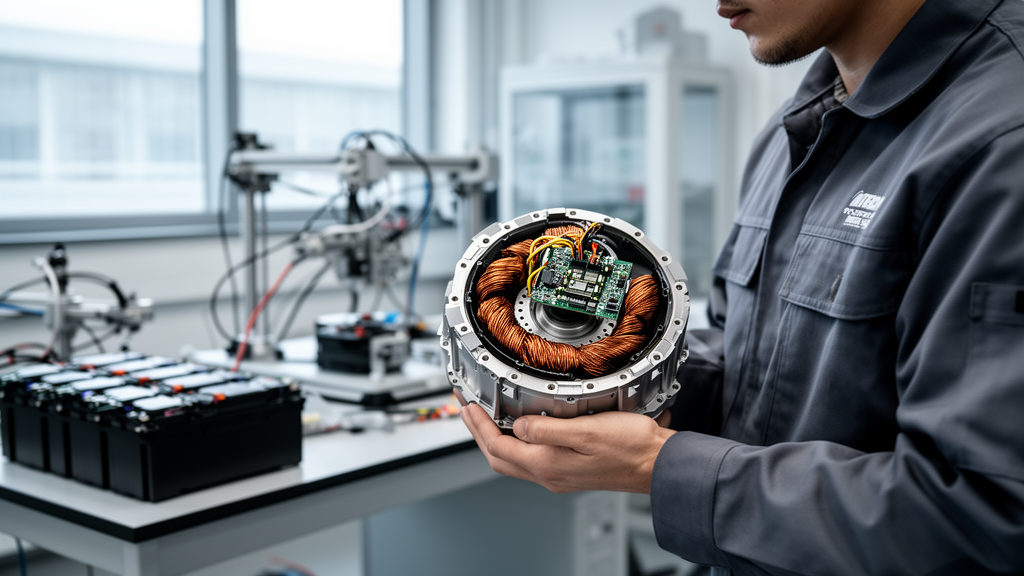
Electric vehicles promise a cleaner future, but beneath their sleek exteriors lies a relentless engineering problem: the drive system, the assembly of motor, gearbox, bearings and shafts that converts battery power into motion, degrades in ways that are notoriously difficult to predict. Unlike a battery, whose state of health can be tracked with a single measurable quantity, an electric drive system operates under the simultaneous assault of electromagnetic forces, mechanical torque fluctuations, thermal cycling and road-induced vibration. A team of researchers in China has now unveiled a physics-informed machine learning framework that tackles this multi-physical complexity head-on, and their results suggest that predicting the lifespan of these critical components can be done with an accuracy that would have seemed unattainable just a few years ago.
The study, published in Applied Intelligence by Zhen Wang and colleagues from Henan University, North China University of Water Resources and Electric Power, and the University of Shanghai for Science and Technology, reports that their model keeps remaining useful life prediction errors within five percent across different service cycles. That figure matters because remaining useful life, often abbreviated as RUL, is the currency of predictive maintenance. If a fleet operator or an onboard diagnostic system knows how many operating hours a drive unit has left before its performance falls below an acceptable threshold, maintenance can be scheduled before failure occurs rather than after, avoiding roadside breakdowns, costly towing and, in the worst cases, safety-critical malfunctions at highway speed.
What sets this work apart from the growing library of data-driven prognostics papers is its insistence on physics. Pure machine learning approaches, however powerful, tend to treat a machine as a black box: they learn statistical patterns in sensor streams without any understanding of why those patterns emerge. That makes them fragile when conditions shift, because a model trained on one fleet’s driving behavior may generalize poorly to another. The researchers instead built physical knowledge into every stage of their pipeline, starting with the failure mechanisms of the drive system’s core components and ending with degradation trajectories that reflect how real drivers actually use their vehicles.
The first stage of the framework is feature construction. From actual operational load data collected from vehicles in service, the team extracted a rich set of multidimensional features in both the time domain and the frequency domain. Time-domain statistics capture the overall amplitude and variability of signals, while frequency-domain analysis reveals the spectral fingerprints of specific mechanical elements, since a damaged bearing or a worn gear mesh leaves characteristic signatures at particular rotational frequencies. On top of these, the researchers engineered multiscale cumulative damage features by integrating the known failure mechanisms of core components, effectively encoding how fatigue accumulates in gears, bearings and shafts under repeated stress cycles. Because this expanded feature space is far too large to feed directly into a deep network without drowning it in redundancy, they applied sparse autoencoder models to compress the information into a compact representation that preserves the physically meaningful content.
The prediction engine itself is a hybrid deep learning architecture that combines a convolutional neural network with a bidirectional long short-term memory network, sharpened by an attention mechanism. The convolutional layers excel at detecting local patterns and interactions among features, while the bidirectional LSTM reads the sequence of degradation indicators in both forward and backward directions, capturing long-range temporal dependencies that a unidirectional model would miss. The attention mechanism then allows the network to weight the most informative time steps and features more heavily, so that the moments when degradation accelerates are not diluted by long stretches of stable operation. Hyperparameters of this architecture were tuned using Bayesian optimization, a sample-efficient search strategy that models the relationship between hyperparameter settings and model performance, avoiding the brute-force cost of grid search.
Training such a model requires degradation data, and here the researchers confronted a practical dilemma: nobody wants to wait a decade for a drive system to wear out naturally on a test bench. Their solution was accelerated durability testing. By running drive systems on a bench under an intensified load spectrum, they compressed years of field wear into a manageable test campaign. The root mean square of vibration signals served as the degradation indicator, a choice grounded in the physics of rotating machinery, since rising vibration energy reflects the growth of wear, looseness and fatigue damage in the drivetrain. From these accelerated tests, the team characterized realistic degradation trajectories that anchor the machine learning model in measurable physical reality.
A crucial subtlety remains: an accelerated test spectrum is not the same as the way an ordinary driver treats a vehicle. Degradation rates differ between the bench and the road, sometimes dramatically. The researchers addressed this by accounting for those differences explicitly, generating nonlinear degradation trajectories tailored to various user profiles. This step is what allows the framework to generalize from laboratory data to the messy diversity of real-world usage, from gentle highway cruising to stop-and-go city driving with frequent hard acceleration. It is also where the uncertainty quantification enters the picture, because translating one degradation regime into another inevitably introduces variability that an honest prognostic system must acknowledge rather than hide.
Uncertainty quantification is arguably the study’s most important contribution to the practice of engineering prognostics. Rather than emitting a single point estimate of remaining life, the framework produces a probability density distribution over possible lifetimes. The results show that this distribution is more concentrated, meaning less uncertain, than those produced by traditional degradation-modeling-based prediction methods, while simultaneously achieving higher accuracy and better generalization. For a maintenance planner, the difference is profound: a narrow, well-calibrated distribution supports confident scheduling decisions, whereas a wide, diffuse one signals that more caution, or more data, is needed. The approach aligns with a broader movement in the field, documented in recent reviews of physics-informed machine learning for prognostics and health management, which argues that fusing physical knowledge with data-driven models is the most credible path forward when labeled failure data is scarce and expensive.
The implications extend well beyond the laboratory. Electric drive systems are among the most expensive and safety-critical subsystems of a vehicle, and their reliability directly shapes consumer trust in electrified transport. A framework like this one could eventually feed onboard health monitoring systems that warn drivers and manufacturers of impending degradation, inform warranty design, guide fleet maintenance schedules for delivery and ride-hailing operators, and even support second-life decisions about when components can be refurbished or repurposed. The research was partially supported by Henan Province major industrial innovation funding and the province’s science and technology research program, and it was carried out in collaboration with an automotive enterprise, whose vehicle operating data and bench test data underpin the analysis, though the datasets are not publicly available due to the restrictions of that collaboration.
There are, of course, caveats. The five percent error bound was demonstrated across the service cycles covered by the study’s data, and the framework’s dependence on proprietary operational data means independent replication will require comparable industrial partnerships. The authors note that the method’s strength lies in integrating physical information with deep learning rather than replacing one with the other, a philosophy that acknowledges both the power and the blind spots of modern artificial intelligence. As electric vehicle fleets age and the first large cohorts of drive systems approach the end of their design lives, tools that can forecast their remaining service with quantified confidence will shift from academic curiosity to operational necessity. This study offers a concrete, technically grounded template for how that shift might happen: respect the physics, exploit the data, and never pretend to know more than the evidence allows.
Subject of Research: Physics-informed machine learning for remaining useful life prediction of electric vehicle drive systems with uncertainty quantification
Article Title: Remaining useful life prediction of electric vehicle drive system using physics-informed machine learning methods with uncertainty quantification
Article References: Wang, Z., Chen, Z., Sun, W., Li, Y., Hou, Y., & Zhao, L. (2026). Remaining useful life prediction of electric vehicle drive system using physics-informed machine learning methods with uncertainty quantification. Applied Intelligence, 56(14), Article 401. https://doi.org/10.1007/s10489-026-07429-1
Image Credits: AI Generated
DOI: 10.1007/s10489-026-07429-1
Keywords: electric vehicle drive system, remaining useful life prediction, physics-informed machine learning, uncertainty quantification, predictive maintenance, deep learning, convolutional neural network, bidirectional LSTM, attention mechanism, accelerated durability testing, sparse autoencoder, Bayesian optimization
Cite Scienmag News
Blake Davidson. (October 8, 2026). Physics Meets AI: New Machine Learning Framework Predicts How Long Electric Vehicle Drive Systems Will Last. Scienmag. https://scienmag.com/physics-meets-ai-new-machine-learning-framework-predicts-how-long-electric-vehicle-drive-systems-will-last/
Blake Davidson. "Physics Meets AI: New Machine Learning Framework Predicts How Long Electric Vehicle Drive Systems Will Last." Scienmag, 8 October 2026, https://scienmag.com/physics-meets-ai-new-machine-learning-framework-predicts-how-long-electric-vehicle-drive-systems-will-last/. Accessed 9 October 2026.
Blake Davidson. "Physics Meets AI: New Machine Learning Framework Predicts How Long Electric Vehicle Drive Systems Will Last." Scienmag. October 8, 2026. https://scienmag.com/physics-meets-ai-new-machine-learning-framework-predicts-how-long-electric-vehicle-drive-systems-will-last/