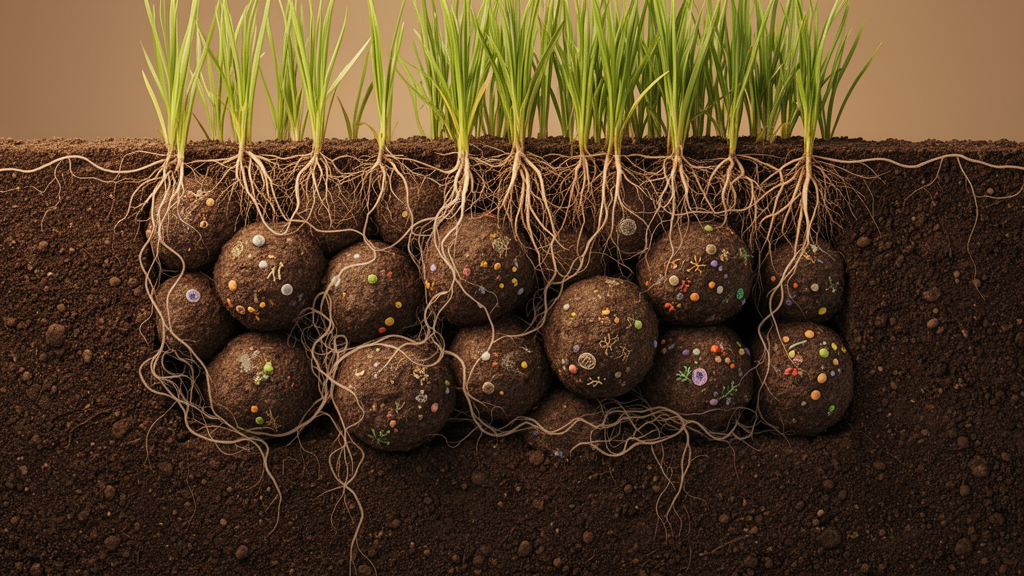
Deep inside the leaves of perennial ryegrass lives a microscopic tenant that never touches the soil, yet according to a new study it can reorganize the entire underground world beneath the plant. The fungus, Epichloë festucae, is a foliar endophyte: it grows systemically through the tissues of its grass host, feeding on plant sugars and, in return, producing compounds that deter herbivores and boost stress tolerance. For decades, ecologists have studied this partnership from the plant’s point of view. But a research team led by Chao Wang, Jie Jin, Yang Yang and Jianfeng Wang, publishing in the journal Plant and Soil, has now traced the fungus’s influence all the way down into the soil itself, revealing that its effects are not uniform. Instead, they vary dramatically depending on the size of the soil aggregates, the crumbs of mineral and organic matter that form the architecture of the underground world.
Soil is not a homogeneous soup of microbes. It is a labyrinth of aggregates ranging from fine microaggregates smaller than a quarter of a millimeter to chunky macroaggregates larger than two millimeters. Each size class creates a distinct microhabitat, with different pore sizes, oxygen availability, water retention and access to organic matter. Microaggregates offer protected niches where slow-growing specialists thrive, while macroaggregates, held together by fungal hyphae and plant roots, are hotspots of decomposition and nutrient cycling. Previous work has shown that microbial diversity often differs across these fractions, but almost nothing was known about how a symbiotic fungus living entirely inside plant shoots could alter those patterns. The new study set out to answer exactly that question.
The experiment took advantage of a long-term field setup in which perennial ryegrass, Lolium perenne, had been grown for five years in plots containing plants either infected with Epichloë festucae, designated E+, or endophyte-free, designated E−. After five growing seasons, the researchers sampled the soils beneath both plot types and physically separated the aggregates into four size fractions: less than 0.25 millimeters, 0.25 to 1 millimeter, 1 to 2 millimeters, and greater than 2 millimeters. From each fraction they extracted DNA and used amplicon sequencing to catalog the bacterial and fungal communities, then related those communities to a suite of soil physicochemical measurements, including nitrogen fractions, soil organic carbon and enzyme activities such as catalase.
The first striking result concerned biodiversity gradients. In soils from endophyte-free ryegrass, both bacterial and fungal diversity, measured with the Shannon index, and species richness, measured with the Chao1 index, declined steadily as aggregate size increased. This pattern suggests that in uninfected soils, the smallest aggregates act as reservoirs of microbial diversity, while the larger, more aerated crumbs support fewer species. But in soils beneath endophyte-infected plants, this decline was noticeably attenuated. The presence of the fungus inside the grass somehow smoothed out the diversity differences between aggregate classes, implying that the plant’s internal symbiont homogenizes the microbial landscape across physical niches that would otherwise diverge.
Community composition told a similar story. Using Adonis analysis, a multivariate statistical test that measures how strongly communities differ among groups, the researchers found that bacterial community dissimilarity among aggregate fractions was reduced under endophyte infection. In other words, without the endophyte, each aggregate size class harbored a distinct bacterial assemblage; with the endophyte, those assemblages became more alike. This convergence is significant because it suggests the infected plants are altering the inputs that drive microbial differentiation among aggregates, most likely through changes in root exudates, litter chemistry and rhizodeposition, the fluxes of carbon and nitrogen that plants pump into the soil and that differ between aggregate microhabitats.
The team then turned to co-occurrence network analysis, which maps the potential ecological interactions among microbial taxa and reveals how complex and interconnected each community is. In endophyte-free soils, network complexity generally increased with aggregate size, meaning the largest crumbs hosted the most densely connected microbial webs. Under endophyte infection, however, the picture changed in a taxon-specific way. Bacterial networks peaked in complexity in the 1 to 2 millimeter fraction, while fungal networks showed the opposite pattern, with their most intricate connections occurring in smaller aggregates. These shifts indicate that the endophyte does not simply add or remove species; it rewires who interacts with whom, and it does so differently for bacteria and fungi.
Perhaps the most consequential findings came from measures of community cohesion and stability. In endophyte-free soils, bacterial cohesion, a metric quantifying the degree of connectedness among taxa, was positively correlated with aggregate size, while community stability was negatively correlated with it. Large aggregates in uninfected soils therefore hosted tightly linked but fragile bacterial communities. In endophyte-infected soils, both relationships were disrupted, breaking the predictable coupling between physical structure and microbial network properties. Because network stability is thought to underpin the resilience of soil functions such as decomposition and nutrient cycling, this decoupling suggests that endophyte infection could fundamentally alter how soil ecosystems respond to disturbance, though the long-term functional consequences remain to be tested.
The chemical fingerprints of the endophyte’s influence were equally clear. Mantel tests, which correlate community composition with environmental variables, showed that bacterial communities in endophyte-infected soils were associated with ammonium nitrogen, nitrate nitrogen and catalase activity, whereas in endophyte-free soils they were associated mainly with total nitrogen and catalase. This shift implicates the nitrogen cycle as a key pathway of endophyte influence, consistent with earlier work by some of the same authors showing that Epichloë infection alters nitrifier and denitrifier communities during host litter decomposition. Structural equation modeling using partial least squares went further, indicating that the associations between the endophyte and fungal diversity were linked to variations in soil nitrate nitrogen and soil organic carbon, pointing to carbon and nitrogen transformations as the mechanistic bridge between a leaf-dwelling fungus and the soil microbiome.
Why should a fungus that never leaves the plant have such reach into the soil? The most plausible explanation lies in the plant-mediated pathway. Epichloë infection changes host physiology: it alters alkaloid production, growth rates, root architecture and the quantity and quality of carbon released through roots and returned through decomposing litter. Over five years of cultivation, these altered inputs accumulate differently in different aggregate fractions, since macroaggregates receive fresh litter and root residues while microaggregates hold older, chemically stabilized organic matter. The endophyte effectively reprograms the resource landscape, and the microbial communities in each aggregate class respond accordingly. Prior studies had already shown that endophyte-infected grasses change rhizosphere communities and soil enzyme activities; the new work extends that influence into the physically structured interior of the soil.
The implications reach well beyond ryegrass pastures. Soil aggregates are increasingly recognized as the biologically relevant scale at which microbial processes occur, and models of carbon sequestration and greenhouse gas emissions depend on assumptions about where in the soil matrix particular microbes live and work. If a heritable, vertically transmitted fungal symbiont can reshape microbial diversity, network architecture and stability across aggregate fractions, then breeding or inoculating forage grasses with specific endophyte strains becomes a potential lever for managing soil function. The authors emphasize that their study provides a basis for predicting soil functional shifts under endophyte infection, and the raw sequence data have been deposited in a public archive for further analysis. What began as a story about a fungus protecting a grass from herbivores has become a story about how one intimate symbiosis can ripple outward, crumb by crumb, through the hidden architecture of the soil.
Subject of Research: Effects of foliar Epichloë endophyte infection on soil microbial communities across aggregate size fractions in ryegrass soils
Article Title: Foliar Epichloë endophyte infection reshapes soil microbial communities across aggregate size fractions in ryegrass soils
Article References: Wang, C., Jin, J., Liu, R., Zhang, D., Ma, B., Zhang, S., Yang, Y., & Wang, J. (2026). Foliar Epichloë endophyte infection reshapes soil microbial communities across aggregate size fractions in ryegrass soils. Plant and Soil. https://doi.org/10.1007/s11104-026-09092-4
Image Credits: AI Generated
DOI: 10.1007/s11104-026-09092-4
Keywords: Epichloë endophyte, perennial ryegrass, soil aggregates, microbial communities, amplicon sequencing, co-occurrence networks, soil organic carbon, nitrogen cycling, soil enzymes, fungal ecology, plant-soil feedbacks, microbiome
Cite Scienmag News
Morgan Morrow. (October 8, 2026). Hidden Fungus Inside Ryegrass Rewrites the Microbial Map of Soil, Aggregate by Aggregate. Scienmag. https://scienmag.com/hidden-fungus-inside-ryegrass-rewrites-the-microbial-map-of-soil-aggregate-by-aggregate/
Morgan Morrow. "Hidden Fungus Inside Ryegrass Rewrites the Microbial Map of Soil, Aggregate by Aggregate." Scienmag, 8 October 2026, https://scienmag.com/hidden-fungus-inside-ryegrass-rewrites-the-microbial-map-of-soil-aggregate-by-aggregate/. Accessed 9 October 2026.
Morgan Morrow. "Hidden Fungus Inside Ryegrass Rewrites the Microbial Map of Soil, Aggregate by Aggregate." Scienmag. October 8, 2026. https://scienmag.com/hidden-fungus-inside-ryegrass-rewrites-the-microbial-map-of-soil-aggregate-by-aggregate/