


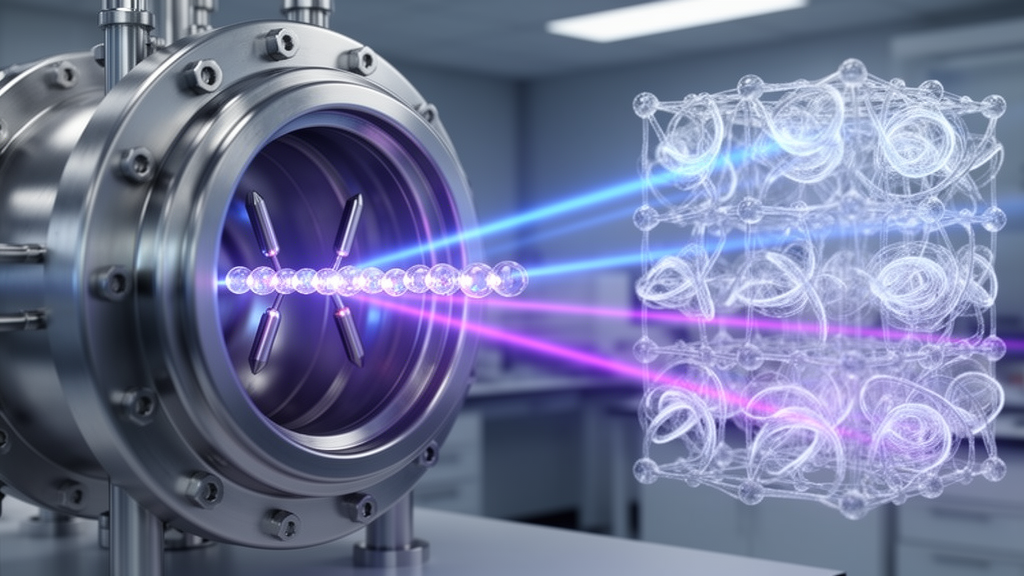
Physicists have long dreamed of watching the strange dance between matter and force fields unfold in real time, unfiltered by the approximations that plague classical supercomputers. That dream has now taken a concrete step forward. In a study published in Nature Physics, a team at the University of Oxford, working with a theorist at the Instituto de Física Teórica in Madrid, has used a hybrid qubit–oscillator trapped-ion quantum computer to simulate a Z2 lattice gauge theory and directly observe the Aharonov–Bohm effect, one of the most counterintuitive phenomena in quantum physics. In their experiment, a quantum of matter moving around a loop of gauge field was either free to travel or frozen in place, depending entirely on whether an invisible thread of magnetic flux pierced the loop.
Gauge theories are the backbone of modern physics. They describe how matter fields interact through force carriers, and their power comes from a rigid local symmetry: the laws of physics must remain unchanged under certain transformations applied independently at every point in space. In the Standard Model, the electromagnetic, weak and strong forces all arise this way, governed by the symmetry groups U(1), SU(2) and SU(3). But the same mathematical machinery also appears in condensed matter systems, from frustrated magnets to high-temperature superconductors and quantum spin liquids. The trouble is that when these theories are strongly coupled, when the interactions are too intense for perturbation theory, and when real-time dynamics or finite densities are involved, the standard workhorse of lattice field theory, Monte Carlo simulation, breaks down. Richard Feynman’s old suggestion that only a quantum machine could efficiently simulate quantum physics becomes not just appealing but necessary.
Lattice gauge theories tame these problems by discretizing space: matter lives on the vertices of a lattice, and gauge fields live on the links connecting them. Among the many possible gauge groups, the simplest non-trivial choice is Z2, a group with just two elements, which makes it a favorite testing ground. Z2 gauge theories describe frustrated antiferromagnets, superconductors and spin liquids, and they are intimately connected to topological quantum error correction, the scheme many believe will make quantum computers fault-tolerant. The richness of the physics grows dramatically with dimension. In one spatial dimension, charges tunnel and begin to feel confinement. In two dimensions, the lattice can be threaded by magnetic flux, and the resulting flux excitations, called visons, can dramatically alter how matter propagates. In three dimensions, discrete analogues of magnetic monopoles appear. All of these regimes are classically intractable in the regimes that matter most.
Previous quantum simulations of Z2 gauge theories had mostly been confined to one-dimensional geometries, where visons and topological effects are absent. Some experiments used cold atoms in Floquet schemes; others used superconducting qubits with digital gates. Work in quasi-two-dimensional settings had typically enforced Gauss’s law to eliminate the matter degrees of freedom entirely, which meant the crucial interplay between dynamical matter and dynamical gauge fields could not be observed. The Oxford team, led by Sebastian Saner and including theorists under Alejandro Bermúdez, took a different route. They built a hybrid architecture in which two fundamentally different kinds of quantum objects share the stage: qubits, encoded in the electronic levels of strontium ions, represent the gauge fields, while harmonic oscillators, the collective vibrational modes of the ion crystal, encode the bosonic matter fields.
This hybrid design is resourceful in two ways. First, by combining discrete and continuous variables, it lets the bosonic nature of matter emerge naturally, without the truncations that plague purely qubit-based encodings. Each matter site can host multiple excitations, and the Hilbert space grows with the richness of the oscillator states rather than with the number of qubits. Second, the experiment blends digital and analogue control. Digital gates prepare the initial states, suppress errors and read out the results, while the actual gauge-invariant time evolution runs as an analogue process under an engineered Z2-symmetric Hamiltonian. The key trick for generating the gauge-matter interaction is a pair of qubit-state-dependent forces, each detuned from a different vibrational mode. Because these forces are conditioned on non-commuting qubit operators, their combined effect produces a resonant tunnelling interaction that flips the gauge field exactly when a matter particle hops, precisely what Gauss’s law demands.
The team started with the simplest building block: a single Z2 link, in which one trapped ion carries both a gauge qubit and two motional modes acting as matter sites. When they initialized the system with a single matter excitation and let it evolve, they watched a beautifully synchronized choreography. As the charge tunnelled from one site to the other, the electric field line attached to it stretched and compressed in lockstep, exactly as Gauss’s law requires. The measured observables, the matter occupations at both sites and the gauge field expectation value, oscillated coherently and in perfect correlation. When the researchers turned up the electric field energy, making it costly to stretch the field line, the tunnelling slowed and its amplitude shrank, a direct precursor of confinement, the same mechanism that binds quarks inside protons.
Then came the crucial step into higher dimensions. By adding a second ion to the crystal, the team created a loop: two gauge qubits and two matter oscillators, the minimal geometry in which magnetic flux can exist. Here Gauss’s law becomes less restrictive, allowing the gauge fields to be prepared not in a simple electric-field basis but in entangled Bell states, superpositions that encode the presence or absence of a Z2 magnetic flux threading the loop. When the gauge fields were prepared in the Bell state corresponding to zero flux, the matter excitation tunnelled freely around the loop at an enhanced rate, its two possible paths through the two links interfering constructively. But when the fields were prepared in the orthogonal Bell state, corresponding to a flux of π and the presence of a vison, the two paths acquired a relative phase of π and interfered destructively. Tunnelling was completely suppressed. The charge simply stayed put, frozen by an interference effect it could never directly see, only feel.
This is the Z2 version of the Aharonov–Bohm effect, the phenomenon in which a charged particle is influenced by a magnetic field it never traverses, encoded here entirely in the quantum state of dynamical gauge fields. The team verified that the flux observable, measured through the correlator of the two gauge qubits, remained constant throughout the evolution, confirming that the Aharonov–Bohm phase was conserved even as the matter and gauge degrees of freedom became entangled. Numerical simulations incorporating independently calibrated error sources, including motional heating of hundreds of quanta per second on the most fragile mode and qubit dephasing, reproduced the data closely, and echo sequences were used to refocus the dominant dephasing noise without cancelling the desired interaction.
The implications stretch well beyond this two-site demonstration. Because the matter sites are genuine bosonic oscillators, the platform can host squeezed states carrying well-defined Z2 charges, and the team already prepared and tunnelled such states experimentally, reconstructing their Wigner functions along the way. The Hilbert space of a squeezed state grows with its squeezing magnitude, hinting at classically intractable dynamics on surprisingly small lattices. Synthetic dimensions offer a scaling path: by selectively addressing qubit–oscillator subsystems along a longer ion chain, one could assemble chains of connected loops, triangular geometries and even tetrahedral lattices, the simplest fully three-dimensional gauge theory, with only modest increases in hardware. The team also outlines a three-way competition, between tunnelling, electric field energy and Aharonov–Bohm interference, that could be used to study interference-driven localization and its breakdown in a gauge-invariant setting. What has been demonstrated here is small, two ions, two oscillators, two qubits, but it is a complete working prototype of how quantum simulators may eventually crack problems that no classical machine ever will.
Subject of Research: Quantum simulation of a Z2 lattice gauge theory and the Aharonov–Bohm effect on a hybrid qubit–oscillator trapped-ion quantum computer
Article Title: Aharonov–Bohm interference in a ({\pmb{\mathbb{Z}}}_{\bf{2}}) lattice gauge theory on a hybrid qubit–oscillator quantum computer
Article References: Saner, S., Băzăvan, O., Webb, D. J., Araneda, G., Ballance, C. J., Srinivas, R., Lucas, D. M., & Bermúdez, A. (2026). Aharonov–Bohm interference in a $${\pmb{\mathbb{Z}}}_{\bf{2}}$$ lattice gauge theory on a hybrid qubit–oscillator quantum computer. Nature Physics. https://doi.org/10.1038/s41567-026-03400-6
Image Credits: AI Generated
DOI: 10.1038/s41567-026-03400-6
Keywords: lattice gauge theory, Z2 gauge theory, Aharonov–Bohm effect, quantum simulation, trapped ions, hybrid qubit–oscillator, Gauss's law, visons, confinement, synthetic dimensions, quantum computing, Nature Physics
Cite Scienmag News
Katie Riggs. (October 8, 2026). Trapped-Ion Quantum Computer Catches Magnetic Flux Freezing Matter in Its Tracks. Scienmag. https://scienmag.com/trapped-ion-quantum-computer-catches-magnetic-flux-freezing-matter-in-its-tracks/
Katie Riggs. "Trapped-Ion Quantum Computer Catches Magnetic Flux Freezing Matter in Its Tracks." Scienmag, 8 October 2026, https://scienmag.com/trapped-ion-quantum-computer-catches-magnetic-flux-freezing-matter-in-its-tracks/. Accessed 8 October 2026.
Katie Riggs. "Trapped-Ion Quantum Computer Catches Magnetic Flux Freezing Matter in Its Tracks." Scienmag. October 8, 2026. https://scienmag.com/trapped-ion-quantum-computer-catches-magnetic-flux-freezing-matter-in-its-tracks/


