


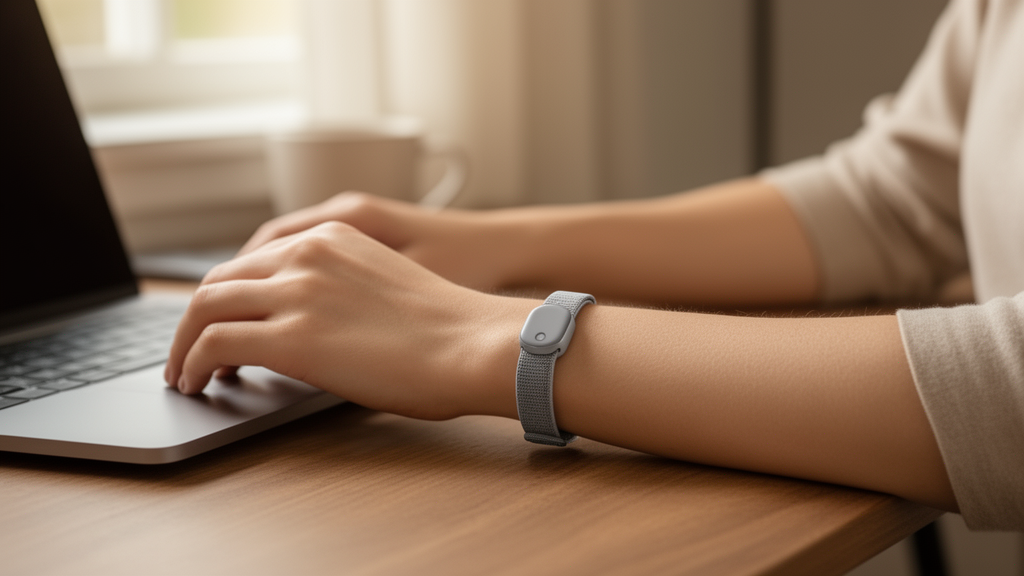
For millions of women living with chronic pelvic pain disorders, the simple act of moving can feel like a negotiation with their own bodies. Conditions such as endometriosis, adenomyosis and uterine fibroids create a cruel paradox: physical activity is one of the few interventions shown to ease pain and improve mental health without making symptoms worse, yet pain-related interference pushes sufferers toward long stretches of inactivity that carry their own health risks. Now a team at the Icahn School of Medicine at Mount Sinai has built a forecasting system that runs entirely on a consumer fitness band, learns each wearer’s habits in just ten days, and predicts with useful accuracy when a prolonged sedentary bout is about to begin — opening a window for a well-timed nudge to stand up and move.
The study, published in npj Women’s Health, analyzed minute-level data from Fitbit Inspire 2 trackers worn by 134 women with chronic pelvic pain disorders over 90 days, alongside a control cohort of 61 healthy participants. Rather than treating movement as a set of isolated categories, the researchers distilled the raw sensor stream into a single continuous quantity they call the physical activity score, or PAS. Fitbit assigns each minute one of four intensity levels — sedentary, light, moderate or vigorous — and the team encoded these as values from zero to one, then averaged them into hourly and 15-minute bins. The result is a smooth, high-resolution behavioral signal that can be forecast like any other time series, and, crucially, thresholded afterward against multiple clinical definitions of sedentary behavior.
The technical heart of the work is a deliberate embrace of simplicity. The researchers compared three model families, all chosen for their modest computational appetite: recursive least squares, an online learning method whose parameters update continuously with each new observation; seasonal autoregressive integrated moving average, or SARIMA, a classical statistical model that captures both short-term dependencies and repeating daily rhythms; and a long short-term memory network, a recurrent neural architecture often assumed to be necessary for temporal data. All three decisively beat simple baselines, confirming that real predictive structure exists in the activity signal. But the deep learning model came last. SARIMA achieved the lowest median forecasting error, with RLS essentially tied, and the LSTM trailed slightly behind both.
That convergence carries a message for the mobile health field. The predictive signal in wearable activity data, it turns out, comes almost entirely from two sources: what the wearer did in the last few hours, and what they habitually do at the same time of day. These are linear, autoregressive patterns — the kind of structure that shallow, interpretable models capture efficiently, without the iterative gradient descent that makes neural network training prohibitively expensive on a phone or wristband. Recursive least squares, in particular, solves for its parameters in closed form, meaning the entire learning lifecycle — training, prediction, adaptation — can run autonomously on the device itself, with no data ever leaving the wearer. Privacy is preserved by design, sidestepping both the infrastructure burden and the documented privacy risks of federated learning pipelines built around large models.
Missing data, the perennial plague of wearable research, proved far less damaging than feared. Consumer devices routinely produce gaps when users remove the tracker to charge it or when synchronization fails, and traditional approaches — discarding days that fail a ten-hour wear-time threshold, or applying multiple imputation after the fact — are incompatible with real-time forecasting. The Mount Sinai team instead used pragmatic, model-appropriate strategies: forward imputation for the online model, substituting the model’s own most recent predictions for missing inputs, and participant-specific mean imputation for the offline models. Strikingly, forecasting error showed essentially no relationship with how much data was missing; a linear fit yielded an R-squared of just 0.002. Because gaps tend to occur in continuous episodes rather than scattered fragments, the temporal patterns the models exploit remain largely intact.
The analysis of what actually drives forecasting errors produced one of the study’s most counterintuitive findings. Variation in accuracy across participants was not explained by missingness, nor by typical activity levels, but overwhelmingly by the intensity of their most active moments: the 95th percentile of wake-time activity predicted error variability with an R-squared of 0.835. Rare bursts of vigorous movement are hard to anticipate and dominate the root-mean-squared error metric. Yet this error turned out to be largely irrelevant to the clinical goal, because sedentary behavior follows more stable, routine-driven dynamics — shaped by work schedules, commutes and mealtimes — than spontaneous high-intensity activity. A model that misjudges the amplitude of an exercise burst can still nail the prediction that a sedentary bout is coming.
Translating forecasts into actionable alerts required careful attention to timing and thresholds. Predicting a full hour ahead produced an unfavorable trade-off between true and false alarms, so the team reframed the task at 15-minute resolution, treating each hour as four consecutive decision windows. Using the forecast of one minus the PAS as a continuous sedentary risk estimate, they tested two clinically grounded definitions of sedentary behavior: complete inactivity, targeting the muscular unloading linked to suppressed lipoprotein lipase activity, and near-zero activity, aligning with the metabolic consensus definition of waking behavior under 1.5 METs. At a conservative operating point calibrated to 20 percent recall, the system generated roughly one true alert per day — one sedentary bout flagged in time to be interrupted — against fewer than 0.5 false alarms, with precision reaching 60 to 72 percent depending on the definition.
The operating point matters enormously, and the authors frame the choice as a deployment decision rather than a technical one. A balanced setting that maximizes the F1-score pushes recall to 82 percent, catching nearly four sedentary bouts per day, but at the cost of 3.5 false alerts daily — a frequency known from prior mobile health research to risk alarm fatigue. Low-intensity wellness coaching may demand the conservative regime, while clinically supervised activity prescriptions could tolerate noisier alerts in exchange for coverage. The timing result is equally consequential: predictive precision was highest for bouts beginning within the next 15 minutes and decayed steadily at longer horizons, the first time this information decay has been characterized at sub-hour timescales for sedentary behavior. That short, sharp window aligns neatly with the emerging science of exercise snacks — brief activity breaks shown to interrupt sitting and improve cardiometabolic outcomes — and with just-in-time adaptive intervention design, which holds that prompts must arrive close to the moment of action to change behavior.
The study’s limitations are acknowledged candidly. The sample consisted mostly of urban-dwelling, college-educated, full-time employed women without major comorbidities, and generalizability to underserved populations — who face distinct structural barriers to activity — remains untested. Consumer-grade Fitbits may underestimate vigorous activity in free-living conditions, though the researchers note that training and evaluating on the same instrument preserves the validity of relative patterns, and prior comparisons suggest commercial devices perform comparably to research-grade accelerometers. The preprocessing pipeline, which excluded any minute lacking heart rate data to avoid mistaking non-wear time for sedentary behavior, may have discarded some valid activity records. Still, forecasting performance was consistent across both the clinical cohort and healthy controls, suggesting the approach captures activity structure that is stable across health states.
What makes the work resonate beyond its clinical niche is its argument about where digital health intelligence should live. In an era fixated on ever-larger models, the Mount Sinai team demonstrates that a one-layer linear method, trained on 240 hours of a single person’s data, can match or beat a neural network — while updating itself continuously, running on commodity hardware, and never transmitting a single data point to a server. As the authors note, online adaptability may become essential when future versions incorporate location, social context or survey data, where life events like a new job or an exercise program would shift behavioral patterns. For now, the framework lays a concrete, privacy-preserving pathway toward precision forecasting for a population that has long been clinically significant yet understudied — one well-timed prompt to stand up at a time.
Subject of Research: On-device machine learning forecasting of sedentary behavior from wearable data in women with chronic pelvic pain disorders
Article Title: Robust forecasting of sedentary bouts in chronic pelvic pain disorders for on-device learning and real-time deployment
Article References: Jegminat, J., Shahnawaz, S., Rodrigues, J., Danieletto, M., Landell, K., Campanella, G., Garber, C. E., Fayad, Z. A., & Ensari, I. (2026). Robust forecasting of sedentary bouts in chronic pelvic pain disorders for on-device learning and real-time deployment. npj Women's Health, 4(1), Article 30. https://doi.org/10.1038/s44294-026-00156-5
Image Credits: AI Generated
DOI: 10.1038/s44294-026-00156-5
Keywords: chronic pelvic pain disorders, sedentary behavior, wearable devices, on-device learning, recursive least squares, time series forecasting, just-in-time adaptive interventions, digital health, endometriosis, physical activity, privacy-preserving machine learning, mHealth
Cite Scienmag News
Ophelia Keating. (October 8, 2026). Simple AI on a Wristband Predicts When Women With Chronic Pelvic Pain Will Sit Too Long. Scienmag. https://scienmag.com/simple-ai-on-a-wristband-predicts-when-women-with-chronic-pelvic-pain-will-sit-too-long/
Ophelia Keating. "Simple AI on a Wristband Predicts When Women With Chronic Pelvic Pain Will Sit Too Long." Scienmag, 8 October 2026, https://scienmag.com/simple-ai-on-a-wristband-predicts-when-women-with-chronic-pelvic-pain-will-sit-too-long/. Accessed 8 October 2026.
Ophelia Keating. "Simple AI on a Wristband Predicts When Women With Chronic Pelvic Pain Will Sit Too Long." Scienmag. October 8, 2026. https://scienmag.com/simple-ai-on-a-wristband-predicts-when-women-with-chronic-pelvic-pain-will-sit-too-long/


