


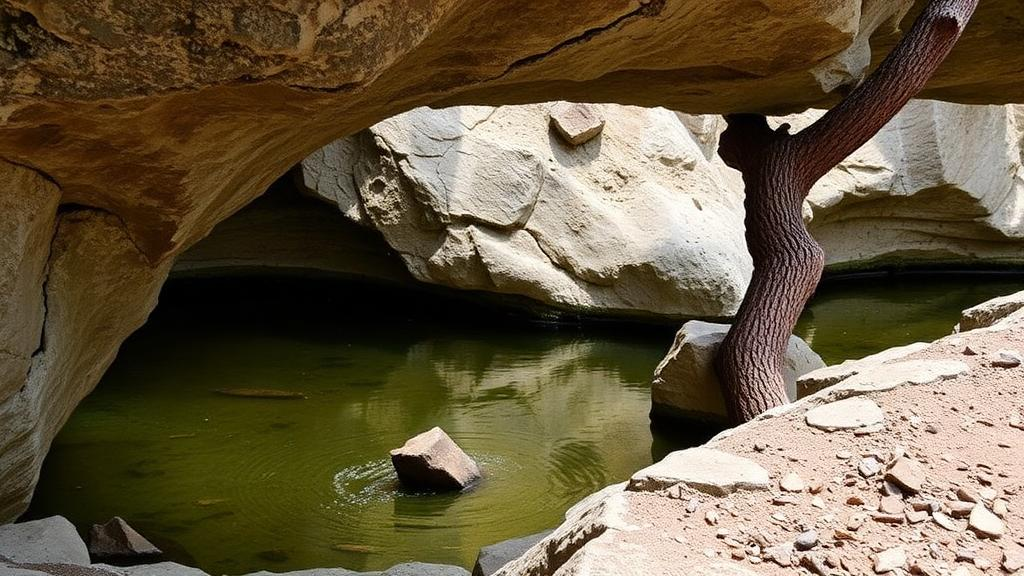
In the parched hills of central Texas, trees appear to defy the odds. Some of the driest, thinnest soils in the region support lush live oaks and junipers that seem to shrug off years of below-average rainfall, while their counterparts growing in deeper soils just a few kilometers away wilt, shed branches, and sometimes die. For decades, ecologists attributed these differences mainly to soil depth. A new study suggests the real story lies deeper still, in the weathered limestone bedrock beneath the soil, where vast quantities of water are stored and tapped by some trees but not others.
The research, published in the journal Plant and Soil, was led by Pedro A. M. Leite of Stephen F. Austin State University together with colleagues at Texas A&M University, the University of British Columbia, and the University of Texas at Austin. The team spent three consecutive drought years monitoring three co-dominant woody species on the Edwards Plateau: live oak (Quercus fusiformis), Ashe juniper (Juniperus ashei), and redberry juniper (Juniperus pinchotii). Their findings reveal that access to rock moisture, not simply the thickness of the soil, strongly shapes how these species partition water belowground and how they cope with drought.
The Edwards Plateau is one of the most extensive karst landscapes in the United States, a terrain carved from Cretaceous limestone in which fractures and dissolution channels riddle the rock. The weathered upper layer, known as the epikarst, acts like a sponge with a rigid skeleton. Unlike soil, whose fine pores roots can freely invade, weathered bedrock confines roots to fractures and dissolution features. Water held within the rock matrix slowly diffuses into these root-occupied cracks, providing a reservoir that depletes far more gradually than soil moisture.
To test how this hidden reservoir influences plant water relations, the researchers selected two contrasting sites at the Texas A&M Sonora Research Station in the drier western portion of the Plateau. One site featured shallow soils less than about thirty centimeters thick overlying weakly cemented, highly fractured Buda Limestone. The other, roughly four kilometers away and nearly identical in rainfall, had deeper clay-rich soils underlain by dense, indurated dolomitic limestone of the Edwards formation with very few fractures. At each site, the team repeatedly measured predawn water potential, an indicator of the water status of a plant’s root zone, in the same mature trees from January 2020 through December 2022.
The results were striking. Across all three species, trees rooted in the shallow soils over weathered bedrock consistently maintained less negative and less variable predawn water potentials than their deep-soil counterparts. This finding runs counter to the intuition from more humid landscapes, where trees on downslope, deeper soils usually enjoy better water supplies. Here, the deep soil stored substantial water after major rains, but that reservoir was drained rapidly during the growing season, partly through competition with deep-rooted grasses. Rock moisture at the shallow-soil site, by contrast, declined slowly over the entire three-year study, buffering the trees against dry spells.
Statistical analysis reinforced the connection. Predawn water potentials of live oak and redberry juniper at the shallow-soil site were positively correlated with bedrock water storage even after statistically controlling for soil moisture, suggesting the trees were literally drawing on the rock. The stress patterns told a parallel story. At the deep-soil site during the extreme drought of summer 2022, Ashe juniper water potentials plummeted below minus 8.5 megapascals, and most trees showed branch dieback. Two of the six monitored live oaks at that site died. At the shallow-soil site, no dieback was observed at all.
To trace where the trees actually obtained their water, the researchers measured the stable isotope ratios of hydrogen and oxygen in xylem water, comparing them with rainwater and soil water collected at different depths. Live oak consistently showed the lightest isotope values at both sites, indicating uptake of deeper or older water little affected by evaporation, most likely rock moisture. Ashe juniper showed the heaviest values, matching shallow, evaporatively enriched soil water, consistent with its relatively shallow root system and high tolerance of embolism, the formation of air bubbles that blocks water transport in xylem.
Redberry juniper proved the most flexible player. In deep soils it behaved like Ashe juniper, relying on shallow water and shifting its isotope signature rapidly toward that of new rainfall after a 36-millimeter storm in March 2020. In shallow soils over weathered bedrock, however, it maintained water potentials comparable to live oak and showed no isotopic shift after that same rain event, which primarily recharged surface layers. This pattern suggests the species can tap rock moisture when it is available, a population-level flexibility that may explain its low drought-induced mortality across Texas ecoregions and its aggressive expansion into new terrain.
The study also helps reconcile earlier, seemingly contradictory findings about which species suffers more during drought. Previous work in the eastern Edwards Plateau found that Ashe juniper often outcompetes live oak on shallow soils, but those sites sit atop dense dolomite with little storage capacity. Where shallow soils overlie highly weathered limestone, as in this study, live oak gains the advantage through its access to rock moisture, likely aided by fine-root morphology that lets angiosperm roots deform and penetrate fractures as narrow as 100 micrometers, far narrower than the fissures conifer roots can occupy.
The implications reach well beyond Texas. Carbonate rocks underlie roughly fifteen percent of the global ice-free land surface, and shallow bedrock lies beneath more than 45 percent of wooded land in the continental United States. As climate change brings less frequent but more intense rainfall punctuated by longer droughts, deep-rooted species able to exploit bedrock reservoirs recharged by big storms may gain ground, while species confined to rapidly depleted soil water will depend on sheer drought tolerance. Incorporating weathered-bedrock storage and species-specific access to it into ecohydrological models, the authors argue, could substantially improve predictions of how the world’s shallow-soil ecosystems will weather the droughts ahead.
Subject of Research: Rock moisture uptake and hydrologic niche segregation among co-dominant woody plants in a semiarid karst landscape
Article Title: Rock moisture access contributes to hydrologic niche segregation among co-dominant woody plants
Article References: Leite, P. A. M., West, J. B., Nehemy, M. F., Rempe, D. M., & Wilcox, B. P. (2026). Rock moisture access contributes to hydrologic niche segregation among co-dominant woody plants. Plant and Soil. https://doi.org/10.1007/s11104-026-09081-7
Image Credits: AI Generated
DOI: 10.1007/s11104-026-09081-7
Keywords: rock moisture, karst ecohydrology, drought resilience, stable water isotopes, woody plant encroachment, Edwards Plateau, predawn water potential, bedrock water storage, hydrologic niche segregation, Quercus fusiformis, Juniperus ashei, Juniperus pinchotii
Cite Scienmag News
Gavin Prescott. (October 8, 2026). Hidden Water in Rock Helps Trees Survive Drought, Study Finds. Scienmag. https://scienmag.com/hidden-water-in-rock-helps-trees-survive-drought-study-finds/
Gavin Prescott. "Hidden Water in Rock Helps Trees Survive Drought, Study Finds." Scienmag, 8 October 2026, https://scienmag.com/hidden-water-in-rock-helps-trees-survive-drought-study-finds/. Accessed 8 October 2026.
Gavin Prescott. "Hidden Water in Rock Helps Trees Survive Drought, Study Finds." Scienmag. October 8, 2026. https://scienmag.com/hidden-water-in-rock-helps-trees-survive-drought-study-finds/


