


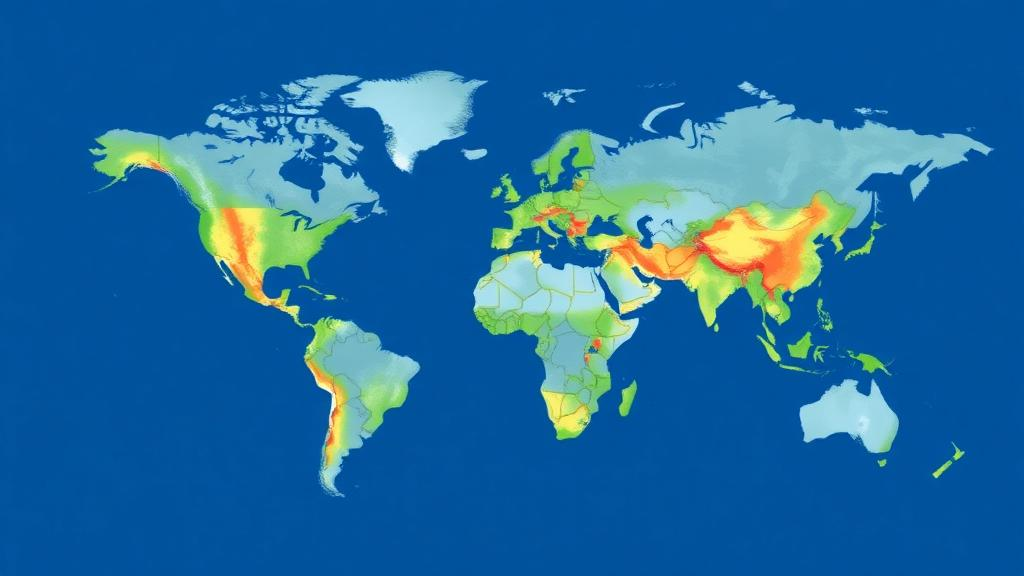
Carbon dioxide monitoring is one of the quiet triumphs of modern science. For decades, a global network of observatories has been sampling the air, hour after hour, building the record that tells humanity exactly how fast the planet’s most important greenhouse gas is accumulating. Yet behind those smooth, iconic curves of rising CO2 lies an uncomfortable truth: the records are full of holes. Instruments break. Flasks are only filled intermittently. Quality-control procedures discard suspicious readings. Now, a research team led by scientists at Sichuan University has unveiled a solution that could reshape how climate researchers work with these foundational measurements — a complete, hour-by-hour reconstruction of CO2 concentrations at Global Atmosphere Watch stations spanning a quarter century, from 2000 through 2024.
The new dataset, described in a preprint under review for the journal Earth System Science Data, addresses a problem that has quietly plagued atmospheric science for years. The Global Atmosphere Watch program, coordinated by the World Meteorological Organization, maintains monitoring stations from the pristine summits of remote islands to densely populated continental interiors. These stations deliver some of the most precise CO2 measurements on Earth, but their hourly records are far from continuous. Gaps arise from flask sampling regimes, instrument interruptions, and the exclusion of data during quality-control screening. Those missing hours are not merely cosmetic blemishes; they can systematically bias daily, monthly, and annual mean estimates of CO2, mask the natural rhythm of day-night concentration swings, and hide short-lived events such as pollution episodes or wildfire plumes.
To repair the record, the team, including Tan Mi, Xueting Pu, Xi Zheng, and colleagues, developed a two-stage reconstruction framework that blends direct observations with independent model-based estimates of atmospheric CO2. The approach integrates the GAW measurements themselves with CO2 fields from CarbonTracker and the Copernicus Atmosphere Monitoring Service, two widely used modeling systems that simulate how carbon dioxide is emitted, transported, and absorbed across the globe. Alongside these, the framework draws on anthropogenic emission inventories, vegetation data, meteorological variables, and spatiotemporal predictors — a rich feature set that allows the reconstruction to capture the physical processes driving CO2 variability at each location rather than simply interpolating between sparse points.
The first stage of the framework tackles the easier problem: filling in missing hours on days when at least one valid observation exists. For these partial days, the researchers employed hour-pair models, which learn the statistical relationships between concentrations at different times of day, to reconstruct the absent hours and produce complete daily profiles. This intra-day gap filling achieved impressive validation statistics, with a coefficient of determination of 0.96 and a root-mean-square error of 3.65 parts per million. In practical terms, the reconstructed values track the true hourly concentrations closely enough to preserve the diurnal cycle — the daily breathing of the biosphere as plants photosynthesize by day and respire by night, and as human activity pulses through morning and evening rush hours.
The second stage confronts the harder challenge: long stretches of time when a station produced no valid observations at all. Here, the team trained a globally trained initial prediction model, which learns from the full network of stations how CO2 behaves across seasons, latitudes, and land-cover types, and then applied station-specific post-corrections to tailor the predictions to each site’s local conditions. This full-sequence reconstruction achieved a coefficient of determination of 0.93 with a root-mean-square error of 4.76 parts per million. Across all stations, the mean filling rate reached 68.9 percent, meaning that on average more than two-thirds of the hourly record was reconstructed rather than directly observed, with a mean reconstruction uncertainty of 2.80 parts per million — a figure that gives users an honest sense of where the data are measured and where they are modeled.
Perhaps the most consequential finding is what happens when the repaired records are fed into the standard global analysis. Using the World Data Centre for Greenhouse Gases framework, the researchers compared global monthly mean CO2 concentrations computed from their reconstructed dataset against those derived from the original, gappy GAW records. The reconstructed values were, on average, 0.54 parts per million higher, with an uncertainty of plus or minus 0.21 parts per million. That may sound like a rounding error in a gas that now exceeds 420 parts per million globally, but in the precision world of greenhouse gas accounting, half a part per million is far from trivial. It suggests that incomplete temporal coverage has been measurably skewing global monthly estimates, potentially affecting the trend lines and seasonal cycle analyses that underpin carbon budget assessments worldwide.
The dataset also proves its worth at the scale of individual events. When compared with grid-cell simulations from CarbonTracker and CAMS, the reconstructed records retained stronger station-scale diurnal variability — the fine-grained local texture that coarse global models tend to smooth away. More dramatically, the reconstruction captured CO2 enhancements during the 2023 Canadian wildfire period, one of the most extreme fire seasons in modern history, when smoke and combustion gases drifted across the continent and beyond. A dataset that can resolve such transient carbon pulses opens a window on processes that monthly means and coarse models simply cannot see, from the immediate atmospheric fingerprint of a burning forest to the hourly interplay between urban emissions and local weather.
The implications reach well beyond record-keeping. Regional carbon-emission inversion — the family of techniques that work backward from atmospheric concentrations to estimate where and how much carbon is being emitted and absorbed — depends critically on accurate, well-characterized concentration data. Inversions are only as good as the observations that constrain them, and gappy records force researchers to either discard valuable information or make assumptions that propagate uncertainty into their emission estimates. A temporally continuous hourly dataset with quantified uncertainty gives inversion scientists a far richer constraint, potentially sharpening estimates of regional carbon fluxes and improving the evaluation of emission reduction policies. The dataset equally supports long-term assessments of global and regional surface CO2 changes and fine-scale analyses of variability that were previously impractical.
The release comes at a moment when the demand for granular carbon data is accelerating. Governments, cities, and corporations are increasingly committing to net-zero targets, and verifying progress toward those targets requires knowing not just annual averages but the dynamics of CO2 in the atmosphere at fine temporal and spatial resolution. Satellites such as those in the Orbiting Carbon Observatory family provide global coverage but with their own gaps and retrieval uncertainties, while ground stations provide the precision anchor points against which satellite data are calibrated. A complete, hourly, quarter-century ground-based record strengthens that entire observational chain, offering benchmark data for model evaluation, satellite validation, and the detection of subtle changes in the global carbon cycle.
The dataset, publicly available through Zenodo, arrives as a preprint currently open for community discussion and peer review at Earth System Science Data, a journal specializing in the publication of high-quality observational datasets. That review process will subject the reconstruction methods to external scrutiny, but the framework’s validation statistics and its demonstrated ability to reproduce both long-term means and short-lived events give the approach a strong foundation. For a field that has spent decades carefully measuring a changing atmosphere, the message of this work is at once sobering and empowering: the gaps in our records were large enough to matter, and now, with a combination of machine learning, physical modeling, and meticulous validation, they can be filled. As the planet’s carbon trajectory becomes ever more central to policy and public life, tools like this reconstruction ensure that the scientific record keeps pace with the atmosphere it is trying to understand.
Subject of Research: Reconstruction of temporally continuous hourly CO2 concentrations at Global Atmosphere Watch stations from 2000 to 2024
Article Title: A global, temporally continuous, hourly CO2 concentration dataset at GAW monitoring stations for 2000–2024: Enabling fine-scale carbon dynamics analysis
Article References: Mi, T., Pu, X., Zheng, X., Nie, G., Liu, X., Zhang, H., Grieneisen, M. L., Zhan, Y., Wang, M., & Yang, F. (2026). A global, temporally continuous, hourly CO 2 concentration dataset at GAW monitoring stations for 2000–2024: Enabling fine-scale carbon dynamics analysis. https://doi.org/10.5194/essd-2026-554
Image Credits: AI Generated
Keywords: CO2, GAW stations, carbon cycle, gap filling, CarbonTracker, CAMS, greenhouse gases, dataset reconstruction, diurnal variability, carbon emissions, wildfires, WDCGG
Cite Scienmag News
Sloane Callahan. (October 8, 2026). New Hourly CO2 Dataset Fills 25-Year Gaps in Global Greenhouse Gas Records. Scienmag. https://scienmag.com/new-hourly-co2-dataset-fills-25-year-gaps-in-global-greenhouse-gas-records/
Sloane Callahan. "New Hourly CO2 Dataset Fills 25-Year Gaps in Global Greenhouse Gas Records." Scienmag, 8 October 2026, https://scienmag.com/new-hourly-co2-dataset-fills-25-year-gaps-in-global-greenhouse-gas-records/. Accessed 8 October 2026.
Sloane Callahan. "New Hourly CO2 Dataset Fills 25-Year Gaps in Global Greenhouse Gas Records." Scienmag. October 8, 2026. https://scienmag.com/new-hourly-co2-dataset-fills-25-year-gaps-in-global-greenhouse-gas-records/


