


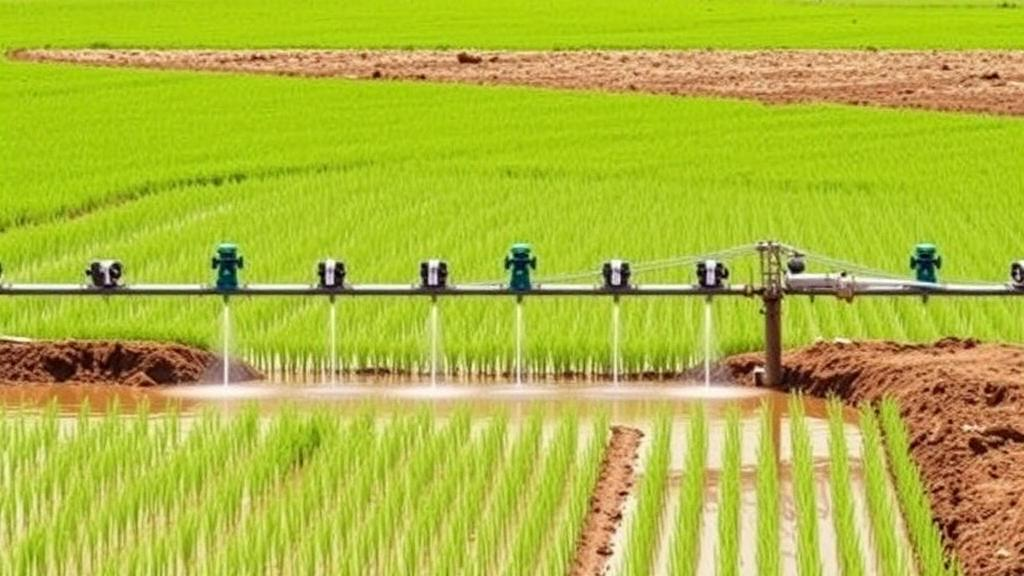
In the highlands and lowlands of Ethiopia, a quiet technological contest is underway, one that could shape the future of smallholder farming across much of sub-Saharan Africa. Farmers who irrigate their fields must decide how to power their pumps: diesel engines, electric motors connected to the grid, or simply their own muscles and those of hired laborers. Each option carries a different price tag, a different yield potential, and a different long-term payoff. A new study published in PLOS Water offers the most detailed accounting yet of how these choices play out in the real world, and its central finding is counterintuitive: the technology that produces the most food per hectare is not the one that leaves the most money in farmers’ pockets.
The research, led by Rahel Deribe Bekele and Dawit Mekonnen together with Tiruwork Arega and Marc Jeuland, draws on an unusually rich body of evidence collected during the 2016/17 agricultural season. The team surveyed 464 rural households cultivating 1,037 irrigated plots, spread across four regions and ten districts of Ethiopia. But the numbers alone tell only part of the story. The researchers also conducted focus group discussions and key informant interviews to capture the lived experience of irrigation, and they linked bio-physical and climatic data to the precise geo-referenced locations of each household and plot. This mixed-methods design allowed them to situate every farm within its actual agro-ecological context, accounting for the soils, rainfall patterns, and terrain that shape what irrigation can achieve.
The methodological heart of the study lies in how it handles a problem that plagues nearly every observational comparison in development economics: self-selection. Farmers are not randomly assigned to diesel, electric, or manual irrigation. Those who adopt diesel pumps may differ systematically from those who rely on hand labor in wealth, education, access to credit, plot characteristics, or entrepreneurial ambition. A naive comparison of incomes across these groups would therefore conflate the effect of the technology with the effect of who uses it. To untangle this, the researchers employed a multivalued treatment effects framework using the Inverse Probability Weighted Regression Adjustment estimator, known in the trade as IPWRA. The approach constructs a credible counterfactual: what would a diesel-pump user’s net returns have looked like had that farmer instead chosen an electric pump or manual lifting, given all observable characteristics?
The IPWRA estimator works in two stages. First, it models the probability that a household selects each energy option based on covariates such as household demographics, asset holdings, plot-level biophysical conditions, and climatic variables. These probabilities generate inverse probability weights that correct for the non-random sorting of farmers into technologies. Second, it fits regression models of outcomes within each treatment group and combines the weighted regressions to estimate what are known as average treatment effects. Because the treatment here is multivalued, three energy categories rather than a simple adopter-versus-non-adopter split, the framework must estimate contrasts between every pair of options, a considerably more demanding statistical exercise. The payoff is a set of causal estimates that are far more defensible than raw comparisons of means.
So what did the numbers reveal? Diesel pumps, it turns out, are the champions of raw productivity. Plots irrigated with diesel-powered pumps achieved the highest total value of production per hectare of any energy option in the study. This makes intuitive sense: diesel pumps are powerful, portable, and available on demand regardless of whether the grid reaches the village. They can lift large volumes of water quickly, allowing farmers to irrigate more intensively and cultivate higher-value crops. For a policymaker looking only at gross output, diesel would appear to be the obvious winner, and indeed many government and donor programs across Africa have promoted motorized pumps on precisely this logic.
But gross output is not net income, and here the story flips. When the researchers subtracted the full costs of operation, the estimated mean net returns were higher for electric pumps and for manual systems than for diesel. The culprits are familiar to any smallholder who has run a combustion engine in a remote setting: fuel and maintenance. Diesel prices in rural Ethiopia are high and volatile, spare parts can be scarce, and repairs often require traveling to distant towns. A pump that sits broken during the critical irrigation window destroys the very productivity advantage it was purchased to deliver. Electric pumps, once the connection exists, benefit from cheaper and more stable energy costs, while manual systems carry almost no operating expenses at all, even though they limit how much water a farmer can lift.
The implications ripple outward well beyond farm accounting. Ethiopia has invested heavily in rural electrification over the past two decades, and this study provides some of the strongest evidence yet that those investments can pay agricultural dividends. Where the grid arrives, farmers gain access to an irrigation energy source that combines substantial lifting capacity with low running costs, a combination that neither diesel nor manual labor can match. The findings also speak directly to climate resilience. As rainfall becomes more erratic across the Horn of Africa, irrigation is increasingly viewed as a buffer against drought, but that buffer is only as reliable as its energy supply is affordable. An irrigation strategy that looks robust on paper but collapses under fuel-price shocks offers false security.
The qualitative strands of the research add texture that surveys alone cannot capture. Focus group discussions and interviews with key informants revealed how farmers weigh these trade-offs in practice, and why the visible costs of diesel, the fuel purchases, the breakdowns, the trips for spare parts, weigh heavily in household decision-making. These accounts help explain the statistical pattern: farmers are not irrational to prefer electric or manual options where feasible, because the economics of daily operation matter more over a season than the peak power of a motor. The integration of climatic and bio-physical data further shows that the returns to any energy choice depend on where a farm sits, its water source, and the crops it grows, meaning there is no single technology prescription that fits all of Ethiopia’s irrigated landscapes.
For policymakers, the study’s message is one of nuance rather than prohibition. Diesel pumps still have a role, particularly in areas beyond the grid where their portability and power enable cultivation that would otherwise be impossible. But the research underscores that promoting affordable, reliable, and sustainable energy technologies is essential if smallholder irrigation is to deliver on its promise of higher productivity and better livelihoods. Subsidies that lower the purchase price of a pump while ignoring the recurring cost of fuel may leave farmers worse off than before. Conversely, extending reliable electricity to irrigable land, or developing solar-powered alternatives that share electric pumps’ low operating costs, could shift the calculus decisively in favor of net returns rather than mere output.
The broader lesson extends across the developing world, where hundreds of millions of smallholders face similar choices among energy options for lifting water. The Ethiopian evidence demonstrates that the technology with the highest headline productivity is not necessarily the one that best serves farmers’ incomes, and that rigorous causal methods, properly accounting for self-selection and local context, can reveal these hidden trade-offs. As governments and international donors design the next generation of irrigation investments, the study suggests a simple guiding question: not which pump moves the most water, but which energy source leaves the most food on the table and the most money in the farmer’s hand at season’s end. Answering that question, the authors argue, is central to building a sustainable, climate-resilient agricultural future for Ethiopia and for smallholder farming systems throughout the tropics.
Subject of Research: Comparative impacts of diesel, electric, and manual irrigation energy options on smallholder farm returns in Ethiopia
Article Title: Energy options for irrigated agriculture and their impacts on returns: Evidence from Ethiopia
Article References: Bekele, R. D., Mekonnen, D., Arega, T., & Jeuland, M. (2026). Energy options for irrigated agriculture and their impacts on returns: Evidence from Ethiopia. PLOS Water, 5(9), e0000601. https://doi.org/10.1371/journal.pwat.0000601
Image Credits: AI Generated
DOI: 10.1371/journal.pwat.0000601
Keywords: Ethiopia, irrigation, smallholder agriculture, diesel pumps, electric pumps, net returns, treatment effects, IPWRA, rural electrification, climate resilience, water pumping, agricultural economics
Cite Scienmag News
Alan Morgan. (October 8, 2026). Diesel Pumps Win on Output but Lose on Profit in Ethiopia’s Irrigation Race. Scienmag. https://scienmag.com/diesel-pumps-win-on-output-but-lose-on-profit-in-ethiopias-irrigation-race/
Alan Morgan. "Diesel Pumps Win on Output but Lose on Profit in Ethiopia’s Irrigation Race." Scienmag, 8 October 2026, https://scienmag.com/diesel-pumps-win-on-output-but-lose-on-profit-in-ethiopias-irrigation-race/. Accessed 8 October 2026.
Alan Morgan. "Diesel Pumps Win on Output but Lose on Profit in Ethiopia’s Irrigation Race." Scienmag. October 8, 2026. https://scienmag.com/diesel-pumps-win-on-output-but-lose-on-profit-in-ethiopias-irrigation-race/


