


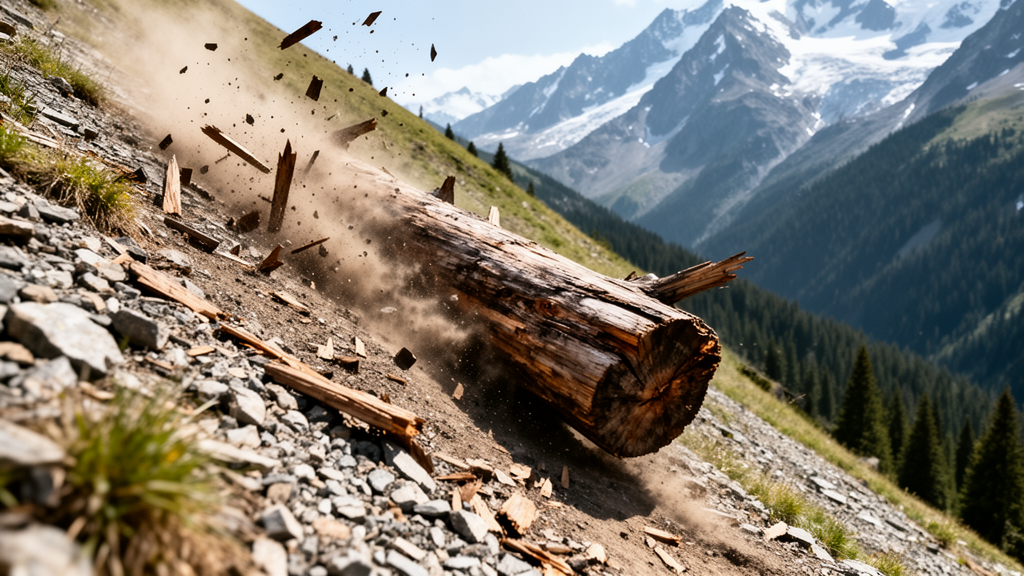
Deadwood is usually celebrated as the quiet hero of mountain forests. It shelters beetles and fungi, nurtures seedlings, and cushions slopes against rockfall and avalanches. But a new study published in Natural Hazards and Earth System Sciences reveals a startling flip side: under the right combination of conditions, a dead tree can transform from protective asset into a projectile, sliding hundreds of metres down a steep forest slope at speeds of up to 30 metres per second and slamming into roads, railways, and buildings. Joël Borner of the WSL Institute for Snow and Avalanche Research SLF and his colleagues have now built the first physics-based simulation framework capable of quantifying exactly when and where this overlooked hazard strikes.
The research was triggered by real events in the Swiss Alps. In June 2022, in the Gruobenwald forest near Klosters, a storm with heavy rain and wind felled a barkless, branchless dead tree standing on a slope of roughly 35 degrees. The snag, about 30 metres long with a diameter at breast height of 75 centimetres, slid approximately 120 metres downhill and came to rest on a road of national importance. Two days later, another log of similar dimensions slid down and lodged in a wooden palisade next to a house. During a subsequent helicopter operation to remove dangerous snags, two more logs were mobilised and slid onto the road and a hiking trail. In February 2022, near Rothenbrunnen, a tree slid some 200 metres in altitude, blocked both a road and a railway line, and apparently launched off a small terrace to jump clean over a 3.5-metre-high rockfall barrier.
Until now, no modelling framework existed to describe how mobilised deadwood moves on steep slopes. The team recognised that sliding logs share key mechanical characteristics with rockfall, including gravity-driven acceleration, impact, sliding, and deflection by obstacles, and therefore adapted the RAMMS::Rockfall simulation software. Their approach rests on nonsmooth rigid-body dynamics, combining hard contact laws with Coulomb friction. Each log is modelled as a rigid, convex polytope shaped like a truncated cone, defined by its diameter at breast height, stem length, and wood density, with the top diameter approximated at half the base diameter. The log’s position and orientation are tracked with generalised coordinates and unit quaternions, while its motion obeys the balance of linear momentum and Euler’s equations for rotation.
Contact between the log and the terrain is detected whenever a vertex of the log’s point-cloud geometry touches or penetrates the digital elevation model. At each contact point, the Signorini condition governs the normal force, and a spatial Coulomb friction law determines whether the log sticks or slips. Impacts are handled with a Newtonian impact law using a normal restitution coefficient of zero, consistent with the underlying rockfall model. Standing trees, whose locations and dimensions were extracted from airborne laser scanning data using single-tree detection, are represented as rigid truncated cones that block or deflect sliding logs. Rockfall barriers are included as thin, rigid, platy obstacles. The equations of motion are solved iteratively with Moreau’s time-stepping scheme and Gauss-Seidel iteration on a high-resolution 0.5-metre digital elevation model.
Calibrating the model against the documented events yielded a remarkably narrow range for the effective sliding friction coefficient, between 0.2 and 0.3, which the authors interpret as the typical contact friction between wet terrain and a wet, barkless log. With this value, the simulations reproduced the observed deposition patterns at both sites. In the Klosters case, 20,000 simulated logs were released and 1,829, or 9.1 percent, reached the national road, with average velocities of 14 metres per second and maxima of 30 metres per second. At Rothenbrunnen, the model confirmed that jumping the barrier was physically plausible: fitting a flight parabola between the take-off and landing traces gave a take-off velocity of 24 metres per second, and 178 of 20,000 simulated logs, or 0.9 percent, cleared the barrier, a small but realistic frequency given that such an event had never before been recorded there.
The simulations distilled three prerequisites for sliding deadwood hazards. First, friction must be low, which occurs when terrain or the log itself is wet, whether from rain, wet snow, or foliage cover. Second, slopes must be very steep, with all documented events occurring on gradients of 35 degrees or more; although the calibrated friction coefficient suggests mobilisation is theoretically possible above about 18 degrees, the macroscopic roughness captured by the terrain model raises the practical threshold. Third, and perhaps most intriguingly, the wood must be in a narrow decay-stage window: late stage II or early stage III in the standard classification, when bark and branches have been lost, slashing sliding friction, but the stem still retains enough structural strength to survive impacts without shattering. For spruce killed by bark beetles, this critical window opens roughly two to five years after death, while beech decays significantly faster.
Forest structure emerged as a decisive factor in the hazard equation. When the researchers removed all standing trees from the Klosters simulation, the fraction of logs reaching the road exploded from 9.1 percent to 74.5 percent; at Rothenbrunnen it rose from 23.3 percent to a full 100 percent. The forest, in other words, is a highly effective shield against hazards created by its own deadwood. Yet trees cut both ways: while they arrest logs, they also deflect them, increasing lateral spread. In the Klosters simulations, lateral spread shrank from values of 40 to 60 degrees with the real forest to 18 to 31 degrees without it, meaning that deadwood can traverse slopes far more widely than rocks and strike infrastructure that rockfall models would deem safe. Notably, logs slid further when the simulation used real laser-scanned tree positions rather than a randomly generated forest of identical density, because natural gullies, which are often sparsely vegetated, form preferential sliding corridors that random tree placement would artificially block.
The findings carry pointed implications for forest management, especially as deadwood volumes in Swiss mountain forests have doubled over three decades, from 17 to 35 cubic metres per hectare, and climate-driven disturbances promise still more standing and lying dead timber. The study reveals a genuine trade-off over time: young deadwood is strong and protective against rockfall and avalanches, mid-stage deadwood in the two-to-five-year window is both still protective and maximally prone to sliding, and old, rotten wood loses its protective value while its ecological worth as habitat and seedling substrate keeps climbing. Spatially, the same gullies that channel sliding logs are also prime locations for intercepting rockfall and stabilising snow. The authors argue that targeted interventions, such as felling and securing snags across the slope on wire-cable-supported stumps, or prioritising removal in the lower, steepest sections of forested slopes where logs have little forest left to traverse, can minimise the sliding hazard while preserving most of deadwood’s protective and ecological benefits.
The model is not without limits, and the authors are candid about them. Logs are treated as rigid bodies that never fracture, standing trees never break or dissipate energy by swaying, and the single effective friction coefficient is tied to the 0.5-metre terrain resolution, rising to an 18 percent reach frequency when a coarser 5-metre model was tested. Initial conditions are idealised, releasing logs upright within a 10-metre release polygon rather than simulating the actual toppling process. Yet because the framework is explicitly conditioned on a prior assessment that mobilisation is possible, these simplifications yield deliberately conservative, worst-case estimates of runout and impact frequency. The researchers also note that slender logs concentrate impact loads on small frontal areas, a concern for ring-net barriers with large mesh openings, and that logs left uncleared in nets can shorten the braking distance available for future rockfall. With well-documented events still rare, the team calls for systematic documentation of future incidents, but their message is already clear: sliding deadwood is a real, quantifiable, and increasingly relevant mountain hazard, and for the first time it can be simulated, mapped, and managed.
Subject of Research: Physics-based simulation of sliding deadwood logs as a natural hazard in steep mountain forests
Article Title: Simulation of sliding deadwood logs in mountain forests: towards a quantitative hazard assessment
Article References: Borner, J., Bebi, P., Bührle, L. J., Ringenbach, A., & Leine, R. I. (2026). Simulation of sliding deadwood logs in mountain forests: towards a quantitative hazard assessment. Natural Hazards and Earth System Sciences, 26(10), 4843-4859. https://doi.org/10.5194/nhess-26-4843-2026
Image Credits: AI Generated
DOI: 10.5194/nhess-26-4843-2026
Keywords: deadwood, mountain forests, natural hazards, rockfall simulation, Coulomb friction, nonsmooth dynamics, forest management, wood decay, Swiss Alps, airborne laser scanning, hazard assessment, bark beetle
Cite Scienmag News
Violet Maxwell. (October 8, 2026). When Deadwood Attacks: Simulating Sliding Logs That Race Down Mountain Slopes. Scienmag. https://scienmag.com/when-deadwood-attacks-simulating-sliding-logs-that-race-down-mountain-slopes/
Violet Maxwell. "When Deadwood Attacks: Simulating Sliding Logs That Race Down Mountain Slopes." Scienmag, 8 October 2026, https://scienmag.com/when-deadwood-attacks-simulating-sliding-logs-that-race-down-mountain-slopes/. Accessed 8 October 2026.
Violet Maxwell. "When Deadwood Attacks: Simulating Sliding Logs That Race Down Mountain Slopes." Scienmag. October 8, 2026. https://scienmag.com/when-deadwood-attacks-simulating-sliding-logs-that-race-down-mountain-slopes/


