


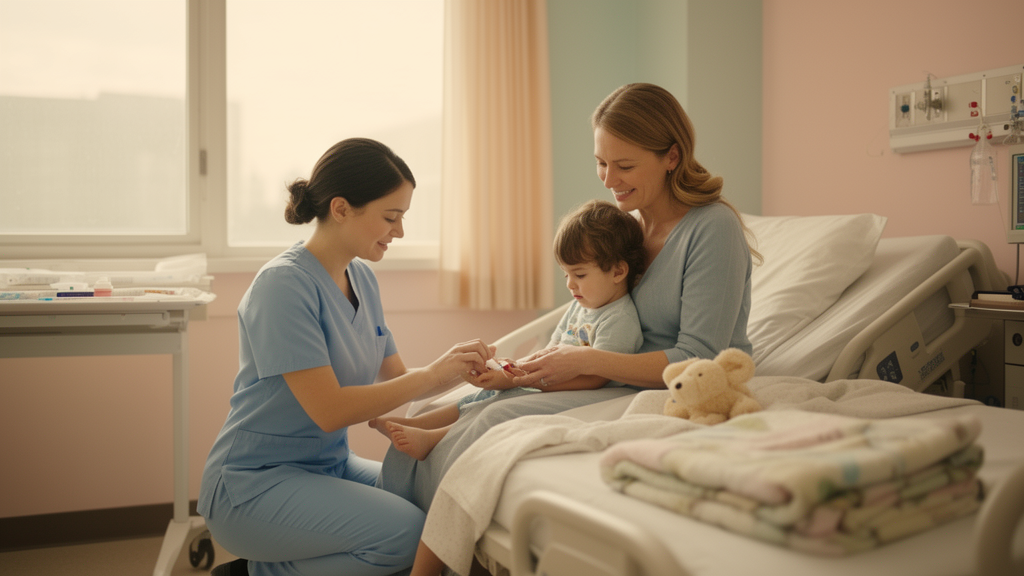
When a child is admitted to a hospital, the entire family enters a state of heightened stress, and the quality of everyday conversations between nurses and parents can shape how that experience is remembered for years. A new systematic review published in BMC Nursing by Noemí Mayoral-Gonzalo of Camilo Jose Cela University and colleagues set out to map exactly what determines parental satisfaction with nurse–parent communication during pediatric hospitalization, which barriers undermine it, and which strategies appear to improve it. The review, registered in PROSPERO (CRD42024518043) and conducted according to the PRISMA 2020 reporting guidelines, searched PubMed, Web of Science, and CINAHL for studies published between 2014 and 2024, ultimately including nine records spanning a range of study designs and hospital contexts.
The stakes of this question are considerable. Children with complex medical conditions require frequent interactions with healthcare services and multidisciplinary teams, meaning that parents of hospitalized children are not casual visitors but continuous participants in care. During pediatric hospitalization, effective nurse–parent communication is essential to the family experience and to satisfaction with care. Because nurses are typically the most constant professional presence at the bedside, the way they convey information, respond to questions, and acknowledge parental concern becomes a central determinant of how families judge the entire admission.
Methodologically, the review followed a rigorous appraisal pipeline. Methodological quality was assessed using the CASPe critical appraisal tool, with an additional sensitivity assessment using the Mixed Methods Appraisal Tool (MMAT) for selected study designs. Because the included studies differed substantially in designs, interventions, and outcome measures, the authors synthesized their findings narratively rather than attempting a meta-analysis. That decision reflects a familiar reality in health services research: communication outcomes are measured with heterogeneous instruments, and pooling satisfaction scores across dissimilar contexts would risk producing misleadingly precise estimates.
The headline finding is cautiously optimistic. Overall, the evidence suggested that parents of hospitalized children generally report positive experiences with nurse–parent communication, although relevant areas for improvement remain. In other words, the default experience of families appears to be a reasonably good one, but the review identifies recurring friction points that erode satisfaction and that hospital administrators and nursing educators can realistically target.
Among the most frequently reported barriers were the lack of staff identification, the use of technical language, and environmental noise. Each of these is deceptively simple. Parents who cannot tell which nurse is responsible for their child on a given shift struggle to direct questions and to build the continuity of trust that effective communication requires. Technical jargon, meanwhile, creates an asymmetry of understanding: a nurse may explain a medication plan accurately, yet if the vocabulary is unfamiliar, the parent leaves the conversation without genuine comprehension. Environmental noise on busy pediatric wards compounds the problem by physically degrading the signal of speech, forcing parents to catch fragments of instructions in acoustically hostile conditions.
On the solution side, the review found that interventions such as bedside communication tools, structured communication strategies, and interactive eHealth resources were generally associated with higher parental satisfaction and improved perceived understanding. Structured approaches give conversations a predictable architecture, ensuring that key information about diagnosis, treatment, and home care is covered systematically rather than left to chance. Bedside tools bring the exchange physically close to the child, allowing parents to connect explanations directly to what they observe. Interactive eHealth tools extend communication beyond the ward round, letting parents review information at their own pace and return to material they did not absorb the first time.
The mechanism by which these strategies work is worth unpacking. Parental satisfaction in this setting is not simply a matter of politeness or friendliness; it tracks closely with perceived understanding and with the parent’s sense of being a competent participant in the child’s care. Structured communication reduces the cognitive load on anxious parents by organizing information into digestible segments. Visual aids and digital resources support retention, since stress and sleep deprivation during hospitalization are known to impair memory for verbal information. By reinforcing the same content through multiple channels, these tools help ensure that understanding survives the emotional turbulence of having a sick child.
However, the authors are explicit about the limits of what can be concluded. Interpretation is constrained by the heterogeneity of the included studies and by the predominance of non-randomized designs with moderate to high risk of bias. Most of the evidence associating communication interventions with higher satisfaction is observational or quasi-experimental, which means confounding cannot be excluded: hospitals that invest in structured communication tools may differ in other ways, such as staffing levels or organizational culture, that independently drive satisfaction. The review therefore concludes that while strategies such as structured bedside communication, visual aids, and digital tools appear promising, stronger empirical evidence is needed before their effectiveness across settings can be established.
This caveat matters for policy. Satisfaction measures increasingly inform hospital quality dashboards and even reimbursement in some health systems, and there is a temptation to roll out communication interventions on the basis of suggestive evidence. The review’s findings support investment in the low-risk, low-cost elements, such as clear staff identification and attention to the acoustic environment, while arguing for properly controlled evaluations of more resource-intensive digital platforms before they are treated as proven solutions. It also highlights a measurement problem: without standardized instruments for parental satisfaction with communication, comparing interventions across hospitals remains difficult, and the field would benefit from greater consensus on outcome measures.
For parents, the practical takeaways are straightforward. Asking nurses to identify themselves, requesting that explanations avoid or define technical terms, and using any written or digital materials the hospital provides can all improve the flow of information. For nurses and the institutions that train them, the review reinforces that communication is not a soft skill appended to clinical work but a core clinical competency with measurable consequences for families. As pediatric care increasingly involves children with complex, chronic conditions and repeated admissions, the cumulative quality of thousands of brief bedside conversations becomes a genuine determinant of child and family outcomes. The Spanish-led team, which included researchers from the Health Research Institute of HM Hospitals, San Carlos Clinical Hospital Institute of Health Research, Universidad Complutense de Madrid, and Universitat Rovira i Virgili, conducted the work without external funding and declared no competing interests, and their synthesis offers a clear roadmap: keep what works, fix the identifiable barriers, and demand better trials before declaring victory.
Subject of Research: Parental satisfaction with nurse–parent communication during pediatric hospitalization
Article Title: Determinants of parental satisfaction in nurse–parent communication during pediatric hospitalization: a systematic review
Article References: Mayoral-Gonzalo, N., Leon, L., del Prado, C. I., Pérez-Manchón, D., Ruiz-Zaldibar, C., Sánchez, R. M., & de Quero Córdoba, M. G. (2026). Determinants of parental satisfaction in nurse–parent communication during pediatric hospitalization: a systematic review. BMC Nursing, 25(1), Article 906. https://doi.org/10.1186/s12912-026-05417-x
Image Credits: AI Generated
DOI: 10.1186/s12912-026-05417-x
Keywords: nurse-parent communication, pediatric hospitalization, parental satisfaction, systematic review, nursing research, health communication, bedside communication tools, eHealth, communication barriers, PRISMA, patient experience, BMC Nursing
Cite Scienmag News
Ophelia Keating. (October 8, 2026). What Really Makes Parents Satisfied With Nurses When Their Child Is Hospitalized. Scienmag. https://scienmag.com/what-really-makes-parents-satisfied-with-nurses-when-their-child-is-hospitalized/
Ophelia Keating. "What Really Makes Parents Satisfied With Nurses When Their Child Is Hospitalized." Scienmag, 8 October 2026, https://scienmag.com/what-really-makes-parents-satisfied-with-nurses-when-their-child-is-hospitalized/. Accessed 8 October 2026.
Ophelia Keating. "What Really Makes Parents Satisfied With Nurses When Their Child Is Hospitalized." Scienmag. October 8, 2026. https://scienmag.com/what-really-makes-parents-satisfied-with-nurses-when-their-child-is-hospitalized/


