


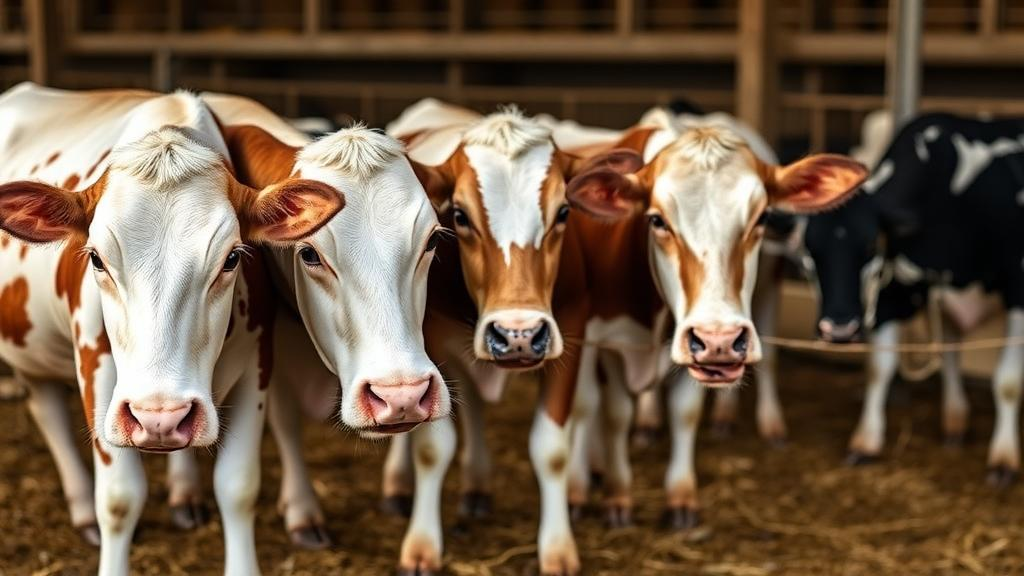
Every glass of milk tells a story about the cow that produced it, and a new study from Czech researchers suggests that the plot is driven far more by environment and physiology than by genetics. A team led by Jindřich Čítek and Eva Samková of the University of South Bohemia analysed more than 800 milk records from 519 dairy cows across five commercial farms and found that the farm where a cow lives and the stage of lactation she is in exert a dominant influence on milk composition and metabolic indicators. By contrast, polymorphisms in five well-known lipogenic genes had only a marginal effect on milk parameters and the fatty acid profile. The findings, published in Archives Animal Breeding, carry practical consequences for how dairy farmers monitor metabolic health, particularly the detection of ketosis, one of the most common and costly metabolic disorders of high-producing dairy cattle.
The study set out to disentangle the genetic and non-genetic factors that shape milk composition and cow metabolism under real field conditions. The researchers analysed 230 Czech Holstein and 289 Czech Simmental cows, sired by 122 bulls and housed on five farms operating free-stall systems. Milk samples were collected during routine performance testing, meaning the animals were handled exactly as they would be in ordinary commercial practice. Roughly half of the cows were sampled twice within the same lactation, allowing the team to build a dataset of 814 individual test-day records spanning the first through sixth lactations and covering days 1 to 305 of milk production.
The analytical toolkit was deliberately broad. In an accredited laboratory of the Czech–Moravian Breeders Association, the team used Fourier transform mid-infrared spectroscopy to measure fat, crude protein, lactose, urea, citric acid, acetone, β-hydroxybutyric acid (BHB), somatic cell counts, and a panel of fatty acids in every sample. DNA was extracted non-invasively from the milk itself, and the cows were genotyped for polymorphisms in five candidate genes central to milk fat synthesis: AGPAT6, SCD1, FASN, LEP, and DGAT1. These genes encode enzymes and regulators of lipid metabolism and have repeatedly been implicated in previous studies as potential markers for milk fat content, fatty acid composition, and susceptibility to metabolic disease.
Statistically, the researchers applied a linear mixed model with repeated measurements, treating gene variant, farm, parity, lactation stage, and breed as fixed effects while accounting for the sire and the permanent environment of each cow as random effects. Two-way interactions among genotype, farm, lactation stage, and parity were also tested. Post hoc comparisons were performed with Scheffé’s test, and Pearson correlations quantified the relationships among milk components. This design allowed the team to ask, with unusual resolution for a field study, which factors truly matter when the messy realities of commercial dairying are taken into account.
The verdict was unambiguous: farm and lactation stage were the most significant factors influencing nearly every milk parameter measured, along with their interaction. The effects of parity and breed were much weaker, a result the authors attribute in part to the partial overlap between breed and farm, since most of the participating herds kept only one breed. Notably, the significance of parity increased once lactation stage was included in the model, suggesting that properly adjusting for the physiological trajectory of lactation reveals genuine differences between first, second, and later calvings that would otherwise be masked by lactation-related variability.
The candidate genes, by contrast, largely failed to leave their mark. The impact of the five polymorphisms on milk parameters and the fatty acid profile was very low, as were the interactions between gene and farm, gene and lactation stage, and parity and lactation stage. This stands in tension with earlier work reporting significant associations between FASN, SCD1, and DGAT1 variants and milk fat traits or fatty acid composition. One caveat concerns the rare FASN genotype, the AA variant, which was detected in only two animals, potentially reducing the statistical power to detect effects for that allele. The authors also note that four of the five loci deviated significantly from Hardy–Weinberg equilibrium, a pattern consistent with the selection pressure and non-random mating that characterise managed livestock populations.
The metabolic story centred on BHB, a ketone body produced when cows mobilise body fat during the negative energy balance of early lactation. BHB levels in milk were significantly influenced by farm in all models, and by parity in the models including AGPAT6, SCD1, and DGAT1, with concentrations rising from 0.046 millimoles per litre in first lactation to 0.062 in second. Intriguingly, lactation stage itself did not significantly affect BHB in any model, unlike its pervasive effect on other components. BHB correlated strongly and positively with acetone, a relationship reflecting shared ketone metabolism, and correlated significantly with the fat-to-protein ratio, confirming earlier reports linking this ratio to energy status.
Yet the study delivers a sobering message about individual-level diagnosis. Although the association between BHB and the fat-to-protein ratio was statistically significant, the authors conclude that predicting ketosis in individual cows from this ratio does not appear reliable. Previous work has shown that while the fat-to-protein ratio can indicate negative energy balance at the herd level, no threshold provides acceptable sensitivity and specificity for identifying hyperketonaemia in a single animal. Instead, the researchers propose that milk BHB itself, which is routinely assessed during standard milk performance testing, may serve as a practical field predictor of clinical or subclinical ketosis, particularly as automatic in-line milk composition recording becomes more widespread.
Other correlations painted a coherent picture of high-producing cows under metabolic strain. Daily milk yield correlated negatively with most milk components, while urea content and milk yield were significantly positively correlated, hinting at higher metabolic intensity in the most productive animals. Lactose content showed a significant negative correlation with the somatic cell score, reinforcing its role as an indicator of udder health, and a weak but significant positive correlation emerged between the somatic cell score and BHB. Milk urea, the authors caution, should be interpreted as a herd-level tool for evaluating protein nutrition rather than as an individual diagnostic, since it is influenced by a wide variety of factors including health status.
The study’s limitations are acknowledged by the authors themselves: the animals came from a limited number of farms, and some genotypes were represented by very few animals. Even so, the central conclusion is robust and actionable. In the contest between genes and environment for control of milk composition, the environment wins decisively under field conditions, with feeding regimes, housing, milking management, and the natural arc of the lactation curve overwhelming the modest contributions of individual lipogenic gene variants. For dairy producers, the practical takeaway is that routine milk recording, especially when it includes BHB measurement, offers a powerful and increasingly automated window into herd metabolism, one that may ultimately catch ketotic cows earlier than any single genetic marker or ratio ever could.
Subject of Research: Genetic and non-genetic factors affecting milk composition and metabolic status in dairy cows
Article Title: Genetic and non-genetic factors influencing milk composition and cow metabolism
Article References: Čítek, J., Samková, E., Brzáková, M., Hanuš, O., Večerek, L., Jozová, E., Hasoňová, L., Baldíková, E., Iliyasu, S. M., & Rost, M. (2026). Genetic and non-genetic factors influencing milk composition and cow metabolism. Archives Animal Breeding, 69(4), 541-552. https://doi.org/10.5194/aab-69-541-2026
Image Credits: AI Generated
Keywords: dairy cattle, milk composition, ketosis, beta-hydroxybutyrate, lipogenic genes, fatty acids, lactation stage, fat-to-protein ratio, animal genetics, metabolic health, FT-MIR spectroscopy, Holstein
Cite Scienmag News
Juliet Wilcox. (October 8, 2026). Farm and Lactation Stage Trump Genes in Shaping Milk Composition and Cow Metabolism. Scienmag. https://scienmag.com/farm-and-lactation-stage-trump-genes-in-shaping-milk-composition-and-cow-metabolism/
Juliet Wilcox. "Farm and Lactation Stage Trump Genes in Shaping Milk Composition and Cow Metabolism." Scienmag, 8 October 2026, https://scienmag.com/farm-and-lactation-stage-trump-genes-in-shaping-milk-composition-and-cow-metabolism/. Accessed 8 October 2026.
Juliet Wilcox. "Farm and Lactation Stage Trump Genes in Shaping Milk Composition and Cow Metabolism." Scienmag. October 8, 2026. https://scienmag.com/farm-and-lactation-stage-trump-genes-in-shaping-milk-composition-and-cow-metabolism/


