


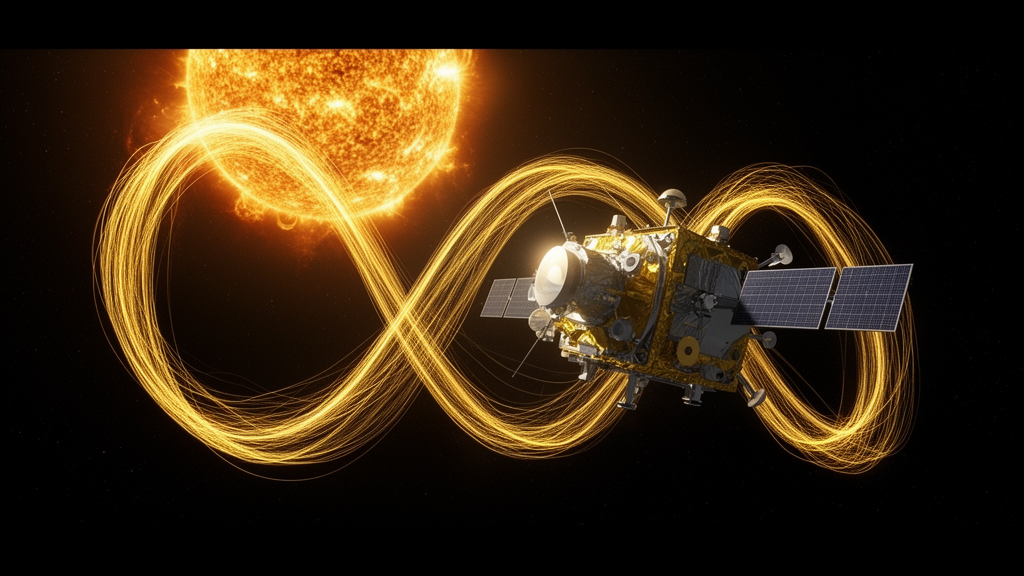
The Sun’s magnetic field is a restless, tangled thing, and every now and then it betrays just how unruly it can be. In the solar wind — the ceaseless outflow of charged particles that streams from the Sun and fills the entire heliosphere — researchers have repeatedly encountered strange S-shaped kinks in the magnetic field, known as switchbacks. These structures, in which the field abruptly folds back on itself before snapping forward again, have puzzled scientists since they were first observed in detail. Now the European Space Agency-led Solar Orbiter spacecraft has flown directly through one of the largest switchbacks ever sampled, and by fingerprinting the particles trapped inside it, the mission has traced the structure all the way back to its birthplace on the surface of the Sun.
The discovery, published in Nature Astronomy by Jesse Coburn of CNRS/LPP in France and colleagues, delivers what researchers are calling a smoking gun for one of two competing theories of how switchbacks form. At the time of the encounter, Solar Orbiter was roughly halfway between Earth and the Sun, well placed to sample the plasma streaming past it. Because the switchback it traversed was exceptionally large, the spacecraft’s instruments were able to detect rarely observed particle populations within it — populations that carry tell-tale chemical fingerprints of their solar origin.
Switchbacks first came to prominence as a major scientific puzzle when NASA’s Parker Solar Probe, flying closer to the Sun than any spacecraft before it, revealed them to be a common and often dramatic feature of the near-Sun solar wind. In 2022, Solar Orbiter added a crucial observational milestone when it spotted a kink in the solar wind’s magnetic field from a distance, confirming through imaging that these structures really are S-shaped, as theorists had predicted but nobody had directly seen. What remained stubbornly unclear was the mechanism that creates them. Do they originate at the Sun itself, or do they develop later as the solar wind travels outward through space?
To answer that question, Coburn’s team turned to Solar Orbiter’s Solar Wind Analyser, or SWA, an instrument suite designed to sample the composition, density, and velocity of the plasma that washes over the spacecraft. Composition is the key. Different regions of the solar atmosphere imprint different chemical signatures on the plasma they release, so by measuring exactly which ions are present inside the switchback, researchers can effectively read a return address written into the particles themselves.
What SWA found was a specific mix of charged oxygen and carbon particles that, according to the team’s analysis, could only have formed in one way: within hot magnetic field loops anchored at the surface of the Sun. That composition points squarely at a formation process known as interchange reconnection. The Sun’s atmosphere contains two fundamentally different kinds of magnetic regions. Open regions have field lines that stretch away from the Sun like highways, along which material can flow freely into space, forming the solar wind. Closed regions have field lines that initially extend outward before curving back down to the solar surface, trapping plasma inside magnetic loops. When an open region interacts with a neighbouring closed one, the field lines can crowd together, snap, and reconnect in new configurations — and in doing so, plasma that was previously confined in a closed loop is released into the open field lines and escapes into space.
That release, the new results indicate, is what created the switchback that Solar Orbiter flew through. The escaping loop plasma carries the composition of the closed-field region, and it is precisely that composition — the oxygen and carbon mixture — that the team identified as the decisive evidence. According to Coburn, there are two main competing theories for how a switchback, and by extension the solar wind itself, forms, and the specific particle mix detected by Solar Orbiter is the smoking gun for interchange reconnection as the origin mechanism for this structure.
But the story does not end at the Sun’s surface, and this is where the finding becomes genuinely reconciliatory rather than simply one-sided. The alternative theory of switchback formation invokes waves and turbulence — the kind of magnetic waves that Solar Orbiter has previously shown to play a key role in heating and accelerating the solar wind. In the new study, the researchers did find signs of such wave activity within the switchback, but critically, the evidence suggests these processes act only after the structure has already left the Sun. Stephanie Yardley of Northumbria University in the UK, a co-author of the paper, explained that once the switchback has departed the solar vicinity, waves and turbulence take over and govern how it moves through space. In other words, the two rival theories are not mutually exclusive alternatives at all. Interchange reconnection creates the switchback; waves and turbulence then shape and evolve it on its journey outward. Both processes are involved — they simply operate at different stages of a switchback’s lifetime.
The technical achievement behind the result is considerable. The team combined in situ measurements of the switchback’s particles from SWA with images of the Sun’s disc and with models of the magnetic fields both on the Sun and in the surrounding heliosphere. Crucially, they developed a new model to identify where the plasma originated, and this model connected Solar Orbiter’s direct particle measurements with data from NASA’s Solar Dynamics Observatory, revealing the switchback’s solar source in unprecedented detail. It is this multi-instrument, multi-spacecraft chain of evidence — composition, imaging, and magnetic modelling converging on the same answer — that elevates the finding from an intriguing correlation to a compelling causal identification.
The implications reach well beyond switchbacks themselves. Understanding how these structures form sheds light on one of the deepest open questions in solar physics: how the Sun heats its outer atmosphere to millions of degrees and accelerates the solar wind particles to the speeds at which they flood the Solar System. The result also demonstrates something methodologically powerful — that the Sun’s atmosphere imprints its chemical signature onto the particles of the solar wind, meaning scientists may be able to read the history of solar plasma even at vast distances from the Sun. Every parcel of wind sampled by a spacecraft could, in principle, be traced back to the specific magnetic environment on the solar surface that released it.
There is also a practical dimension that gives the discovery real-world weight. The solar wind and its embedded magnetic field tie Earth to the Sun, and when the Sun’s activity turns violent, the consequences can be severe. Solar storms can disturb satellite operations, disrupt radio communications and navigation systems, damage power grids, and endanger astronauts beyond Earth’s protective atmosphere. Daniel Müller, ESA’s Project Scientist for Solar Orbiter, emphasised that as humans on Earth and in space, our lives are entangled with what happens on our star, and that understanding the dynamics of the solar wind has key implications for keeping the planet safe from extreme space weather events. The more we know about how solar material and magnetic fields are released into space, the better we can prepare for solar storms and protect the space-based infrastructure and technology on which modern society depends. Müller added that the discovery would not have been possible without Solar Orbiter, since no other spacecraft combines the necessary proximity to the Sun with the right instruments to make the connection between a structure in the solar wind and its source on the solar surface — a demonstration, he noted, of the mission delivering exactly the kind of science it was designed for, linking the Sun to its wider environment.
Subject of Research: The coronal origin of magnetic switchbacks in the solar wind observed by Solar Orbiter
Article Title: Solar Orbiter tracks origin of mysterious magnetic switchbacks
Article References: Solar Orbiter tracks origin of mysterious magnetic switchbacks. (n.d.). Original publication
Image Credits: AI Generated
DOI: Not provided
Keywords: Solar Orbiter, switchbacks, solar wind, interchange reconnection, ESA, magnetic field, space weather, solar magnetism, Nature Astronomy, Solar Wind Analyser, heliophysics, solar storms
Cite Scienmag News
Bethany Barker. (October 8, 2026). Solar Orbiter Flies Through Giant Magnetic Kink and Traces It Back to the Sun. Scienmag. https://scienmag.com/solar-orbiter-flies-through-giant-magnetic-kink-and-traces-it-back-to-the-sun/
Bethany Barker. "Solar Orbiter Flies Through Giant Magnetic Kink and Traces It Back to the Sun." Scienmag, 8 October 2026, https://scienmag.com/solar-orbiter-flies-through-giant-magnetic-kink-and-traces-it-back-to-the-sun/. Accessed 8 October 2026.
Bethany Barker. "Solar Orbiter Flies Through Giant Magnetic Kink and Traces It Back to the Sun." Scienmag. October 8, 2026. https://scienmag.com/solar-orbiter-flies-through-giant-magnetic-kink-and-traces-it-back-to-the-sun/


