


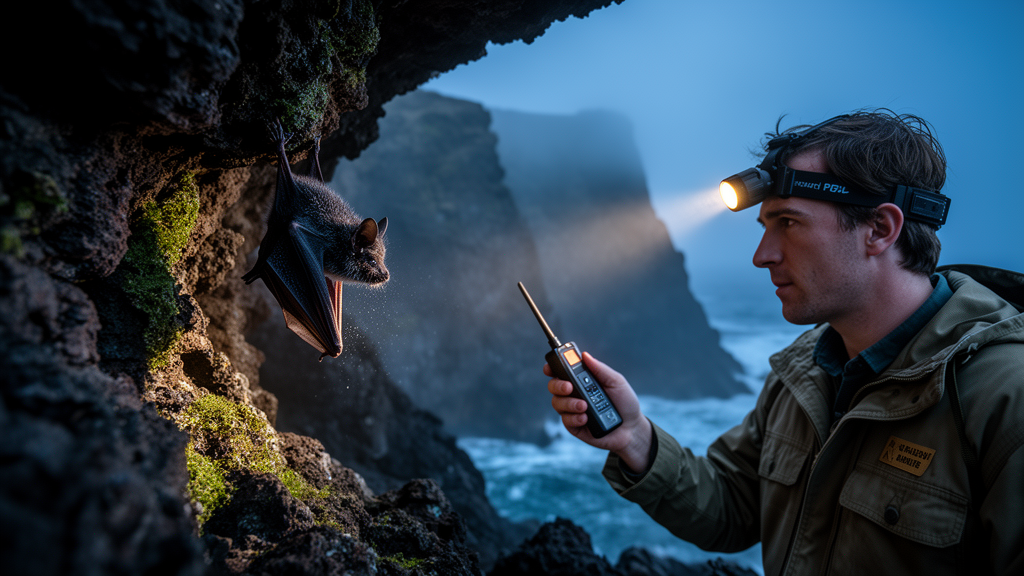
On Flores, the westernmost island of the Azores archipelago, bats have long been little more than a mystery. The island sits roughly 1,400 kilometres west of mainland Portugal and about 2,200 kilometres east of Newfoundland, making it one of the most isolated landmasses in the North Atlantic. For decades, surveys and long-term monitoring suggested that only unidentified pipistrelle bats lived there, and the island’s bat fauna was assumed to be the simplest in the entire archipelago. A new study, published in the journal Web Ecology, has now overturned that assumption. By combining autonomous acoustic recording with mitochondrial DNA analysis, researchers led by Ana Rainho of the University of Lisbon have confirmed that two bat species occur on Flores, including the first record of the endemic Azorean bat on the island.
The Azores host just two confirmed extant bat species, both of them endemics with restricted ranges. The Azorean bat, Nyctalus azoreum, is found nowhere else in the world and has so far been confirmed on seven of the archipelago’s nine islands. The Madeiran pipistrelle, Pipistrellus maderensis, is a Macaronesian endemic that also occurs in Madeira and the Canary Islands. In the western group of the Azores, composed of Flores and the even smaller Corvo, only pipistrelle-type calls had ever been detected acoustically. But recent observations of bats flying during daylight hours on Flores, together with the recovery of a dead pipistrelle specimen, raised questions about what was really living on the island and prompted the new investigation.
The genetic half of the study rested on a single, poignant specimen. In August 2024, a nature conservation ranger recovered a dead bat at Fazenda on the northern coast of Flores. The dark brown adult, with a forearm measuring 32.4 millimetres, bore tears in its wing membranes and lower abdomen, and contextual evidence suggested it had likely been killed by a domestic cat. Researchers excised a three-millimetre puncture of wing tissue, stored it in ethanol, and extracted genomic DNA in the laboratory. They amplified a fragment of the mitochondrial cytochrome b gene by polymerase chain reaction and sequenced it commercially, producing an 814-base-pair sequence that was subsequently deposited in GenBank under accession number PZ699694.
The sequence told an unambiguous story. When compared against public databases, it showed its highest identity, 98.8 percent, with P. maderensis sequences from the Madeira archipelago. To place the Flores bat in a broader geographic context, the team built a median-joining haplotype network from 465 base pairs of cytochrome b, drawing on published sequences from Madeira, Porto Santo, the Canary Islands, and multiple populations of the related Kuhl’s pipistrelle from Europe, North Africa, and the Middle East, alongside Azorean N. azoreum sequences. The Flores specimen fell squarely within the P. maderensis cluster, most closely associated with haplotypes from Madeira and Porto Santo. Intriguingly, the Flores sequence represents a unique haplotype, separated by six mutational steps from the shared Madeira and Porto Santo group and ten steps from the nearest Canarian haplotype, a pattern that hints at either colonisation from the Madeira region or shared ancestry followed by local differentiation in the Azores.
This genetic confirmation carries real weight for Macaronesian biogeography. Although P. maderensis had previously been genetically identified on the Azorean island of Santa Maria, that sequence was never published in a public database, meaning the Flores specimen now constitutes the first publicly available genetic reference for the species in the Azores. Until now, pipistrelle records across most of the archipelago rested on acoustic detections alone, which cannot distinguish P. maderensis from morphologically similar relatives with complete certainty. The new sequence establishes a baseline for future studies of population structure, connectivity, and colonisation history across the scattered island groups of the region, where small founder populations can diverge rapidly in isolation.
The acoustic half of the study was equally revealing. Between 16 and 19 September 2024, the team deployed autonomous AudioMoth recorders at ten sites across Flores, mounted on tree trunks or poles about 1.8 metres above the ground. The devices sampled at 192 kilohertz in a cyclical pattern of four and a half minutes of recording followed by a thirty-second pause, running continuously over consecutive 24-hour periods. Persistent heavy rainfall caused two devices to malfunction, and two remote northwestern sites could not be reached by vehicle, but the remaining ten sites provided broad coverage of the island’s main habitat types. Out of 5,760 recordings, 296 files contained bat activity, yielding a total of 3,862 bat passes, each defined as at least two sequential recognisable echolocation pulses.
The species split within those passes was strikingly lopsided. Pipistrellus maderensis accounted for 99.6 percent of all recorded activity and was detected at every sampled site, confirming its status as the most widespread and acoustically active bat on Flores, with particularly high activity along the northern coast. Nyctalus azoreum, by contrast, contributed just 0.4 percent of passes and was detected only at a handful of sites in the central and southern parts of the island. The two species can be reliably separated acoustically because their echolocation calls occupy similar but non-overlapping frequency ranges: N. azoreum calls peak at around 32.1 kilohertz, while Pipistrellus calls peak at about 45.3 kilohertz. The detection of the Azorean bat at sites that had been surveyed before suggests that earlier non-detections reflected low detectability and lower sampling effort rather than true absence, since previous surveys relied on short-duration hand-held detectors rather than recorders running for days at a time.
Activity patterns followed a strictly nocturnal rhythm. Every call was recorded between sunset at 20:06 and sunrise at 07:47 local time, with no daytime activity detected during the study period, despite N. azoreum being known elsewhere in the archipelago to forage in daylight. Both species remained active throughout the night, tapering off in the hours before dawn. The earliest P. maderensis call came at 20:07 and the latest at 07:30, while N. azoreum activity spanned from 20:23 to 05:40. To test whether the bats favoured particular environments, the researchers classified sites as stream or urban habitats and fitted a negative binomial generalised linear mixed model with the number of passes per night as the response. The effect of species on activity was only marginal, and neither habitat nor the species-by-habitat interaction was statistically significant, suggesting that both species use a range of environments on the island, although the very low number of Azorean bat detections limits any firm conclusions about its habitat preferences.
The findings matter well beyond Flores. Island bat populations are typically small, isolated, and vulnerable to habitat alteration, invasive species, and stochastic events, and previous work has shown substantial genetic structuring among N. azoreum populations, with haplotypes often restricted to individual islands and limited inter-island gene flow. That pattern implies the small Flores population may have little connection to bats elsewhere in the archipelago, raising questions about its long-term viability and the mechanisms that allow it to coexist with the far more abundant pipistrelle. The authors argue that continued monitoring is essential, and they recommend reassessing the occurrence of N. azoreum on neighbouring Corvo using passive acoustic recording, since earlier hand-held surveys there may likewise have missed a rare species. Surveys on São Miguel, Terceira, and Faial, where P. maderensis has not yet been confirmed, could also clarify the pipistrelle’s full distribution.
There is also a sobering conservation note embedded in the data. The only P. maderensis specimen collected during the study was likely predated by a domestic cat, a vivid illustration of the threat that introduced predators pose to island bats worldwide. Cats are increasingly recognised as significant predators of bats on oceanic islands, where native species evolved without such hunters and often roost or forage in accessible places. Combined with the apparent rarity of the Azorean bat on Flores and the vulnerability that comes with small population size, the study underscores a broader lesson: even in a well-studied European archipelago, remote islands can still hide species that only modern, patient, and integrated methods, listening to the night and reading the DNA of a single recovered wing, can bring to light.
Subject of Research: Distribution and conservation of bat species on Flores Island in the Azores, assessed through genetic and bioacoustic monitoring
Article Title: Bats of a remote island: integrated genetic and bioacoustics monitoring confirms species occurrence in Flores (Azores, Portugal)
Article References: Rainho, A., Estácio, C. S., Silva, C. G., & Gabriel, S. I. (2026). Bats of a remote island: integrated genetic and bioacoustics monitoring confirms species occurrence in Flores (Azores, Portugal). Web Ecology, 26(2), 193-202. https://doi.org/10.5194/we-26-193-2026
Image Credits: AI Generated
Keywords: Azores, Flores Island, bats, Nyctalus azoreum, Pipistrellus maderensis, bioacoustics, mitochondrial DNA, island biogeography, conservation, endemic species, haplotype network, invasive predators
Cite Scienmag News
Margaret Porter. (October 8, 2026). Hidden Bats of a Remote Atlantic Island Revealed by DNA and Sound. Scienmag. https://scienmag.com/hidden-bats-of-a-remote-atlantic-island-revealed-by-dna-and-sound/
Margaret Porter. "Hidden Bats of a Remote Atlantic Island Revealed by DNA and Sound." Scienmag, 8 October 2026, https://scienmag.com/hidden-bats-of-a-remote-atlantic-island-revealed-by-dna-and-sound/. Accessed 8 October 2026.
Margaret Porter. "Hidden Bats of a Remote Atlantic Island Revealed by DNA and Sound." Scienmag. October 8, 2026. https://scienmag.com/hidden-bats-of-a-remote-atlantic-island-revealed-by-dna-and-sound/


