


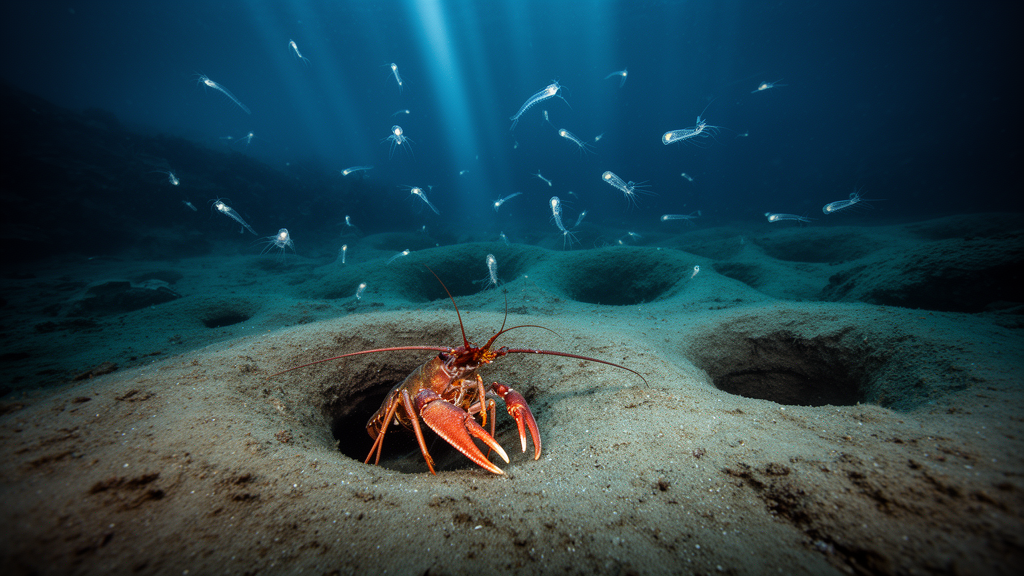
Deep beneath the surface of the northwestern Mediterranean Sea, on muddy continental slopes some 300 to 700 meters down, the Norway lobster Nephrops norvegicus digs its burrows and sustains one of Europe’s most valuable fisheries. But the stocks of this commercially prized, ecologically important species are showing clear signs of overexploitation, and a new study reveals that the network of marine protected areas designed to rescue them may be far less effective than hoped. By simulating the oceanic journeys of more than half a million virtual larvae over twelve years, researchers have produced the first connectivity-based assessment of the region’s deep-sea MPA network, and their findings carry a striking message: the current protected areas shield only a tiny fraction of settling larvae, and even modest, strategically placed additions could dramatically improve the odds of recovery.
The stakes extend well beyond a single shellfish. The Norway lobster is considered an umbrella species for benthic ecosystems, because its constant burrowing bioturbates the sediment, oxygenating and remineralizing the seafloor in ways that promote infaunal diversity and overall habitat quality. In the northwestern Mediterranean, France established three demersal fishery no-take zones in 2018, and Spain followed in 2022 with a network of 27 such zones. Of the 30 protected areas, ten overlap the lobster’s preferred depth range, and four were specifically created to support its recovery. Yet only one of these sites has ever been monitored to evaluate whether lobster populations are actually bouncing back, and the question of whether larvae spawned inside one reserve ever reach another had never been systematically addressed.
To answer it, the research team combined a high-resolution hydrodynamic reanalysis of the Mediterranean with an individual-based model of larval transport. Daily current velocities, temperatures, and salinities from the Copernicus Marine Service, resolved at roughly 4 to 5 kilometers horizontally across 141 vertical layers, drove the movement of 566,115 particles per simulation, a number chosen to capture 95 percent of dispersal variability in the study area. Each particle represented a single larva tracked for up to 45 days, the assumed duration needed to reach the postlarval stage at typical winter bottom temperatures of around 13 degrees Celsius. The model domain stretched from the Gulf of Lion down to the Balearic Islands and the Ibiza Channel, capturing the Northern Current as it follows the continental slope.
What makes the simulation technically notable is its biological realism. Larval development in Nephrops follows empirical relationships in which pelagic larval duration shrinks exponentially as water temperature rises, and the model tracked three distinct zoeal stages plus the postlarva, each with its own temperature-dependent timetable. Vertical behavior was equally stage-specific: the first zoea ascends to the surface and begins diel vertical migrations, the second remains near the surface with daily migrations, and the third descends toward the seabed. Swimming speeds and directions were drawn stochastically from published distributions, and larvae were released at midnight on mid-winter dates between 2010 and 2022, reflecting the species’ spawning phenology. Sixty simulations in total, five release dates across twelve years, allowed the team to separate persistent connectivity patterns from year-to-year noise.
The results paint a sobering picture of the existing network. Between 24 and 33 percent of modelled larvae settled in predicted suitable habitat, while roughly half settled in deeper areas outside it. Settlement hotspots clustered around the Cap de Creus canyon complex, the Palamos Canyon, the northern margin of the Blanes Canyon, and the central Ebro continental slope, with additional concentrations near the Balearic Islands. Yet of all the larvae settling across the region, the existing MPA network protected just 2.8 percent. Only two of the reserves specifically designated for lobster recovery, the Barcelona and Vilanova sites, stood out with high modelled settlement densities of about 21 larvae per square kilometer, and their larval origins shifted markedly from year to year, tracing back to sources from the Gulf of Lion to the widening of the Ebro Shelf.
Interannual variability emerged as a central theme. Most protected areas maintained only one to two connections per year, with an average link frequency below 0.3, meaning larval exchange between reserves was both weak and inconsistent. No single site established stable links throughout the entire twelve-year period. Three reserves, however, showed relatively persistent connectivity, likely because of their oceanographic setting in a region influenced by retentive mesoscale eddies, and in one case simply because a larger area of roughly 225 square kilometers increases the probability of repeated connections. At the northern edge of the network, one reserve connected to a different neighbor every year and never repeated a link, marking it as clearly peripheral. These findings underscore that where a reserve sits relative to oceanographic features can matter as much as its size.
To identify where new protection would help most, the team turned to Eigen Perturbation Theory, a mathematical framework that treats the larval exchange between habitat patches as a network and uses the dominant eigenvectors of the connectivity matrix to rank each site’s contribution to overall connectivity. Perturbation analysis then estimates how protecting a candidate site would perturb, and ideally improve, the network’s performance. Applied to the twelve years of simulated larval trajectories, this approach generated two scenarios: an expanded network adding 30 candidate sites near existing reserves, and an entirely redesigned network of 16 sites. Five sites appeared in both scenarios, and two of the redesigned candidates emerged as key stepping stones linking the northern and southern halves of the network.
The improvements were substantial. Larval settlement in suitable habitat rose by 4.5 percent under the expanded network and by 8.1 percent under the full redesign, compared with the current configuration. Both alternatives also increased the number of annual links between reserves, raised the probability of repeated connections, and produced more stable particle flows, all indicators of a network better able to sustain populations through environmental fluctuations. Encouragingly, both configurations enhanced larval supply to fishing grounds as well, suggesting that connectivity-informed protection can deliver ecological and socio-economic benefits simultaneously. The researchers note that a realistic path forward may involve merging the two scenarios and prioritizing the highest-performing sites, since many of the best candidates lie in French waters while the conservation benefits would primarily support Spanish fisheries, a jurisdictional complication that pure science cannot resolve.
The study also sounds a warning about a warming sea. Over the simulation period, water temperature during the larval phase rose by nearly 0.6 degrees Celsius, corresponding to a two-day reduction in pelagic larval duration, even as daily transport distances remained stable at 3.3 to 8.2 kilometers per day. As Mediterranean circulation continues to shift, particularly in the northern Balearic Sea, the retention patterns that currently sustain some southern reserves could weaken, and species with narrow habitat requirements and limited adult mobility are especially vulnerable. The authors argue that connectivity analyses, especially when extended to projected future conditions, can identify persistent settlement areas that may function as climate refugia, informing climate-resilient MPA design. Their framework, which is readily transferable to other species with modelable connectivity, offers policymakers a concrete tool for the EU’s 30-by-30 commitment: even within political and practical constraints, targeted, evidence-based adjustments to protected area networks can yield measurable gains for deep-sea recovery in a rapidly changing ocean.
Subject of Research: Larval connectivity modelling to optimise marine protected area networks for Norway lobster recovery in the NW Mediterranean Sea
Article Title: Optimising Connectivity in Deep‐Sea MPA Networks for Nephrops norvegicus Recovery in NW Mediterranean Sea
Article References: Clavel‐Henry, M., Bahamon, N., López, M., Aguzzi, J., Navarro, J., & Company, J. B. (2026). Optimising Connectivity in Deep‐Sea MPA Networks for Nephrops norvegicus Recovery in NW Mediterranean Sea. Ecology and Evolution, 16(10), Article e74447. https://doi.org/10.1002/ece3.74447
Image Credits: AI Generated
DOI: 10.1002/ece3.74447
Keywords: Norway lobster, Nephrops norvegicus, marine protected areas, larval dispersal, connectivity, NW Mediterranean, deep-sea conservation, Eigen Perturbation Theory, fisheries management, climate change, biophysical modelling, MPA network design
Cite Scienmag News
Margaret Porter. (October 8, 2026). Rethinking Deep-Sea Protected Areas: Larval Highways Hold the Key to Norway Lobster Recovery. Scienmag. https://scienmag.com/rethinking-deep-sea-protected-areas-larval-highways-hold-the-key-to-norway-lobster-recovery/
Margaret Porter. "Rethinking Deep-Sea Protected Areas: Larval Highways Hold the Key to Norway Lobster Recovery." Scienmag, 8 October 2026, https://scienmag.com/rethinking-deep-sea-protected-areas-larval-highways-hold-the-key-to-norway-lobster-recovery/. Accessed 8 October 2026.
Margaret Porter. "Rethinking Deep-Sea Protected Areas: Larval Highways Hold the Key to Norway Lobster Recovery." Scienmag. October 8, 2026. https://scienmag.com/rethinking-deep-sea-protected-areas-larval-highways-hold-the-key-to-norway-lobster-recovery/


