


A team of materials scientists at the North University of China in Taiyuan has shown that a single, seemingly mundane variable — the temperature at which a metal-organic framework is heated until it carbonizes — can make the difference between a mediocre battery anode and one that keeps delivering substantial capacity even at punishingly fast charging rates. Writing in the journal Ionics, Yihang Tian, Kai Yuan, Yongping Qu and their colleagues describe how pyrolyzing the cobalt-based zeolitic imidazolate framework ZIF-67 at three different temperatures produces nitrogen-doped carbon nanotubes with dramatically different microstructures, and how the material fired at 700 degrees Celsius emerges as the clear winner for lithium-ion storage.
ZIF-67 is a crystalline scaffold in which cobalt ions are linked by organic imidazolate ligands into a porous, cage-like architecture. Materials chemists love such frameworks because, when heated in an inert atmosphere, they collapse in a controlled way: the cobalt nodes catalyze the growth of carbon nanotubes while the organic struts supply the carbon and nitrogen. The result is a self-assembling composite in which conductive carbon tubes are threaded with metallic cobalt and doped with nitrogen atoms — precisely the combination of conductivity, catalytic activity and defect chemistry that battery engineers seek in an anode. But the final product is exquisitely sensitive to how hot the furnace gets, and until now the trade-offs had not been systematically mapped for this system.
The researchers prepared three samples, carbonized at 500, 700 and 900 degrees Celsius, and labeled them N-CNTs-500, N-CNTs-700 and N-CNTs-900. At 500 degrees the framework conversion is incomplete, leaving a poorly developed carbon network. At 900 degrees the tubes grow more fully but the nitrogen dopants begin to burn off and the structure coarsens. The 700-degree middle ground proved to be the sweet spot: semi-closed nitrogen-doped carbon nanotubes that encapsulate cobalt clusters, a high specific surface area of 352.66 square meters per gram, and an abundance of the pyrrolic and pyridinic nitrogen configurations, along with cobalt coordinated to nitrogen in Co-Nx sites, that give doped carbons their electrochemical personality.
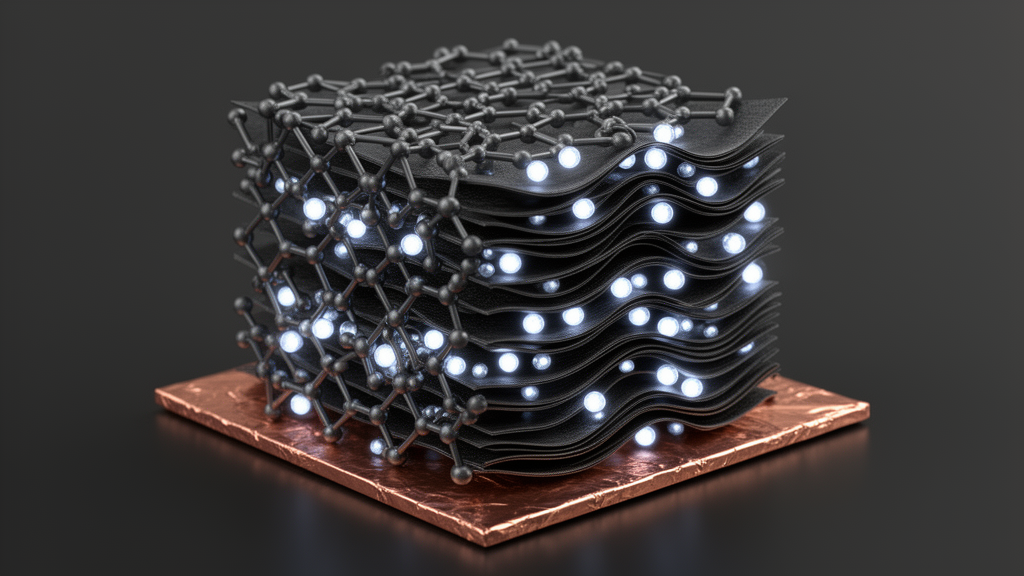
One of the most intriguing findings concerns the atomic geometry of the carbon itself. In ordinary graphite, carbon atoms sit in flat hexagonal sheets stacked 0.335 nanometers apart. The 700-degree material instead shows an expanded interlayer spacing of 0.381 nanometers, which the authors attribute to five-membered carbon rings that warp the sheets into curved, saddle-shaped regions the paper describes as Riemann surfaces — a mathematical term borrowed from differential geometry to describe locally non-Euclidean curvature. Those five-membered rings act like wedges inserted into the hexagonal lattice, forcing the planes apart and creating extra room for lithium ions to slip between the layers and additional sites for them to bind.
The electrochemical payoff is striking. At a modest current density of 0.1 amperes per gram, the N-CNTs-700 anode delivers a reversible capacity of 970.1 milliampere-hours per gram — roughly two and a half times what commercial graphite manages. More importantly for real-world fast charging, it still retains 356.2 milliampere-hours per gram when the current is cranked up to 8 amperes per gram, an eighty-fold increase in rate, and it sustains 130 milliampere-hours per gram after 1,000 cycles at 3 amperes per gram. Both the 500-degree and 900-degree analogues fall well short on every count, confirming that the microstructure, not merely the chemical composition, governs performance.
The team traces the high-rate capability to a synergy between two features of the material. The first is the conductive nanotube network itself, which provides highways for electrons and short diffusion distances for ions. The second is the dense population of nitrogen defects, which does something subtler: it introduces what electrochemists call extrinsic pseudocapacitance, meaning lithium ions are stored at defect sites through fast, surface-like charge-transfer reactions rather than slow solid-state diffusion. Because pseudocapacitive storage does not depend on ions burrowing deep into a crystal lattice, it can keep pace with very high charging currents — the fundamental reason capacitors charge in seconds while batteries normally take hours.
The nitrogen defects also reshape the solid-electrolyte interphase, the thin reaction layer that forms on any anode the moment it touches electrolyte. The SEI is a double-edged entity: it must exist to passivate the surface, but if it is thick, resistive or chemically heterogeneous it throttles the very ions it is supposed to conduct. The authors report that their material promotes a bilayer SEI with an inorganic-rich inner layer and an organic-rich outer layer. Inorganic components such as lithium fluoride, which the paper’s keywords highlight, are mechanically robust and ionically conductive, while the organic exterior cushions the interface. This architecture effectively lowers the energy barrier for desolvation — the step in which a lithium ion sheds its shell of solvent molecules before entering the electrode — and reduces interfacial charge-transfer resistance, the kinetic bottleneck that most limits fast charging.
That desolvation insight connects this work to a broader frontier in battery science. In recent years, researchers have come to appreciate that the speed limit of a lithium-ion cell is often set not inside the electrode but at its surface, where ions must be stripped of their solvation shells and pushed across a resistive interface. Strategies ranging from electronegative surface coatings to dipole-engineered electrolytes have been pursued to lower this barrier. The Taiyuan study adds a materials-design route to that toolbox: by tuning the defect chemistry of the carbon itself, the interface that forms on it self-organizes into a structure that welcomes lithium ions rather than repelling them.
The Riemann-surface concept likewise builds on an emerging theme. Previous work has shown that locally curved carbon surfaces, whether engineered in hard carbons or in sp2/sp3-hybridized networks, can unlock lithium storage at extreme low temperatures and boost capacity beyond what flat graphite allows, because curvature disrupts the ordered stacking that limits ion insertion. By showing that five-membered-ring-induced curvature arises naturally during the temperature-controlled pyrolysis of a cobalt zeolitic imidazolate framework, the new study suggests a scalable, synthesis-driven way to bake that geometry into an anode without exotic processing steps.
For a field racing toward batteries that charge in minutes without sacrificing lifespan, the message of the Ionics paper is that the furnace dial matters as much as the recipe. A 200-degree shift in pyrolysis temperature transformed the same starting framework from a sluggish electrode into one that pairs near-graphite-beating capacity with genuine high-rate endurance, thanks to expanded interlayer spacing, defect-rich nitrogen chemistry, encapsulated cobalt catalysts and a self-assembled, inorganic-rich protective film. The authors position their systematic temperature map as a foundation for the rational design of high-rate anodes based on ZIF-67-derived carbons — and, by extension, a template for anyone engineering MOF-derived carbons where atomic-scale curvature and interfacial chemistry, not just surface area, decide who wins the fast-charging race.
Subject of Research: Temperature-controlled pyrolysis of ZIF-67 into nitrogen-doped carbon nanotubes for high-rate lithium-ion battery anodes
Article Title: Temperature-tailored pyrolysis of ZIF-67 into N-Doped carbon nanotubes: Riemann Surface distortion, robust inorganic-rich SEI, and high-rate lithium storage
Article References: Temperature-tailored pyrolysis of ZIF-67 into N-Doped carbon nanotubes: Riemann Surface distortion, robust inorganic-rich SEI, and high-rate lithium storage. (n.d.). https://doi.org/10.1007/s11581-026-07527-7
Image Credits: AI Generated
DOI: 10.1007/s11581-026-07527-7
Keywords: ZIF-67, metal-organic framework, nitrogen-doped carbon nanotubes, pyrolysis, lithium-ion batteries, anode materials, Riemann surfaces, solid-electrolyte interphase, pseudocapacitance, fast charging, cobalt clusters, Co-Nx sites
Cite Scienmag News
Faith Mcneil. (October 8, 2026). Curved Carbon From a Cobalt Framework Supercharges Fast-Charging Battery Anodes. Scienmag. https://scienmag.com/curved-carbon-from-a-cobalt-framework-supercharges-fast-charging-battery-anodes/
Faith Mcneil. "Curved Carbon From a Cobalt Framework Supercharges Fast-Charging Battery Anodes." Scienmag, 8 October 2026, https://scienmag.com/curved-carbon-from-a-cobalt-framework-supercharges-fast-charging-battery-anodes/. Accessed 8 October 2026.
Faith Mcneil. "Curved Carbon From a Cobalt Framework Supercharges Fast-Charging Battery Anodes." Scienmag. October 8, 2026. https://scienmag.com/curved-carbon-from-a-cobalt-framework-supercharges-fast-charging-battery-anodes/


