


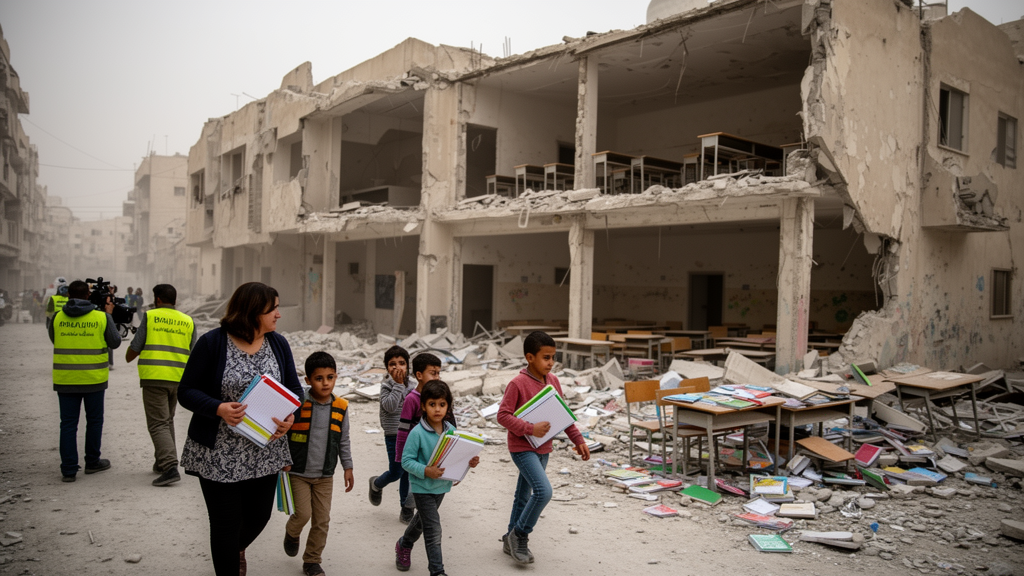
A group of researchers writing in The BMJ has issued a forceful call to the international community: deliberate attacks on a society’s education system during armed conflict, a phenomenon the authors describe as scholasticide, must be publicly condemned as a war crime and its perpetrators held to account. The editorial, led by Dr Rana Dajani of the Hashemite University in Jordan and colleagues, argues that the systematic destruction of schools, universities, and academic infrastructure is not merely a series of isolated tragedies but a coordinated degradation of the foundations on which health, healthcare, and scientific capacity depend. The authors point to recent attacks in Palestine, Iran, Colombia, the Democratic Republic of Congo, Ethiopia, Haiti, and Ukraine as evidence that the problem is global in scope and growing in severity.
The scale of destruction documented in the editorial is stark. According to figures cited from the United Nations, Israeli airstrikes over the past three years have severely damaged or destroyed more than 90 percent of school buildings in Gaza, disrupting education for all 658,000 children in the territory. The British Society for Middle Eastern Studies, as referenced by the authors, reports that every university in Gaza has been destroyed and that more than 200 academics have been killed. These numbers, the editorial argues, represent something qualitatively different from the incidental collateral damage that accompanies most warfare. They describe a pattern in which the institutions that produce knowledge, train physicians and engineers, and transmit collective memory from one generation to the next are themselves targeted.
The authors are careful to define why scholasticide deserves its own category of concern. Beyond the immediate harm to individuals, the damage to buildings, and the interruption of lessons, they identify a systemic degradation with direct consequences for health and healthcare. Universities are not simply places of learning; they are the training grounds for the medical workforce, the research infrastructure for public health, and the institutional memory of a society. When universities and hospitals are destroyed, the editorial notes, it can take decades after fighting ceases to restore both the physical infrastructure and the trained staff who once populated it. A destroyed teaching hospital cannot produce the surgeons, nurses, and epidemiologists a recovering society needs, and a destroyed laboratory cannot monitor disease outbreaks or rebuild agricultural systems.
The consequences for children are equally profound and long-lasting. Interrupted education exposes young people to long-term learning loss, diminishes their future opportunities, and undermines the economic rebuilding that must follow any cessation of hostilities. A generation that misses years of schooling carries that deficit into adulthood, reducing earning potential, weakening civic institutions, and slowing the transfer of technical knowledge. The authors frame this as a form of harm that compounds over time: the longer education systems remain disrupted, the more difficult and expensive reconstruction becomes, and the deeper the scars on a society’s human capital.
At the heart of the editorial is a legal argument. International humanitarian law strictly prohibits attacks on civilian infrastructure for essential services, including schools and hospitals, the authors explain. These protections are not aspirational statements but binding obligations on parties to any conflict, codified in the Geneva Conventions and their additional protocols, which classify civilian objects as immune from attack and deliberate targeting of them as a violation amounting to a war crime. Yet the authors observe that such attacks have rarely been formally investigated or sanctioned. This gap between the letter of the law and its enforcement, they argue, weakens confidence in the universal rule of law and signals to belligerents that the destruction of educational institutions carries no meaningful cost.
The impunity problem, as the authors frame it, is therefore structural rather than incidental. When violations of international humanitarian law go uninvestigated, the deterrent effect of the law erodes. Perpetrators learn that condemnation is rhetorical and accountability is optional. The editorial insists that restoring the credibility of a law-based global order demands that perpetrators of scholasticide be held to account, and that this accountability must be visible, public, and consequential. Without it, the protections that nominally shield schools and hospitals in wartime become words on paper rather than constraints on conduct.
To close that gap, the authors advance a concrete set of demands directed at the international community. They call for the application of economic and trade sanctions against perpetrators of scholasticide, a measure designed to impose real material costs on states and armed groups that target education systems. They further call for the prosecution of the sale of arms that are likely to be used for violations of international humanitarian law, placing responsibility not only on those who fire the weapons but on the states and companies that supply them when the foreseeable use is unlawful. Arms transfer regimes under international law already require exporting states to assess the risk that weapons will be used in serious violations, and the authors argue that this obligation should be enforced with respect to attacks on schools and universities.
Beyond governments, the editorial addresses universities, professional bodies, and civil society worldwide. The authors urge these institutions to consider adopting boycott and divestment policies until compliance with international law is assured. This appeal situates academic and professional communities as actors with leverage of their own: research partnerships, institutional investments, and professional collaborations can be conditioned on respect for the legal protections that education systems enjoy in wartime. The authors themselves embody this engagement; the declared interests accompanying the editorial note that Dr Dajani co-runs the Palestine Scholars project to commemorate killed academics in Gaza, while the other co-authors declare no competing interests, and The BMJ judged that there were no disqualifying financial ties to commercial companies.
The editorial’s central claim is distilled in the authors’ own words: Education sustains a society’s knowledge production and its collective identity and memory. It is essential to health and healthcare. Scholasticide is a war crime that must end. Restoring human capital, scientific capacity, and institutional continuity are vital. And law based global order demands that perpetrators be held to account. The statement links the fate of education to the fate of medicine and science directly. Medical research and training depend on universities, laboratories, and teaching hospitals; when those institutions are destroyed, the pipeline of clinicians and researchers dries up for a generation, and the health consequences of war are extended decades beyond the ceasefire.
Published as a commentary in The BMJ on 9 September 2026, the editorial arrives at a moment when the documented destruction of educational infrastructure in multiple conflicts has made the question of enforcement impossible to ignore. Its authors do not claim that condemnation alone will stop the attacks; rather, they argue that the combination of public condemnation, sanctions, arms trade accountability, and institutional pressure from the academic and professional world can begin to restore the deterrence that international humanitarian law is meant to provide. The message to the international community is unambiguous: the protection of schools and universities in war is not a humanitarian luxury but a legal obligation, and the era of impunity for those who violate it should come to an end.
Subject of Research: Deliberate attacks on education systems in armed conflict and accountability under international humanitarian law
Article Title: End impunity for targeted attacks on schools and universities, urge experts
Article References: End impunity for targeted attacks on schools and universities, urge experts. (n.d.). Original publication
Image Credits: AI Generated
DOI: Not provided
Keywords: scholasticide, The BMJ, international humanitarian law, war crimes, Gaza, education in conflict, academic freedom, accountability, arms trade, university destruction, children's education, Rana Dajani
Cite Scienmag News
Courtney Benton. (October 8, 2026). Experts Demand Accountability as Scholasticide Devastates Education in War Zones. Scienmag. https://scienmag.com/experts-demand-accountability-as-scholasticide-devastates-education-in-war-zones/
Courtney Benton. "Experts Demand Accountability as Scholasticide Devastates Education in War Zones." Scienmag, 8 October 2026, https://scienmag.com/experts-demand-accountability-as-scholasticide-devastates-education-in-war-zones/. Accessed 8 October 2026.
Courtney Benton. "Experts Demand Accountability as Scholasticide Devastates Education in War Zones." Scienmag. October 8, 2026. https://scienmag.com/experts-demand-accountability-as-scholasticide-devastates-education-in-war-zones/


