


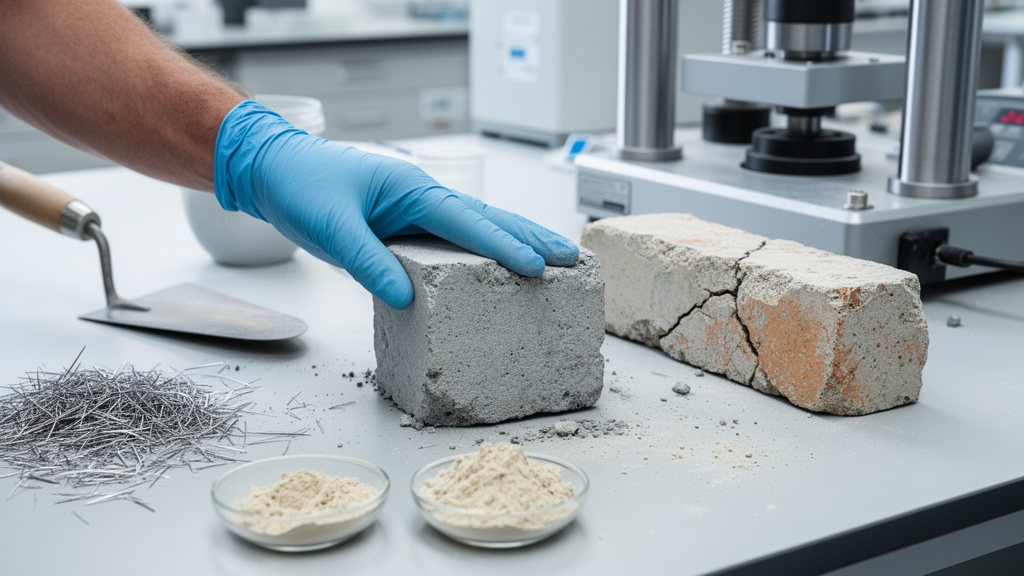
Concrete may look monolithic and unyielding, but at the microscopic scale it is a labyrinth of connected pores through which water, chloride ions, and other aggressive agents slowly travel, corroding steel reinforcement and degrading structures from the inside out. A new study published in Results in Engineering by Dorsa Taghvaei, Pouriya Behzad, Setareh Ghaderan, and Mohammad Ali Dastan Diznab shows that two humble additives—a porous ceramic called Lightweight Expanded Clay Aggregate (LECA) and hair-thin polypropylene fibers—can work together to reshape that labyrinth in ways that boost both strength and durability. The findings offer a recipe for lighter cementitious materials that do not sacrifice the mechanical performance engineers demand.
LECA is a manufactured aggregate produced by expanding clay at high temperature, yielding hard, spherical granules riddled with internal voids. Because it weighs far less than natural sand and gravel, it is attractive for lightweight concrete, which reduces structural dead load and improves thermal and acoustic insulation while lowering cost. The catch is well documented: previous studies found that replacing natural aggregate with LECA can significantly weaken concrete. Corinaldesi and Moriconi reported compressive strength losses of roughly 18 to 28 percent when natural sand was replaced with LECA in self-compacting concrete, and Youm and colleagues found that coarse LECA reduced splitting tensile strength, compressive strength, and elastic modulus by up to nearly 48 percent. Polypropylene fibers, meanwhile, are known to stitch microcracks together and improve toughness, but above roughly 0.3 percent by weight of cement they tend to clump and ball during mixing, degrading the mix rather than improving it.
The Iranian research team set out to explore the underexplored middle ground: what happens when a modest 10 percent of sand is replaced by volume with LECA and a modest 0.2 percent by volume of polypropylene fibers is added, individually and in combination? They prepared four mortar mixes with a constant cement content of 670 kilograms per cubic meter and a water content of 302 kilograms per cubic meter: a plain control mix (P0L0), a mix with 10 percent LECA (P0L10), a mix with 0.2 percent fibers (P0.2L0), and a hybrid containing both (P0.2L10). The LECA had dry and saturated surface-dry densities of 1542 and 1704 kilograms per cubic meter with 5.0 percent water absorption, while the fibers were 12 millimeters long, 19 micrometers in diameter, with a tensile strength of 400 megapascals. Fibers were added gradually in several steps to ensure uniform dispersion, and cube and prismatic specimens were water-cured and tested at 3, 7, 14, and 28 days.
The compressive strength results reveal a striking early-age reversal. Replacing sand with LECA alone cut the 3-day strength from 19.20 to 15.87 megapascals, a drop of about 17.4 percent, as expected from the porous, weaker aggregate. Yet by 14 and 28 days the LECA mix had overtaken the control, with gains of 23.8 and 18.2 percent respectively. The authors attribute this to LECA’s internal water reservoir effect: the porous aggregate absorbs mixing water early and gradually releases it during hydration, densifying the cement matrix and strengthening the bond between paste and aggregate over time. Fibers alone had little effect at 3 days but raised 7-day strength by about 26.9 percent, from 24.27 to 30.80 megapascals, by bridging and restraining early microcracks during setting.
The hybrid mix delivered the best of both worlds early on. Combining LECA and fibers lifted 3-day compressive strength by roughly 23 percent, to 23.60 megapascals, and 7-day strength by about 25 percent, to 30.27 megapascals, compared with the control. At 28 days, however, the benefit largely evaporated: the hybrid reached only 32.80 megapascals, a marginal 2 percent gain over the control and slightly below the LECA-only mix. The researchers explain that by later ages the fiber-induced voids and weak fiber–matrix interfaces begin to offset LECA’s hydration benefits. Interestingly, the standard logarithmic strength-versus-time model fit the fiber-containing mixes poorly, with a bi-linear relationship describing their development better.
Flexural strength told an even more compelling story. LECA alone reduced early flexural strength, dropping the 3-day value from 6.43 to 4.70 megapascals and the 7-day value by about 16.5 percent, because its porous structure weakens the aggregate–paste interface. Fibers alone slightly hurt 3-day flexural strength but boosted it substantially from 7 to 28 days, reaching 11.69 megapascals at 28 days, thanks to their crack-bridging action under bending stresses. The hybrid mix, however, produced the highest flexural strength at every single age tested: 6.74, 7.95, 9.12, and 10.75 megapascals at 3, 7, 14, and 28 days respectively. Continued hydration refined the matrix while the fibers delayed crack propagation, a synergy that proved most valuable precisely where concrete is most vulnerable—under tension at early ages.
Durability was probed with two complementary techniques. In the Rapid Chloride Migration Test, performed according to AASHTO TP64 on 28-day cylinders, a 60-volt direct field drives chloride ions from a sodium chloride solution into the specimen for about 18 hours, after which silver nitrate spraying reveals the penetration depth. The control mix showed a migration rate of 0.0123 millimeters per volt-hour. Adding 10 percent LECA reduced this by about 4.9 percent to 0.0117, an improvement the authors link to increased tortuosity of transport pathways. Fibers alone left migration essentially unchanged, and the hybrid mix measured 0.0125, only marginally above the control. Electrical conductivity, measured with an alternating-current system to avoid polarization errors, dropped noticeably in the LECA mixes, from 0.0370 to 0.0339 per ohm-meter, confirming that the lightweight aggregate interrupts the continuous capillary pore network that normally serves as the highway for ion movement.
Scanning electron microscopy helped explain why apparent porosity and actual transport do not always go hand in hand. Images of LECA-containing specimens revealed abundant spherical voids up to 188 micrometers across, and in the hybrid mix up to 395 micrometers, yet these belong largely to the sealed interior of the LECA particles themselves, whose impervious outer shell and dense interfacial transition zone keep them out of the connected pore network. Fluid and ion transport occurs mainly through the fine capillary pores of the cement paste, and LECA particles interrupt that network, forcing ions onto longer, more winding paths. The microscopy also exposed a subtle trade-off with the fibers: hydrophobic polypropylene bonds poorly to the hydrophilic cement matrix, creating micro-gaps of roughly 15 to 30 micrometers around the filaments and at the LECA interface. These gaps do not connect into continuous channels, but under the sustained 60-volt field of the migration test they can act as local weak zones, which is why the hybrid mix showed slightly higher chloride migration despite lower overall conductivity.
The broader significance lies in the balance achieved. Previous studies in which large amounts of lightweight aggregate weakened the matrix, or in which high fiber dosages caused clustering and non-uniform transport, suggest that more is not better. By capping LECA at 10 percent sand replacement and fibers at 0.2 percent by volume, the researchers produced a composite that reaches 32.80 megapascals in compression and 10.75 megapascals in flexure at 28 days, resists bulk ion transport by disrupting continuous capillary pathways, and weighs measurably less than the control, at 2.03 versus 1.92 grams per cubic centimeter for the LECA mixes. For infrastructure exposed to chlorides—marine structures, bridge decks, and pavements subjected to de-icing salts—such a material could extend service life while reducing structural weight. The study also delivers a methodological caution: mechanical strength alone does not capture durability, and pairing migration testing with conductivity measurements, as this team did, reveals transport behavior that strength data alone would hide. As lightweight and fiber-reinforced concretes move toward wider structural use, this kind of coupled mechanical–transport–microstructural framework may become the standard by which new mixes are judged.
Subject of Research: Mechanical and durability characterization of polypropylene fiber-reinforced mortar containing lightweight expanded clay aggregate
Article Title: RCMT, electrical conductivity, and mechanical characterization of polypropylene fiber-reinforced LECA mortar
Article References: Taghvaei, D., Behzad, P., Ghaderan, S., & Dastan Diznab, M. A. (2026). RCMT, electrical conductivity, and mechanical characterization of polypropylene fiber-reinforced LECA mortar. Results in Engineering, 32, Article 113256. https://doi.org/10.1016/j.rineng.2026.113256
Image Credits: AI Generated
DOI: 10.1016/j.rineng.2026.113256
Keywords: LECA, polypropylene fibers, lightweight concrete, chloride migration, electrical conductivity, compressive strength, flexural strength, durability, pore structure, SEM, cement mortar, RCMT
Cite Scienmag News
Denise Maddox. (October 8, 2026). Lightweight Clay and Tiny Fibers Team Up to Make Tougher, More Durable Mortar. Scienmag. https://scienmag.com/lightweight-clay-and-tiny-fibers-team-up-to-make-tougher-more-durable-mortar/
Denise Maddox. "Lightweight Clay and Tiny Fibers Team Up to Make Tougher, More Durable Mortar." Scienmag, 8 October 2026, https://scienmag.com/lightweight-clay-and-tiny-fibers-team-up-to-make-tougher-more-durable-mortar/. Accessed 8 October 2026.
Denise Maddox. "Lightweight Clay and Tiny Fibers Team Up to Make Tougher, More Durable Mortar." Scienmag. October 8, 2026. https://scienmag.com/lightweight-clay-and-tiny-fibers-team-up-to-make-tougher-more-durable-mortar/


