


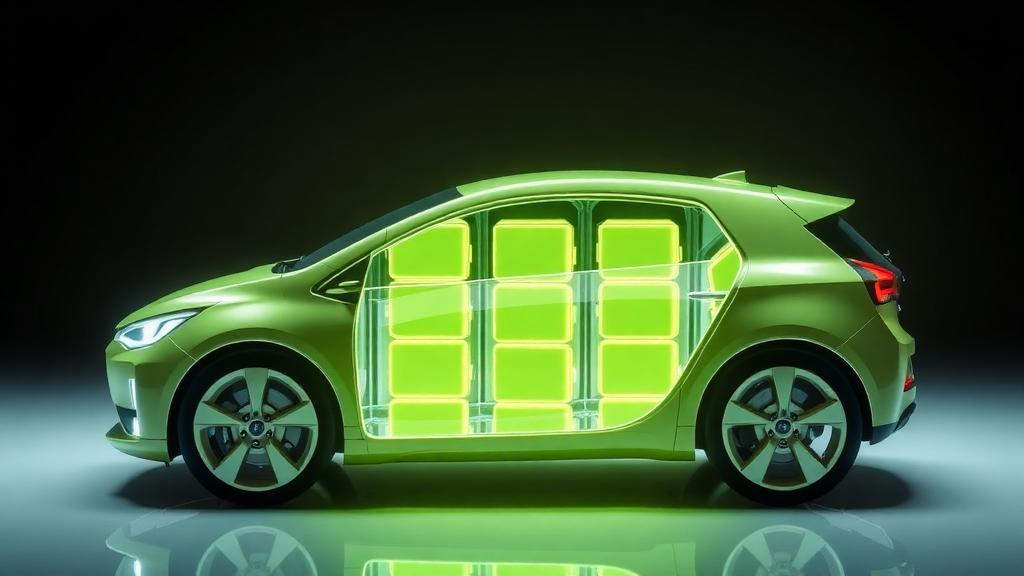
Electric vehicle batteries are often described as a single component, but in reality a modern pack is a vast assembly of hundreds, sometimes thousands, of individual lithium-ion cells wired together in series and parallel to deliver the voltage and energy a vehicle demands. Each of those cells is a small electrochemical system with its own manufacturing tolerances, temperature history, and aging trajectory. Even when cells leave the factory nearly identical, they do not degrade at the same rate. Over years of charging cycles, thermal swings, and varying loads, differences emerge, and those differences matter enormously. A new study led by researchers at Chalmers University of Technology in Sweden, published in Nature Communications, quantifies just how much they matter, and demonstrates that a fundamentally different way of wiring a battery pack could unlock more than 20 percent additional lifespan in certain vehicles while simultaneously lowering the total cost of ownership over the battery’s lifetime.
The core problem the Chalmers team set out to address is elegantly simple to state and stubbornly difficult to solve. In today’s battery architectures, cells are connected in fixed configurations, and because they are bound together electrically, the performance of the entire pack is constrained by its weakest member. Albert Škegro, a doctoral student at the Department of Electrical Engineering at Chalmers and first author of the study, uses a vivid physical analogy to describe the situation. He likens the cells to individuals connected by a rope, all trying to move forward. Because they are tethered to one another, everyone must keep pace with the slowest cell and must stop entirely when that cell stops. In electrochemical terms, when one cell in a series string reaches the end of its usable capacity or its voltage limits, the whole string must stop charging or discharging, even if neighboring cells still hold substantial usable energy. That stranded capacity is effectively lost every single cycle, and as the weakest cell continues to age faster than its peers, the gap widens and the pack’s useful life shrinks.
This weakest-link phenomenon is not a new observation. Previous research, including a recently published study co-authored by Chalmers researcher Changfu Zou, had already established that cell-to-cell differences play a decisive role in the performance and lifespan of electric vehicle batteries, and that the weakest cells clearly limit the entire battery pack. What makes the new work significant is that it moves beyond diagnosis to a system-level assessment of a potential cure. The researchers mapped the benefits of so-called reconfigurable battery packs, in which switches and control systems can dynamically change the electrical connections between cells. Instead of a fixed topology locked in at the factory, a reconfigurable pack can reroute current around a cell that is underperforming, allowing the remaining healthy cells to keep contributing their full capacity to the vehicle. The battery, in effect, becomes an adaptive structure that can reorganize itself as its components age at different rates.
The modeling results are striking. In the researchers’ simulations, the most advanced version of the concept, in which each individual cell can be controlled separately, extends the lifespan of the battery by more than 20 percent in some high-voltage vehicles, such as electric trucks and long-range electric cars. Those vehicle classes benefit most because they contain many series-connected cells, which multiplies the statistical likelihood that at least one cell will lag behind the rest and drag down the pack. Škegro captures the promise of the approach directly: with the solution in the study, the battery can bypass the cell that is causing problems and continue forward, rather than being held back by it. The researchers are careful to note, however, that the 20 percent figure represents a theoretical upper limit under optimal conditions. In practice, controlling every cell individually would require a large amount of additional electronics, and manufacturers are more likely to control groups of cells together, which captures a portion, though not all, of the available benefit.
That nuance is central to how the Chalmers team frames the technology’s future. Changfu Zou, Professor at the Department of Electrical Engineering at Chalmers and co-author of the study, emphasizes that reconfiguration is not a binary choice between fully dynamic control and none at all. It is a spectrum, he explains, and where a manufacturer chooses to sit on that spectrum determines how much of the potential benefit can be realized. A design that switches between small groups of cells might use fewer components and add less cost, while a fully granular design extracts the maximum lifetime gain. This framing turns the concept from a single invention into a design space, one that automakers and battery manufacturers can explore according to their cost targets, voltage architectures, and vehicle duty cycles. It also explains why the potential is greatest in high-voltage vehicles with long range and many series-connected cells, where the penalty of fixed wiring is most severe.
To translate the modeling into terms that matter to vehicle owners and fleet operators, the researchers analyzed a concrete example: a typical 80 kilowatt-hour car battery covering 12,000 kilometers of driving per year. The analysis assumes that a conventional battery pack would be replaced after 10 years, in line with current industry practice. In the model, the reconfigurable pack reaches that same end-of-life threshold after roughly 11 years, meaning about 14 months of additional service. Just as importantly, the reconfigurable pack carries a higher residual value at any given point in its life, because it has deteriorated less through aging. For a private electric car owner, a battery that lasts longer is a clear advantage, both in usable years and in the car’s second-hand value. For a fleet with hundreds of battery packs, Škegro notes, extending battery life can translate into significant savings, since battery replacement is one of the largest lifetime costs of electrified commercial operations.
The economics are not automatically favorable, and the researchers are transparent about the trade-off. The technology is not yet available in series-produced or mass-produced vehicles, though it has been tested in research and industrial prototypes. Because reconfiguration requires additional switches, sensors, and control electronics, a reconfigurable pack carries a higher initial cost than a conventional one. The study shows, however, that under many realistic conditions, the combination of a longer service life and a higher residual value can outweigh that additional cost over the battery’s lifetime. In other words, the question is not whether the technology adds cost up front, but whether the extended life and preserved value repay that investment, and the answer, in the modeled scenarios, is frequently yes. The strongest business case emerges precisely where the technical benefit is largest: in high-voltage, long-range vehicles with many cells in series.
Beyond lifespan and cost, the researchers point to sustainability gains that flow from a more tolerant battery architecture. Today, considerable resources are devoted to testing and matching cells with similar characteristics during manufacturing, a costly sorting process intended to minimize the very cell-to-cell variation that limits fixed-configuration packs. A battery that can bypass weak cells tolerates greater variation between cells, which could reduce the need for such precise matching and lower the energy and expense embedded in pack production. The benefits extend past the first life of the pack as well. Because a reconfigurable pack degrades more gracefully, a larger portion of it can be given a second life, for example as stationary energy storage, where capacity demands are lower and partially aged cells can still provide years of useful service. Škegro frames this in stark terms: a battery pack taken out of service prematurely means both wasted material and wasted energy, so keeping packs in use for longer is a sustainability argument even before the economics are considered.
The study, titled System-level assessment of dynamic reconfiguration for lifetime and cost outcomes in electric vehicle battery packs, was conducted in collaboration with industry, with co-authors including Bo Bijlenga of PHINIA Inc in Åmål and Alexander Bessman of Scania CV AB in Södertälje, alongside Torsten Wik and Changfu Zou of Chalmers. The authors declare no competing interests. As electric vehicle fleets grow and battery production scales into the terawatt-hour range, even single-digit percentage improvements in pack longevity carry enormous consequences for raw material demand, cost, and the carbon footprint of electrified transport. The Chalmers work suggests that one of the most promising levers is not a new chemistry or a new electrode material, but a smarter electrical architecture, one that stops letting the slowest cell on the rope dictate the pace for everyone else.
Subject of Research: Reconfigurable electric vehicle battery packs that bypass weak cells to extend lifespan and reduce cost
Article Title: Electric vehicle batteries get a longer lifespan when weak cells are bypassed
Article References: Electric vehicle batteries get a longer lifespan when weak cells are bypassed. (n.d.). Original publication
Image Credits: AI Generated
DOI: Not provided
Keywords: electric vehicles, battery packs, reconfigurable batteries, cell degradation, Chalmers University of Technology, Nature Communications, battery lifespan, lithium-ion cells, battery cost, sustainability, smart battery architecture, second-life batteries
Cite Scienmag News
Faith Mcneil. (October 8, 2026). Smart battery architecture bypasses weak cells to extend EV battery life by 20 percent. Scienmag. https://scienmag.com/smart-battery-architecture-bypasses-weak-cells-to-extend-ev-battery-life-by-20-percent/
Faith Mcneil. "Smart battery architecture bypasses weak cells to extend EV battery life by 20 percent." Scienmag, 8 October 2026, https://scienmag.com/smart-battery-architecture-bypasses-weak-cells-to-extend-ev-battery-life-by-20-percent/. Accessed 8 October 2026.
Faith Mcneil. "Smart battery architecture bypasses weak cells to extend EV battery life by 20 percent." Scienmag. October 8, 2026. https://scienmag.com/smart-battery-architecture-bypasses-weak-cells-to-extend-ev-battery-life-by-20-percent/


