


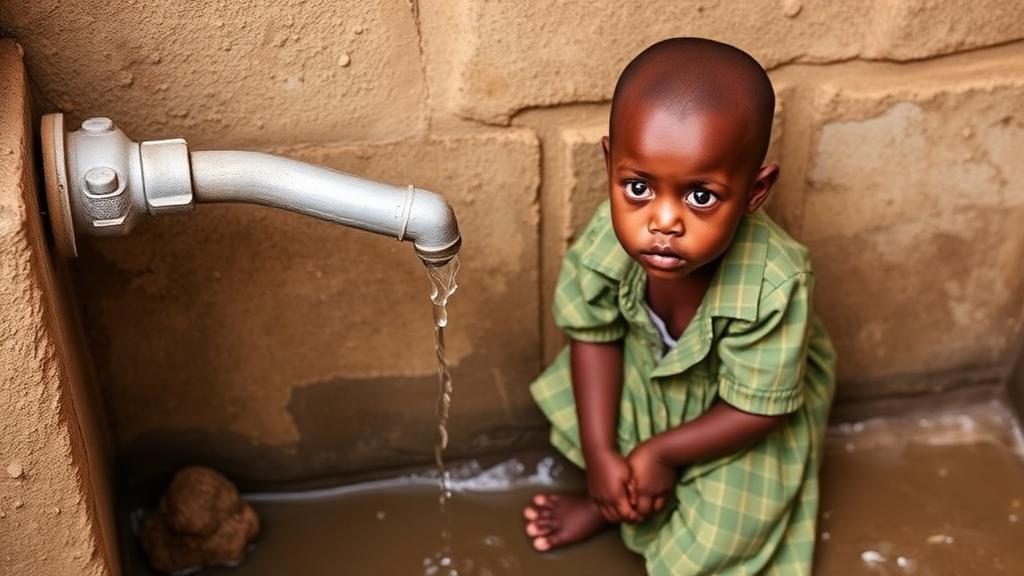
Diarrheal disease remains one of the most relentless threats to young children in low-income settings, and a new prospective cohort study from central Ethiopia now offers some of the clearest longitudinal evidence yet on just how much a household’s water connection shapes that risk. Researchers following 292 households in Hosanna Town found that children experience an average of 1.6 diarrheal episodes per year, but the burden falls far from evenly. In homes without piped water on the premises, the incidence climbed to 2.2 episodes per child per year, while children in homes with a piped connection inside or around the dwelling suffered roughly half as many, at 1.0 episodes per year. The findings, published in BMC Pediatrics, arrive at a moment when global health agencies are rethinking how water access, hygiene behavior, and food safety interact to drive one of the world’s biggest killers of children under five.
The study, led by Abiot Abera Aydamo of the Ethiopian Institute of Water Resources at Addis Ababa University and Wachemo University, together with Sirak Robele Gari and Seid Tiku Mereta, was designed to overcome a persistent weakness in the childhood diarrhea literature. Most studies in developing countries, including Ethiopia, have relied on cross-sectional surveys that capture a single snapshot in time, making it difficult to distinguish whether risk factors precede illness or merely coincide with it. By following the same households prospectively across seasons and recording each new diarrheal episode as it occurred, the Hosanna team could measure incidence directly and track how exposure to specific hazards translated into disease over time. The research covered three kebeles, the smallest administrative units in Ethiopia, chosen to represent the peri-urban and informal settlements that ring many fast-growing Ethiopian towns.
Data collection combined three complementary methods. Caregivers, primarily mothers, answered a pretested structured questionnaire covering household characteristics, water handling, sanitation, and child care practices. Trained observers conducted spot-check observations of household conditions, a technique that helps verify what families report with what can actually be seen in the home environment, from the cleanliness of water storage containers to the presence of handwashing stations. Finally, a dedicated diarrhea recording questionnaire allowed caregivers to log each episode of illness as it happened, reducing the recall bias that plagues surveys asking parents to remember illnesses weeks or months in the past. This triangulation of self-report, observation, and longitudinal symptom tracking is what gives the study its unusual analytical power for a resource-constrained setting.
On the statistical side, the researchers deployed two modeling approaches. Bivariate logistic regression provided an initial screen of associations, while the core analysis relied on Generalized Estimating Equations, or GEEs. The choice was deliberate and technically meaningful. Where mixed-effects models estimate subject-specific effects, essentially asking how a risk factor changes the trajectory for a particular child, GEEs estimate population-averaged effects, asking how a risk factor shifts the expected disease burden across the whole community. For public health planning, that population-averaged framing is often the more useful one, because interventions such as extending piped networks or running handwashing campaigns operate at the community scale rather than for individual children one at a time. The results were expressed as adjusted incidence rate ratios, or AIRRs, which quantify how much each factor multiplies the rate of diarrheal episodes after accounting for other variables.
The risk factor hierarchy that emerged is striking in its coherence. Children in households with piped water located off the premises, meaning families had to fetch water from taps or standpipes outside the home, experienced 1.57 times the incidence rate of diarrhea compared with children whose homes had water on premises. Unsafe disposal of child stool raised the rate by a factor of 1.47, and children who ate unheated leftover food faced a 1.43-fold increase. The single largest behavioral hazard was poor handwashing by caregivers at critical moments, such as before preparing food, before feeding a child, and after using the latrine or cleaning a child, which was associated with an adjusted incidence rate ratio of 1.95, nearly doubling the rate of illness. Each of these factors represents a well-established pathway by which fecal pathogens travel from the environment into a young child’s mouth, but seeing them quantified together in a single longitudinal cohort, with seasonal coverage, sharpens the picture considerably.
Water quality itself told an equally important story. The team tested household drinking water for Escherichia coli, the standard bacterial indicator of fecal contamination, and found that children drinking contaminated water suffered significantly more diarrhea during both the dry and rainy seasons. That seasonal consistency matters. In many settings, water quality deteriorates dramatically during the rains, when runoff washes waste into shallow wells and unprotected springs, and the rainy season is typically when diarrhea cases surge. But the Hosanna data show that contamination is not merely a wet-weather problem; households drawing E. coli-laden water face elevated risk year-round. This suggests that household water treatment, whether boiling, chlorination, or filtration, could deliver benefits across every season, and that the dry-season contamination likely reflects persistent problems in storage, handling, and source protection rather than episodic weather-driven events alone.
Age emerged as a powerful and protective axis in the analysis. Children aged 24 to 35 months and 36 to 59 months had significantly reduced risk of diarrhea compared with younger children, a pattern consistent with the immunology and behavior of early childhood. Infants and toddlers who are crawling, teething, and exploring their environment by mouth are exposed to far more environmental pathogens, and their immune systems are still naive to the rotating cast of viruses and bacteria that cause gastroenteritis. As children grow older, improved motor control, more adult-like eating habits, and accumulating immunity all push risk downward. The finding reinforces a message that pediatric and water researchers have long emphasized: the window from birth to roughly two years of age is when water, sanitation, and hygiene interventions pay their largest dividends, and it is exactly the window in which the Hosanna cohort shows the heaviest disease burden.
Not all the news in the study is grim. Better hygienic practices were found to be protective against childhood diarrhea, confirming that the behavioral side of the equation works in both directions. Just as poor handwashing at critical times nearly doubles incidence, consistent hygiene practices measurably reduce it. This bidirectional evidence base strengthens the case for hygiene promotion programs that go beyond infrastructure, targeting the specific moments when pathogens are most likely to jump from hands, food, or utensils into a child. The study’s authors argue that improving on-premises water access, promoting mothers’ handwashing at critical times, encouraging household water treatment, and strengthening hygiene and food safety practices are all essential levers for reducing diarrheal disease in settings like Hosanna, and their data provide the incidence estimates and effect sizes needed to model what such interventions might achieve.
The broader significance of the work lies in what it says about peri-urbanization. Hosanna Town, like many secondary cities across Ethiopia and sub-Saharan Africa, is growing faster than its water and sanitation infrastructure can expand. Families settling in informal and peri-urban neighborhoods often live within a few hundred meters of a piped network yet remain unconnected, forced to fetch water in quantities too small for generous hygiene and to store it in containers that invite recontamination. The 2.2 versus 1.0 episodes-per-year contrast between unconnected and connected households is a direct measure of what that infrastructure gap costs in child health. For a disease that remains a leading cause of illness and death among children under five in developing countries, an intervention that halves incidence simply by delivering water to the household tap represents one of the most cost-effective public health opportunities available.
The study received ethical approval from Ethiopia’s National Research Ethics Review Committee under the Ministry of Education and was conducted in accordance with the Declaration of Helsinki, with written consent obtained from the mothers and caregivers of all participating children. It was supported by the Ethiopian Institute of Water Resources at Addis Ababa University and Wachemo University. The authors state that the findings provide evidence to guide interventions aimed at reducing childhood diarrhea in Ethiopia and other developing countries, and the longitudinal design gives that evidence a durability that single-snapshot surveys cannot match. As governments and donors weigh investments in water infrastructure against competing priorities, the Hosanna cohort offers a concrete, quantified answer to a deceptively simple question: what happens to child health when clean water finally reaches the home? The answer, measured episode by episode over a full year of dry seasons and rains, is that the burden of childhood diarrhea drops by half, and the pathogens that stalk the youngest children lose their most reliable ally.
Subject of Research: Incidence and risk factors of diarrhea among under-five children in peri-urban central Ethiopia
Article Title: Incidence of caregiver-reported diarrhea and associated risk factors among under-five children in Hosanna Town, central Ethiopia: a prospective cohort study
Article References: Aydamo, A. A., Gari, S. R., & Mereta, S. T. (2026). Incidence of caregiver-reported diarrhea and associated risk factors among under-five children in Hosanna Town, central Ethiopia: a prospective cohort study. BMC Pediatrics. https://doi.org/10.1186/s12887-026-07776-5
Image Credits: AI Generated
DOI: 10.1186/s12887-026-07776-5
Keywords: diarrhea, under-five children, Ethiopia, piped water, water access, handwashing, E. coli, prospective cohort study, water sanitation and hygiene, child health, peri-urban settlements, food safety
Cite Scienmag News
Phoebe Ingram. (October 8, 2026). Piped Water at Home Halves Diarrhea Risk in Ethiopian Children, Cohort Study Finds. Scienmag. https://scienmag.com/piped-water-at-home-halves-diarrhea-risk-in-ethiopian-children-cohort-study-finds/
Phoebe Ingram. "Piped Water at Home Halves Diarrhea Risk in Ethiopian Children, Cohort Study Finds." Scienmag, 8 October 2026, https://scienmag.com/piped-water-at-home-halves-diarrhea-risk-in-ethiopian-children-cohort-study-finds/. Accessed 8 October 2026.
Phoebe Ingram. "Piped Water at Home Halves Diarrhea Risk in Ethiopian Children, Cohort Study Finds." Scienmag. October 8, 2026. https://scienmag.com/piped-water-at-home-halves-diarrhea-risk-in-ethiopian-children-cohort-study-finds/


