


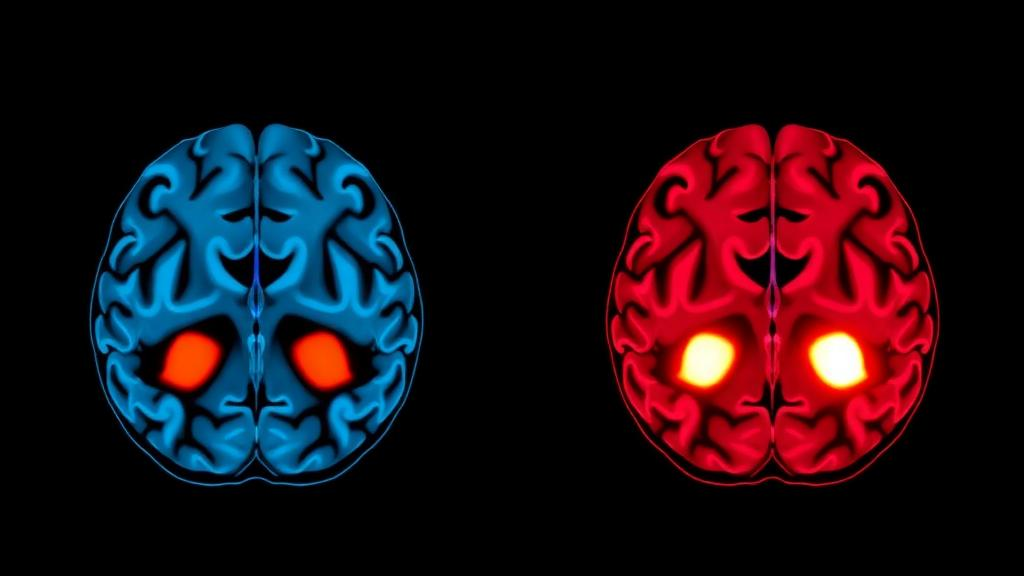
Mindfulness has been prescribed, downloaded, and praised as a single mental virtue for years, but a new brain-imaging study suggests that the label may be hiding two very different neural creatures under one name. In one of the largest structural neuroimaging investigations of its kind, researchers report that the two core subdomains of trait mindfulness — presence, the capacity for moment-to-moment awareness, and acceptance, the non-judgmental integration of experience — show opposing associations with grey matter volume in distinct brain regions. The findings, published in the journal Mindfulness, offer the first direct structural evidence that the counterbalancing relationship between these two components, long proposed by psychologists, may be written into the anatomy of the brain itself.
The research team, led by Robin Kamrla and Konrad Schöniger of Martin Luther University Halle-Wittenberg, analyzed structural MRI scans and questionnaire data from 261 healthy adults aged 18 to 64. Participants completed the German version of the Freiburg Mindfulness Inventory, a 14-item questionnaire that yields separate scores for presence and acceptance, alongside clinical interviews and standardized measures of depression and anxiety. All participants were free of current psychiatric diagnoses and psychotropic medication, allowing the researchers to examine how everyday differences in trait mindfulness map onto brain structure in a non-clinical population.
What set this study apart was its analytical strategy. Rather than correlating each mindfulness subscale with brain structure separately — the approach taken by most previous work — the team built a single multiple regression model that included both subscales simultaneously and then explicitly tested for regions where the two moved in opposite directions. This differential dissociation approach directly asks whether a brain region grows with one component while shrinking with the other, a pattern that would be invisible, or even misleadingly averaged away, in conventional univariate analyses. Grey matter volume was estimated with voxel-based morphometry using high-resolution T1-weighted images acquired on a 3 Tesla scanner, and results were corrected for multiple comparisons using non-parametric threshold-free cluster enhancement with 5,000 permutations.
The results revealed a striking split. Acceptance, measured by items such as being friendly to oneself when things go wrong, correlated positively with grey matter volume in the left rolandic operculum and the left postcentral gyrus — regions that make up the primary and secondary somatosensory cortex, the brain’s machinery for perceiving bodily and sensory signals. Presence, by contrast, was negatively associated with grey matter in those same cortical areas. In other words, the more a participant scored on acceptance relative to presence, the larger the volume of their somatosensory regions; the more they scored on presence relative to acceptance, the smaller those volumes appeared.
The second direction of dissociation produced an equally compelling finding, this time in the limbic system. Within a targeted region-of-interest analysis of the amygdala, the almond-shaped structure central to emotion perception and threat processing, grey matter volume in the right hemisphere was negatively correlated with acceptance and positively correlated with presence. Higher presence paired with lower acceptance was associated with a larger amygdala, while higher acceptance with lower presence accompanied a smaller one. This pattern echoes the Monitor and Acceptance Theory of mindfulness proposed by Lindsay and Creswell in 2017, which holds that monitoring — the presence-like component — can intensify all experiences, negative, positive, and neutral alike, whereas acceptance dampens affective reactivity and counterbalances that amplification.
The psychometric data reinforced the neural story. Acceptance scores correlated strongly and negatively with both depression and anxiety symptoms, and these relationships held even after statistically controlling for presence. Presence, meanwhile, showed correlations with depression and anxiety that vanished entirely once acceptance was taken into account. This mirrors the earlier work of Kohls and colleagues, who found that only acceptance, not presence, was linked to reduced anxiety and depression — the very conditions for which mindfulness-based interventions appear most effective. The new study extends that dissociation from questionnaires to brain anatomy, suggesting that the clinical benefits of mindfulness may flow primarily through acceptance-related neural circuits.
Post-hoc analyses sharpened the picture further. When each subscale was examined separately while controlling for the other, acceptance was associated with grey matter in the bilateral rolandic operculum, bilateral postcentral gyrus, supplementary motor area, cingulate cortex, and precuneus, as well as limbic structures including the right amygdala, parahippocampal gyrus, and superior temporal pole. Presence, in its unique variance, was linked to negative associations in somatosensory and auditory regions such as Heschl’s gyrus. The researchers interpret this as evidence that acceptance is tied to the deep, non-judgmental processing of bodily sensations and emotions, whereas presence reflects the capacity for intentional shifts of attention — a refocusing skill that, on its own, does not engage the emotion-integration circuitry.
The authors are careful about what these structural correlations can and cannot mean. Grey matter volume is an indirect marker, mediated by factors such as neural efficiency and plasticity, and the study’s cross-sectional design cannot determine whether brain shape shapes mindfulness or mindfulness practice reshapes the brain. The sample was also predominantly young and healthy, limiting generalizability to clinical populations, and individual meditation experience was not assessed. The researchers themselves note that the study was not preregistered and that their post-hoc analyses captured only the variance unique to each subscale, not the substantial portion the two share — the subscales correlated at r = 0.56 in this sample.
Even with those caveats, the implications are considerable. If mindfulness is treated as a single unified construct, interventions may inadvertently train the wrong component for the wrong goal. Someone high in presence but low in acceptance might, according to the Monitor and Acceptance Theory, experience heightened affective reactivity — attending intensely to everything without the emotional integration that acceptance provides. The new neurostructural findings give that theoretical framework an anatomical footing: presence was associated only with neocortical regions, while acceptance reached into the limbic system in the opposite polarity. The two subdomains, the authors argue, may function as complementary and partially compensatory mechanisms within the broader mindfulness construct.
Future work, the team suggests, should test whether the same dissociation appears in functional MRI responses to emotional stimuli, and whether longitudinal or intervention-based designs can establish causal relationships between meditation practice, acceptance, and limbic structure. The differential analysis framework itself may prove portable, offering a template for teasing apart compensatory mechanisms in other psychological constructs that have been lumped together under single labels. For now, the message for both scientists and practitioners is clear: the mindful brain is not one thing. Being fully present and being fully accepting recruit different, and in places opposing, neural signatures — and understanding that duality may be the key to explaining why mindfulness helps some minds and, occasionally, intensifies the experience of others.
Subject of Research: Neurostructural correlates of the presence and acceptance subdomains of trait mindfulness in healthy adults
Article Title: Neural Correlates of Dissociating Mindfulness Subdomains: A Differential Analysis Approach
Article References: Kamrla, R., Schöniger, K., König, P., Zwiky, E., Küttner, A., Scheiwe, G. S., Andreev, J., Fleischer, L., Uhlig, M., Ptasczynski, L. E., Spitzer, M., Deistung, A., Wohlgemuth, W. A., Selle, J., & Redlich, R. (2026). Neural Correlates of Dissociating Mindfulness Subdomains: A Differential Analysis Approach. Mindfulness. https://doi.org/10.1007/s12671-026-02993-6
Image Credits: AI Generated
DOI: 10.1007/s12671-026-02993-6
Keywords: mindfulness, presence, acceptance, grey matter volume, amygdala, voxel-based morphometry, Freiburg Mindfulness Inventory, Monitor and Acceptance Theory, somatosensory cortex, emotion regulation, structural MRI, trait mindfulness
Cite Scienmag News
Glenn Wilkins. (October 7, 2026). Mindfulness Is Not One Skill: Brain Scans Reveal Opposing Signatures of Presence and Acceptance. Scienmag. https://scienmag.com/mindfulness-is-not-one-skill-brain-scans-reveal-opposing-signatures-of-presence-and-acceptance/
Glenn Wilkins. "Mindfulness Is Not One Skill: Brain Scans Reveal Opposing Signatures of Presence and Acceptance." Scienmag, 7 October 2026, https://scienmag.com/mindfulness-is-not-one-skill-brain-scans-reveal-opposing-signatures-of-presence-and-acceptance/. Accessed 7 October 2026.
Glenn Wilkins. "Mindfulness Is Not One Skill: Brain Scans Reveal Opposing Signatures of Presence and Acceptance." Scienmag. October 7, 2026. https://scienmag.com/mindfulness-is-not-one-skill-brain-scans-reveal-opposing-signatures-of-presence-and-acceptance/


