


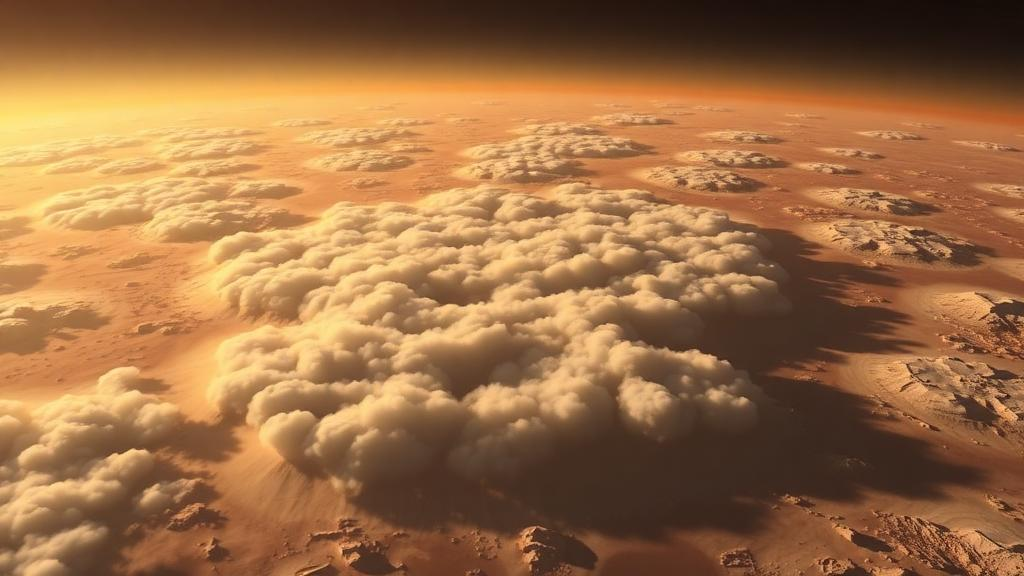
Every morning during the Martian southern spring, an extraordinary cloud unfurls from the leeward flank of Arsia Mons, one of the giant Tharsis volcanoes. Over the course of a few hours it stretches into a narrow ribbon of water ice that can extend for well over a thousand kilometres westward, making it one of the most striking and enigmatic cloud structures in the Solar System. For years, this Arsia Mons Elongated Cloud, or AMEC, has stubbornly resisted reproduction in numerical models of the Martian atmosphere. Conventional cloud physics, the kind routinely used to simulate clouds on Earth and Mars alike, simply could not produce a structure with the observed brightness, length, altitude and daily rhythm all at once. A new study published in Nature Geoscience by Jorge Hernández-Bernal of the Laboratoire de Météorologie Dynamique in Paris and his colleagues argues that the missing ingredient is something remarkable: the first natural evidence that clouds can be born directly from water vapour, without any pre-existing particle to seed them.
The process in question is called homogeneous ice nucleation. In most planetary atmospheres, water vapour does not condense into ice on its own. Instead, it freezes onto airborne motes of dust, salt or other tiny solids, a process known as heterogeneous nucleation. These foreign particles lower the energetic barrier to ice formation, allowing ice to grow at modest levels of supersaturation, the condition in which the air holds more water vapour than it can stably support. Homogeneous nucleation, by contrast, requires water molecules to organise themselves spontaneously into a stable ice embryo purely by chance collisions. The energy cost of creating a new ice surface from nothing is so high that the vapour must be supersaturated by many hundreds of percent before this becomes statistically likely. On Earth, such extreme supersaturation is essentially never reached in the lower atmosphere, which is why the process is considered a curiosity rather than a working mechanism.
There is, however, one place on Earth where homogeneous nucleation is thought to operate: the polar summer mesosphere, at altitudes near eighty kilometres, where temperatures plunge below minus one hundred and fifty degrees Celsius and noctilucent clouds of tiny ice crystals form. Theoretical studies have also suggested that ephemeral ice clouds could nucleate homogeneously in the upper mesosphere of Venus. Yet homogeneous nucleation from water vapour has never been directly observed in nature on any planet, and atmospheric scientists have generally regarded it as too demanding to matter under realistic conditions. The new work challenges that assumption by pointing to a planet where the conditions are, paradoxically, far more favourable than on Earth, despite Mars having much less water overall.
Mars’s atmosphere is thin, cold and nearly dust-dominated, and it sits well below the triple point of water, meaning liquid water cannot persist and water cycles almost entirely between vapour and ice. Crucially, the Martian atmosphere contains very few condensation nuclei at high altitude. Airborne dust exists, but its abundance drops sharply with height, and the number of available particles per cubic centimetre in the upper troposphere can be minuscule compared with Earth’s aerosol-rich air. When an air parcel rich in water vapour is rapidly cooled in such a particle-poor environment, supersaturation can climb to extreme values before any heterogeneous freezing gets a chance to consume the excess vapour. In that regime, homogeneous nucleation becomes not just possible but competitive, and the model developed by Hernández-Bernal and colleagues shows that it can take over entirely.
The team embedded a detailed scheme of homogeneous ice nucleation from water vapour into meteorological models of Mars, including the Mars Planetary Climate Model developed at the Laboratoire de Météorologie Dynamique and a mesoscale model capable of resolving the winds around individual volcanoes. The mesoscale simulations capture a key dynamical ingredient of the AMEC: a cold pocket of air that forms on the western, leeward side of Arsia Mons in the early morning hours, where orographic flow, gravity waves and the volcano’s enormous height combine to chill the air dramatically. As air parcels traverse this cold pocket, temperatures fall low enough, and supersaturation rises high enough, for water vapour to freeze spontaneously into vast numbers of minuscule ice crystals, each only a fraction of a micrometre across.
The results were striking. With homogeneous nucleation switched on, the model reproduced the distinctive characteristics of the AMEC that had eluded conventional microphysics: the cloud’s extreme elongation, its recurrent diurnal cycle of growth and dissipation, its high altitude near the top of the tropospheric boundary, and its optical brightness. The homogeneously nucleated particles, being numerous and tiny, scatter sunlight efficiently and give the cloud its characteristic appearance, while the dynamics of the cold pocket stretch the freshly formed ice into the long tail that streams away from the volcano. Simulations using only heterogeneous nucleation on dust, the standard assumption for Martian water ice clouds, failed to match the observed cloud, regardless of how the properties of the dust nuclei were tuned. Sensitivity tests showed that the outcome depends delicately on thermodynamic parameters such as the surface energy of ice and the vapour pressure over ice at very low temperature, with small adjustments shifting the cloud’s brightness and extent in ways consistent with the observational constraints.
Those observational constraints come from an unusually rich set of spacecraft data, all openly available. The Visual Monitoring Camera on the European Space Agency’s Mars Express orbiter, originally a humble engineering webcam, has provided a long record of the cloud’s daily evolution, complemented by the high-resolution imagery of the HRSC instrument on the same spacecraft. Images from the Mars Colour Camera aboard the Indian Space Research Organisation’s Mars Orbiter Mission and from the Emirates eXploration Imager on the United Arab Emirates’ Hope probe added further coverage. This multi-mission archive allowed the team to pin down the cloud’s morphology, timing and radiative properties with enough precision to make the model comparison meaningful, and the modelling code and datasets have been released openly for other researchers to scrutinise and extend.
The implications extend well beyond one photogenic cloud. If homogeneous nucleation from water vapour is operating on Mars, then the standard picture of cloud formation on that planet, in which dust grains almost always serve as the scaffolding for ice, is incomplete. High-altitude water ice clouds influence the Martian climate in important ways, affecting the vertical distribution of water vapour, the radiative budget of the atmosphere and even the formation of snowfall. Clouds that nucleate homogeneously consist of far more, and far smaller, particles than heterogeneously nucleated ones at the same water content, which changes how they scatter light and how they sediment. Climate models that omit this pathway may therefore misrepresent the water cycle and its climatic feedbacks, particularly in the cold, clean air above the great volcanoes and in the polar regions.
For Earth, the finding is a provocative nudge rather than a direct overturning. Terrestrial clouds below the mesosphere almost certainly form heterogeneously, thanks to the planet’s abundant aerosols, and the extreme supersaturations required for homogeneous freezing of water vapour are not reached in the troposphere. But the Mars result demonstrates that the process is viable under real planetary conditions, not merely in laboratory chambers, and it encourages a re-examination of assumptions about where and when homogeneous nucleation might matter, including in the mesospheres of Earth and Venus and potentially in the atmospheres of exoplanets with cold, clean, water-bearing air. The study also highlights how laboratory measurements of the vapour pressure and surface tension of supercooled water and ice, performed over the past decade, now feed directly into planetary-scale conclusions.
There is also a lesson in how the discovery was made. The AMEC was long known to observers and had been modelled before, but only by combining a decade of serendipitous spacecraft imagery with high-resolution mesoscale dynamics and a microphysical scheme that most modellers had set aside as irrelevant did the pieces fall into place. A cloud that looked like a mere curiosity of Martian meteorology has turned out to carry a fundamental message about how matter changes phase in extreme environments. As missions continue to monitor Mars’s atmosphere with ever finer instruments, the elongated cloud of Arsia Mons may prove to be the first confirmed natural laboratory for a process that textbooks had filed away as theoretically possible but practically impossible, a reminder that the universe often finds ways to cross thresholds we assumed were out of reach.
Subject of Research: Homogeneous ice nucleation from water vapour in the Martian atmosphere
Article Title: Homogeneous ice nucleation from water vapour suggested by elongated clouds on Mars
Article References: Hernández-Bernal, J., Määttänen, A., Spiga, A., & Forget, F. (2026). Homogeneous ice nucleation from water vapour suggested by elongated clouds on Mars. Nature Geoscience, 19(10), 1213-1217. https://doi.org/10.1038/s41561-026-02089-9
Image Credits: AI Generated
DOI: 10.1038/s41561-026-02089-9
Keywords: Mars, Arsia Mons Elongated Cloud, homogeneous ice nucleation, cloud microphysics, water ice clouds, planetary atmospheres, supersaturation, Nature Geoscience, Martian climate, mesoscale modelling, heterogeneous nucleation, atmospheric science
Cite Scienmag News
Violet Maxwell. (October 7, 2026). Mars’s Strange Stretched Cloud Points to a Rare Form of Ice Birth Never Seen Before. Scienmag. https://scienmag.com/marss-strange-stretched-cloud-points-to-a-rare-form-of-ice-birth-never-seen-before/
Violet Maxwell. "Mars’s Strange Stretched Cloud Points to a Rare Form of Ice Birth Never Seen Before." Scienmag, 7 October 2026, https://scienmag.com/marss-strange-stretched-cloud-points-to-a-rare-form-of-ice-birth-never-seen-before/. Accessed 7 October 2026.
Violet Maxwell. "Mars’s Strange Stretched Cloud Points to a Rare Form of Ice Birth Never Seen Before." Scienmag. October 7, 2026. https://scienmag.com/marss-strange-stretched-cloud-points-to-a-rare-form-of-ice-birth-never-seen-before/


