


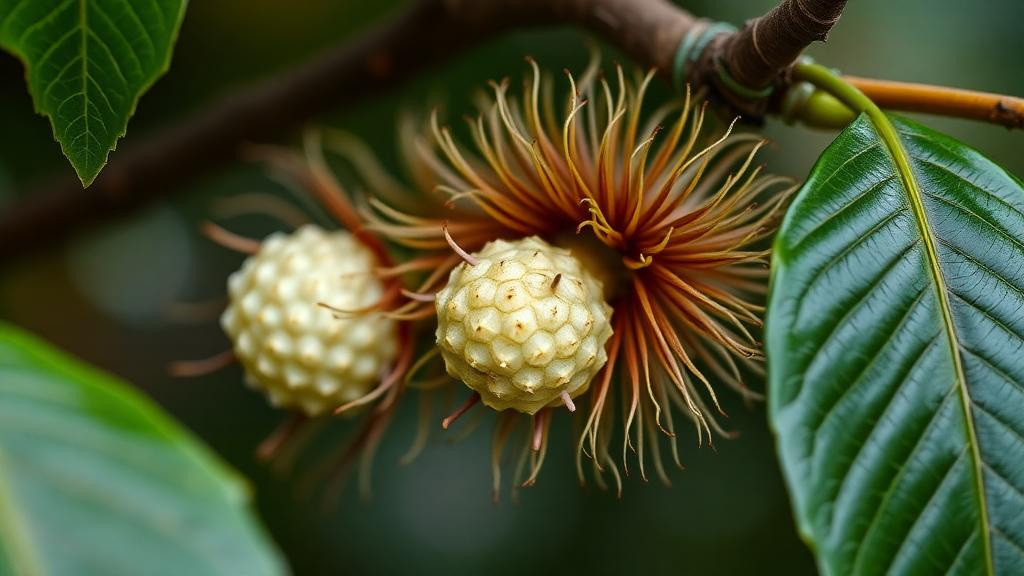
Deep in the lowland rainforests of Papua New Guinea, an extraordinary ecological drama unfolds at a scale few people ever notice. Tiny gall-forming insects hijack the tissues of rainforest trees, forcing them to build sculptural nurseries around their young. But those nurseries are far from safe. A new study, published in Ecology and Evolution, has mapped one of the largest tropical plant–gall–parasitoid food webs ever assembled, and its findings overturn a long-standing assumption about how the third trophic level behaves in the species-rich tropics: instead of a community of flexible generalists, the researchers found parasitoids so specialised that the entire network is stitched together from tightly bound, one-to-one partnerships.
The research, led by Philip T. Butterill and Sam Finnie with colleagues at the New Guinea Binatang Research Centre, focused on forest patches near Madang town in Madang Province. Over eight months, from August 2010 to March 2011, the team searched the foliage of 32 locally common woody plant species, spanning basal eudicots, rosids, asterids and even a single gymnosperm. Each species received identical sampling effort, roughly 78 hours of foliage searching per plant species, spread evenly across sites and seasons. The result was a conservative haul of about 8,150 galled plant modules, from which the researchers reared 820 individual parasitoids representing 102 species.
The scale of the sampling matters, because questions about host specificity in tropical food webs have long been hampered by patchy data. Using rarefaction and extrapolation methods, the team estimated that their sampling captured roughly 95 percent of the parasitoid community associated with the targeted hosts and galls. Completing the species accumulation curve, they calculate, could add another 10 to 35 parasitoid species, but would require nearly double the effort. That level of coverage lends unusual confidence to the network statistics that followed.
What those statistics revealed was striking. By the traditional definition, 79 percent of the 102 parasitoid species were specialists, attacking only a single host gall species. Even after removing rare singletons and doubletons, which can inflate apparent specialisation, two-thirds of the remaining species remained monophagous. A complementary index of specialisation, d-prime, told the same story: 61 percent of parasitoid species scored above the interpretive midpoint of 0.5, and the mean value was significantly higher. At the level of the whole network, specialisation reached an H2-prime of 0.89, far above the average of 0.65 reported in a major synthesis of host–parasitoid networks. The community was dominated by chalcid wasps, which accounted for 92.4 percent of individuals and 83.3 percent of species, with the family Eulophidae alone making up nearly half of all species.
This degree of specialisation challenges a persistent hypothesis in tropical ecology. Because specialist herbivores on rare plant species occur at low densities, some researchers have argued that parasitoids in diverse tropical forests must be generalists to make a living. Studies of leaf-mining insects in tropical forests have indeed documented predominantly generalist parasitoid communities. But the gall-parasitoid web of Madang shows the opposite pattern, and the authors point to several interlocking mechanisms. In temperate regions, most gallers are uni- or bivoltine, producing at most one or two synchronous generations per year, which creates intense competition among parasitoids for brief resource pulses. In the aseasonal tropics, overlapping generations mean that only a small fraction of galls are at a suitable developmental stage at any moment, favouring specialists whose life cycles are precisely synchronised with a single host over opportunistic generalists chasing sporadic late-stage galls.
Taxonomy adds another layer. The dominant gall formers in the tropics are cecidomyiid midges, which are almost exclusively host specialists, whereas the cynipid gall wasps that dominate northern temperate gall communities, tied closely to oak trees, tend to be more flexible. Quercus is largely absent from the tropics, shifting the galler pool toward lineages whose parasitoids are repeatedly reported as highly host-specific. The parasitoid specialisation in the Papua New Guinean web closely mirrors the extreme host fidelity of the gallers themselves, suggesting a reciprocal pattern in which each trophic level locks the others into place. The authors tentatively propose a latitudinal gradient in gall-parasitoid specialisation, intensifying toward the equator, while acknowledging that a definitive test will require studies in transitional forests where cynipids and cecidomyiids co-occur.
Specialisation has cascading consequences for indirect interactions. When parasitoids attack multiple hosts, they can mediate apparent competition, in which an increase in one herbivore species boosts shared enemies and suppresses another. The researchers quantified this potential for all pairs of the 42 gall species from which parasitoids emerged. Of 861 possible heterospecific pairs, only 7 percent had any non-zero potential, and even those values were low, averaging 0.069. Sixteen gall species shared no parasitoids at all with any other species. In contrast, the mean potential for intraspecific competition, each host’s capacity to fuel its own enemies, was 0.76. In this web, gallers are far more likely to be regulated by their own specialist parasitoids than to be caught in cross-species enemy-mediated conflict, exactly as the team hypothesised.
The second major finding concerns gall appearance. Galls vary enormously in size, structure and colour, and the researchers scored each of 78 gall morphospecies for apparency, a composite of size and visual similarity to the host plant organ, based on standardised inspection of photographs and specimens. Using negative binomial generalised linear models with host gall abundance as a covariate, they tested which traits best predicted the number of parasitoid species reared from each gall type. Abundance was the strongest single predictor, as expected. But among morphological traits, apparency and gall-former taxon were retained in the final model, which explained just over 50 percent of the deviance. More conspicuous galls, those that stand out from the plant by virtue of large size or contrasting colour, hosted consistently richer parasitoid assemblages. Notably, apparency outperformed gall size alone in model comparisons, indicating that the composite visual signal carries information that raw dimensions do not.
Why would showy galls attract more enemies? One possibility is that parasitoids rely heavily on visual cues when locating hosts, perhaps especially because some gall-forming insects can suppress the volatile chemical signals that plants normally emit when attacked. Another provocative idea is the aposematic gall hypothesis, which suggests that chemically defended, brightly coloured galls warn off predators. Yet evidence from caterpillar-parasitoid systems shows that aposematism can reduce predation while increasing parasitism, consistent with a safe haven hypothesis in which well-defended hosts offer ideal conditions for parasitoids. The same logic may extend to galls. The authors are careful to stress that their apparency scores reflect human vision, not parasitoid spectral sensitivity, and that ultraviolet reflectance and natural canopy lighting were not measured, so the pattern remains correlative rather than a demonstration of cause.
An intriguing secondary result emerged when the analysis was restricted to the cecidomyiids, the dominant gall taxon. Within this single lineage, plant module, whether the gall occurred on leaves, stems or other organs, became a significant predictor of parasitoid richness alongside apparency, even though module effects were masked in the multi-taxon analysis. This suggests that microhabitat within the plant shapes parasitoid recruitment primarily within host lineages, while lineage identity and overall conspicuousness dominate comparisons across the full community. The broader implications are sobering for anyone estimating tropical biodiversity: extrapolating the observed ratio of roughly three parasitoid species per plant species to the more than 500 woody species recorded in a nearby forest dynamics plot, the authors estimate that parasitoid diversity in this forest could exceed 1,000 species, a hidden multitudes figure that underscores how much of tropical food web complexity still awaits discovery.
Subject of Research: Specialisation and gall apparency in a tropical plant–gall–parasitoid food web
Article Title: Gall Apparency Drives Parasitoid Richness in a Highly Specialised Gall‐Parasitoid Food Web From a Tropical Rainforest
Article References: Butterill, P. T., Finnie, S., Sam, K., Fayle, T. M., Freiberga, I., & Novotny, V. (2026). Gall Apparency Drives Parasitoid Richness in a Highly Specialised Gall‐Parasitoid Food Web From a Tropical Rainforest. Ecology and Evolution, 16(10), Article e74375. https://doi.org/10.1002/ece3.74375
Image Credits: AI Generated
DOI: 10.1002/ece3.74375
Keywords: food webs, parasitoids, gall-forming insects, tropical rainforest, Papua New Guinea, host specialisation, apparent competition, gall morphology, Cecidomyiidae, tri-trophic interactions, network ecology, biodiversity
Cite Scienmag News
Gavin Prescott. (October 7, 2026). Showy Galls Pay a Price: Parasitoid Richness Tracks Conspicuousness in Tropical Rainforest Food Web. Scienmag. https://scienmag.com/showy-galls-pay-a-price-parasitoid-richness-tracks-conspicuousness-in-tropical-rainforest-food-web/
Gavin Prescott. "Showy Galls Pay a Price: Parasitoid Richness Tracks Conspicuousness in Tropical Rainforest Food Web." Scienmag, 7 October 2026, https://scienmag.com/showy-galls-pay-a-price-parasitoid-richness-tracks-conspicuousness-in-tropical-rainforest-food-web/. Accessed 7 October 2026.
Gavin Prescott. "Showy Galls Pay a Price: Parasitoid Richness Tracks Conspicuousness in Tropical Rainforest Food Web." Scienmag. October 7, 2026. https://scienmag.com/showy-galls-pay-a-price-parasitoid-richness-tracks-conspicuousness-in-tropical-rainforest-food-web/


