


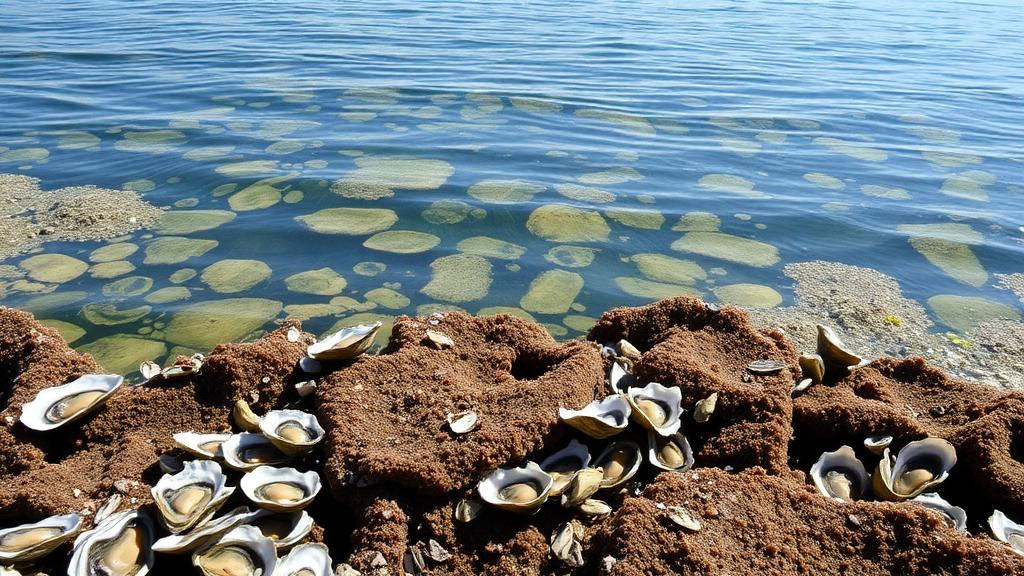
Oyster reefs have long been celebrated as a rare double win for coastal communities: rugged, living breakwaters that knock down storm waves while quietly burying carbon in the mud beneath them. A new study published in Nature Geoscience puts that second claim under the microscope, and the results are likely to reshape how restoration planners think about one of the ocean’s most iconic ecosystem engineers. By drilling into the layered remains of 25 natural intertidal reefs along the North Carolina coast, a team led by Antonio B. Rodriguez of the University of North Carolina at Chapel Hill reconstructed nearly two millennia of reef growth and found a striking pattern: rising seas dramatically accelerate reef accretion, yet the reefs still fail to function as net carbon sinks because the carbon they bury is offset by the carbon dioxide released when oysters build their shells.
The central insight of the study is that the pace of sea-level rise acts as a master control on how fast oyster reefs grow upward. For roughly 18 centuries before 1800 CE, when relative sea level along this stretch of coast climbed at about 0.9 millimeters per year, the reefs accreted slowly, adding height and sediment at a modest, steady rate. After 1800, as the rate of relative sea-level rise accelerated toward the modern value of approximately 2.4 millimeters per year, the same reefs responded by accreting vertically and accumulating sediment three times faster than before. In other words, healthy reefs did not merely keep pace with rising water; they ramped up their construction in response to it, creating the vertical space they needed as flooding intensified.
The mechanism behind this acceleration is elegantly physical. As sea level rises, it creates what geologists call accommodation space, the vertical room available for sediment to fill in. Faster rise means more room, and the reefs exploited it. The team’s cores show that the accelerated accretion was driven by an increased flux of both shell material and organic-rich sediment into the subsurface. Oysters are prodigious filter feeders, pumping water and packaging suspended particles into biodeposits that settle onto the reef, and their shells form the rigid framework that traps this fine material. The result, visible in the stratigraphy, is a reef matrix rich in shell fragments and organic matter, deposited far more rapidly in the last two centuries than at any time in the preceding 1,800 years.
To build this record, the researchers vibracored 25 natural intertidal reefs across five North Carolina estuarine systems, including Back Sound, the North River, the Newport River, the White Oak River and the Shallotte River. They radiocarbon-dated articulated shells of the eastern oyster, Crassostrea virginica, at multiple depths in each core, calibrated those ages with the Marine20 curve, and constructed age-depth models using the Bayesian software OxCal. From these models they calculated mass accumulation rates and vertical accretion rates through time, correcting for sediment compaction and core shortening. The composition of each subsample, including dry bulk density, percent shell and percent mud, allowed them to separate the organic carbon buried in the reef matrix from the inorganic carbon locked in carbonate shell material.
That separation matters enormously for the carbon story. When the team tallied the organic carbon accumulating in the reefs, they found that faster accretion after 1900 indeed meant more organic carbon being buried per unit time. Oysters actively promote the deposition of organic matter, and the study’s data show that reef sediments are enriched in organic material relative to surrounding estuarine muds. On paper, this looks like a blue carbon success story, the kind of natural climate solution that restoration advocates and policymakers have been eager to bank on. Salt marshes, mangroves and seagrass meadows have earned their reputations as carbon burial hotspots, and oyster reefs have frequently been lumped into the same category.
But the ledger has a second column. Building a shell is a carbon-intensive enterprise. Oysters extract carbonate from seawater to construct their shells, and in doing so they release carbon dioxide; the calcification reaction shifts the carbonate chemistry of the water and liberates CO2 to the atmosphere. When the researchers compared the organic carbon buried in the reefs against the CO2 emitted during shell formation, the two fluxes essentially cancelled each other out. None of the 25 reefs sampled functioned as a net carbon sink. The organic carbon story, real as it is, is offset by the inorganic carbon cost of the very shells that make the reef a reef. This finding aligns with earlier work by some of the same authors, including a 2017 study in Proceedings of the Royal Society B that first flagged oyster reefs as potential carbon sources rather than sinks.
The implications cut in two directions at once, and that tension is what makes the study so consequential for coastal policy. On the positive side, the demonstration that reefs can triple their accretion rate in response to accelerating sea-level rise is a powerful endorsement of their role as living breakwaters. Nature-based infrastructure, from living shorelines to reef-based breakwaters, is increasingly promoted as a way to protect communities from storm waves, and the new data suggest that healthy reefs have the capacity to keep pace with, and continue damping waves under, the higher rates of rise projected for the coming decades. The wave-attenuation service, in other words, appears robust to climate change as long as the reefs themselves remain healthy.
On the carbon side, however, the study delivers a caution against marketing oyster reef restoration as a greenhouse gas mitigation strategy. The authors show that as sea-level rise accelerates further, vertically growing reefs are likely to become larger sources of CO2, not smaller ones, because faster accretion means more shell production and more calcification-driven emissions, even as organic carbon burial increases in parallel. The net change in carbon burial, the study concludes, is minimal. For planners weighing investments in nature-based infrastructure, this means oyster reefs should be valued primarily for their coastal protection, habitat and water-quality benefits, while carbon accounting should be left to marshes, mangroves and seagrasses, whose burial economics are far more favorable.
There is also a sobering caveat about the future. The remarkable responsiveness the researchers documented depends on reefs being healthy, with robust oyster recruitment, adequate shell production and estuarine conditions that support vigorous growth. The authors explicitly caution that the ongoing deterioration of the estuarine conditions needed to sustain healthy oyster reefs warns against projecting these ecosystem service trade-offs into the coming century. Overharvesting, disease, low-oxygen events, sedimentation and ocean acidification have already degraded reefs worldwide, and a stressed reef cannot triple its growth rate to meet a rising sea. Historical evidence, including studies linking large-scale oyster bed harvesting to elevated coastal vulnerability, underscores how quickly this natural infrastructure can be lost.
What emerges from the study is a more honest, more nuanced portrait of the oyster reef as a piece of climate-era infrastructure. It is a breakwater of genuine and possibly growing value, capable of astonishing resilience when given the chance, and it is not a carbon sink, no matter how appealing that label might be. The 2,000-year record extracted from North Carolina’s estuaries shows nature responding dynamically to a changing coast, and it hands restoration science a crucial correction: the services an ecosystem actually provides over decadal to millennial timescales can differ sharply from the ones measured on young, restored reefs less than a decade old. As sea level continues to climb, the reefs will keep building. Whether the estuaries around them remain healthy enough to let them is the question that will determine if this living infrastructure endures.
Subject of Research: The effect of sea-level rise on oyster reef accretion and net carbon burial
Article Title: Sea level-induced oyster reef accretion causes minimal net carbon burial change
Article References: Rodriguez, A. B., Ridge, J. T., Bost, M. C., Nice, N., Eisemann, E., Sharifi, Y., Himmelstein, J. D., & Fodrie, F. J. (2026). Sea level-induced oyster reef accretion causes minimal net carbon burial change. Nature Geoscience. https://doi.org/10.1038/s41561-026-02121-y
Image Credits: AI Generated
DOI: 10.1038/s41561-026-02121-y
Keywords: oyster reefs, sea-level rise, carbon burial, blue carbon, coastal protection, living shorelines, Crassostrea virginica, ecosystem services, calcification, North Carolina estuaries, Nature Geoscience, climate change
Cite Scienmag News
Violet Maxwell. (October 7, 2026). Oyster Reefs Grow Faster as Seas Rise, but They Are Not the Carbon Sinks We Hoped. Scienmag. https://scienmag.com/oyster-reefs-grow-faster-as-seas-rise-but-they-are-not-the-carbon-sinks-we-hoped/
Violet Maxwell. "Oyster Reefs Grow Faster as Seas Rise, but They Are Not the Carbon Sinks We Hoped." Scienmag, 7 October 2026, https://scienmag.com/oyster-reefs-grow-faster-as-seas-rise-but-they-are-not-the-carbon-sinks-we-hoped/. Accessed 7 October 2026.
Violet Maxwell. "Oyster Reefs Grow Faster as Seas Rise, but They Are Not the Carbon Sinks We Hoped." Scienmag. October 7, 2026. https://scienmag.com/oyster-reefs-grow-faster-as-seas-rise-but-they-are-not-the-carbon-sinks-we-hoped/


