


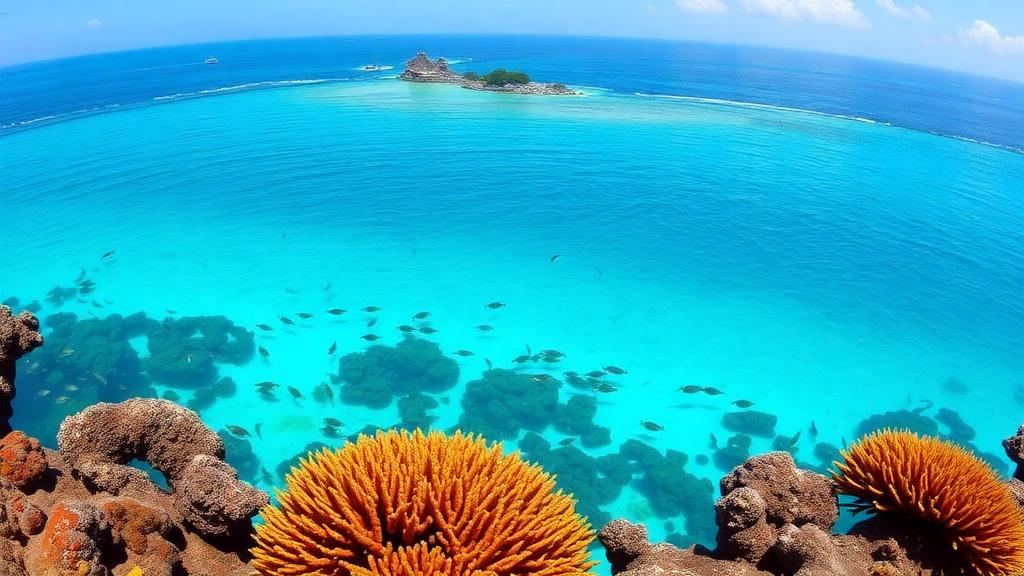
Coral reefs are often described as the rainforests of the sea, but unlike a forest, a reef’s vital signs cannot be read from its canopy alone. Scientists must instead measure the invisible flows of oxygen and carbonate minerals that pass between the reef and the water sweeping over it. A new three-year study published in the journal Coral Reefs has done exactly that on the shallow forereefs of Palau, delivering one of the most detailed portraits yet of how a living reef breathes, builds its skeleton, and responds to the shocks of storms and shifting seasons. The research, led by Alexandra Khrizman of Stanford University together with Elisabeth Boles, David Mucciarone, Jenny Hamilton, Martin Volaric, Stephen Monismith, and Robert Dunbar, quantified two fundamental metabolic currencies of reef health: net community production, the balance between photosynthesis and respiration, and net community calcification, the balance between the construction and dissolution of calcium carbonate.
The team deployed two complementary measurement techniques across multiple sites on Palau’s forereef during three consecutive summer field campaigns from 2021 to 2023. The first, the gradient-flux method, relies on sensors stacked at different heights above the seafloor to detect subtle vertical differences in oxygen and pH, from which the upward or downward flux of these chemical species can be computed. The second, eddy covariance, captures the rapid turbulent fluctuations of vertical velocity and oxygen concentration in the water column, allowing researchers to integrate the exchange of oxygen between the benthic community and the overlying water in real time. Pairing these hydrodynamic and biogeochemical measurements with structure-from-motion photogrammetry, a technique that reconstructs three-dimensional seafloor maps from overlapping photographs, allowed the team to link every flux measurement to the actual composition and architecture of the reef below.
The numbers that emerged reveal a reef system operating across a remarkably wide metabolic range. Diel-integrated net community production spanned from minus 408 to plus 569 millimoles of oxygen per square meter per day across sites and years, meaning some reef patches consumed more oxygen than they produced on a daily basis while others exported a substantial photosynthetic surplus. Net community calcification ranged from minus 218 to plus 503 millimoles of calcium carbonate per square meter per day, a spread that includes both active reef growth and episodes of net dissolution, in which seawater chemistry erodes the reef’s carbonate framework faster than organisms can rebuild it. Spatial differences between sites reached 173 millimoles of oxygen per square meter per day, while year-to-year changes at individual sites reached 226 millimoles, demonstrating that both where you look on a reef and when you look can fundamentally change the answer to the simple question of whether the reef is growing or shrinking.
When the researchers examined which environmental variables best explained these fluxes, one factor towered above the rest: light. As the engine of photosynthesis for the symbiotic algae living inside coral tissues, solar radiation dominated the variability in community production, with weaker but still meaningful contributions from water flow speed, temperature, and depth. This hierarchy matters for reef monitoring because it suggests that measurements taken under different lighting conditions are not directly comparable, and that any attempt to track reef metabolism over time must carefully account for the light environment. It also reinforces a long-standing theme in reef biogeochemistry: the coupling between physical forcing and biological function is tight, and disentangling the two requires simultaneous, high-frequency measurement of both.
Perhaps the most ecologically revealing finding concerns the interplay between reef geometry, hydrodynamics, and metabolism. Most of the studied sites were net heterotrophic, consuming more organic matter than they produced, yet still actively calcifying. But the degree of heterotrophy was not random. Sites adjacent to the Tabkukau channel, where strong tidal currents flush the reef and where tabular corals dominate the benthos, were less heterotrophic than their neighbors. In contrast, sites with weak water flow and abundant branching corals exhibited stronger heterotrophy. The authors interpret this pattern as evidence of a deep coupling between benthic community composition, water movement, and reef metabolism. Fast flow enhances the delivery of oxygen and nutrients and strips away metabolic byproducts, while different coral morphologies create distinct boundary layers and particle-trapping environments. A branching colony in slack water experiences a very different chemical microclimate than a broad table coral in a tidal jet, and the community-level fluxes reflect those differences.
The photogrammetric component of the study added a crucial dimension of verification. By comparing high-resolution three-dimensional reconstructions of the seafloor across years, the team documented increasing coral cover and rising colony-level calcification rates, confirming that the reef was genuinely accreting rather than merely appearing productive in snapshot measurements. This combination of methods, linking chemical fluxes to physical change in reef structure, offers a template for how future reef monitoring programs might move beyond single-metric assessments toward a more complete accounting of reef health. Structure-from-motion photogrammetry has matured rapidly in recent years, and its integration with in situ flux measurements represents a significant methodological advance for the field.
The study also captured the reef’s response to an unexpected natural experiment. In 2023, Typhoon Khanun passed to the north of Palau, and the stormy weather that accompanied it coincided with a marked increase in productivity and an episode of net carbonate dissolution across the study sites. The researchers attribute this pattern, at least in part, to nutrient inputs and sedimentation associated with land runoff. The mechanism is a familiar one in reef science: pulses of nutrients can fertilize algal and microbial production, boosting oxygen fluxes in the short term, while organic matter loading and sediment respiration consume oxygen and release carbon dioxide, acidifying the near-bottom water and pushing carbonate chemistry toward dissolution. The episode illustrates how storms can leave a biogeochemical fingerprint on reefs even when the storm track spares them from direct physical devastation, and it echoes earlier work documenting how extreme rainfall events pulse substantial nutrients and sediments from land to nearshore communities across the tropical Pacific.
One of the study’s most sobering results concerns the pitfalls of short-term monitoring. At the site with the longest continuous record, net community production shifted dramatically from heterotrophy, at minus 155 millimoles of oxygen per square meter per day in 2021, to autotrophy, at plus 71 millimoles in 2023. On its face, that is an encouraging trajectory for a recovering reef. But the authors found that this apparent trend was driven largely by a handful of extreme days with exceptionally high production. Remove those outliers, and the multi-year shift looks far less certain. The lesson is a methodological one with implications well beyond Palau: reef metabolism is highly episodic, and conclusions drawn from short deployments or a few favorable sampling windows risk capturing weather rather than climate. The authors argue that longer-term monitoring is essential to distinguish genuine ecological recovery from statistical noise generated by a few extraordinary days.
Palau’s reefs provide an unusually valuable natural laboratory for this kind of work. The archipelago has experienced significant thermal stress in recent decades, yet its reefs have shown notable resilience and capacity for recovery following disturbances, including sequential super typhoons documented by earlier research teams. Understanding the metabolic underpinnings of that resilience, whether a reef produces enough energy to fuel growth and repair, and whether it builds carbonate framework faster than it dissolves, is central to predicting which reefs will persist as ocean warming and acidification accelerate. The metabolic framework developed in this study offers a way to make those predictions quantitative rather than anecdotal, grounding reef resilience in measurable rates of oxygen and carbonate exchange.
The broader significance of the work lies in its demonstration that reef-scale metabolism can be measured rigorously, repeatedly, and at meaningful spatial resolution, using instruments and techniques that are increasingly accessible to the research community. All of the data supporting the findings, including raw and processed datasets and the photogrammetric products such as orthomosaics and digital elevation models, have been made publicly available through the Stanford Digital Repository, lowering the barrier for other teams to replicate the approach at their own study sites. As coral reefs worldwide face intensifying thermal bleaching, storms, and coastal development, the ability to take their metabolic pulse continuously and accurately may prove as important to their conservation as any single ecological census. The Palau study shows both the promise of that capability and the patience it demands: three years of fieldwork, and still the authors call for more time in the water.
Subject of Research: Reef-scale metabolic fluxes of net community production and calcification on Palau's shallow forereefs
Article Title: Quantifying metabolic functioning of coral reefs: a 3-year study in Palau
Article References: Khrizman, A., Boles, E. L., Mucciarone, D. A., Hamilton, J., Volaric, M., Monismith, S. G., & Dunbar, R. B. (2026). Quantifying metabolic functioning of coral reefs: a 3-year study in Palau. Coral Reefs. https://doi.org/10.1007/s00338-026-02952-6
Image Credits: AI Generated
DOI: 10.1007/s00338-026-02952-6
Keywords: coral reefs, Palau, net community production, net community calcification, eddy covariance, gradient flux, structure-from-motion photogrammetry, reef metabolism, Typhoon Khanun, ocean acidification, reef resilience, biogeochemistry
Cite Scienmag News
Violet Maxwell. (October 7, 2026). Three-Year Palau Study Tracks the Metabolic Pulse of Coral Reefs. Scienmag. https://scienmag.com/three-year-palau-study-tracks-the-metabolic-pulse-of-coral-reefs/
Violet Maxwell. "Three-Year Palau Study Tracks the Metabolic Pulse of Coral Reefs." Scienmag, 7 October 2026, https://scienmag.com/three-year-palau-study-tracks-the-metabolic-pulse-of-coral-reefs/. Accessed 7 October 2026.
Violet Maxwell. "Three-Year Palau Study Tracks the Metabolic Pulse of Coral Reefs." Scienmag. October 7, 2026. https://scienmag.com/three-year-palau-study-tracks-the-metabolic-pulse-of-coral-reefs/


