


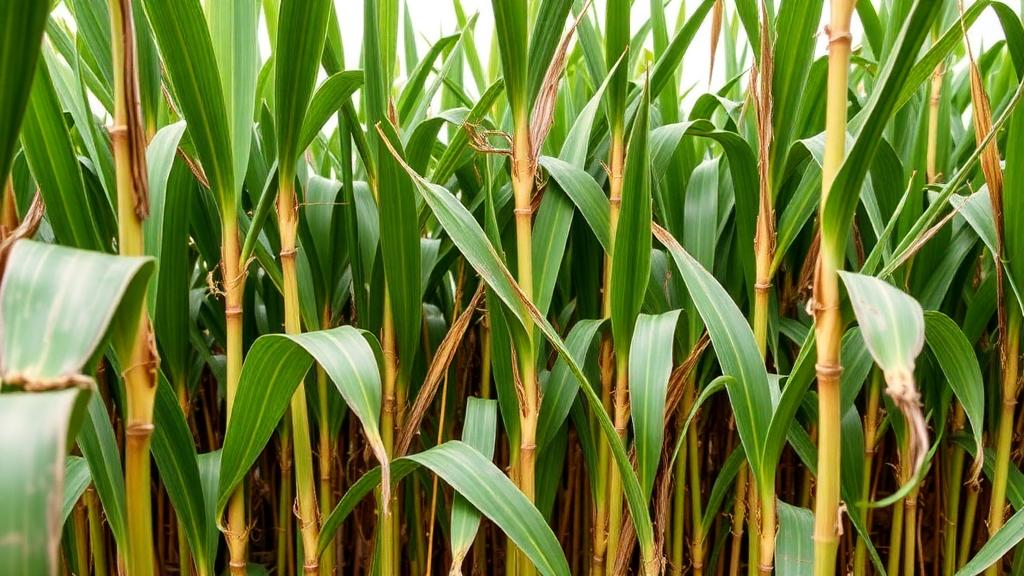
Drought is one of the most punishing constraints on global sugarcane production, and breeders have long looked to the crop’s wild relatives for genes that could help commercial varieties survive prolonged dry spells. One such relative, Narenga porphyrocoma, is a hardy grass that thrives where cultivated sugarcane wilts, making it an attractive reservoir of stress-resistance genes. But a new study published in BMC Plant Biology reveals that not every gene inherited from a drought-hardy wild species is a friend of drought tolerance. Researchers at the Guangxi Academy of Agricultural Sciences have characterized NpSCI2A, a member of the potato inhibitor I family of protease inhibitors, and shown that far from protecting plants against water stress, this protein actively undermines it by silencing a pair of essential chloroplast-associated enzymes.
The story begins with a seemingly counterintuitive observation. When the team surveyed gene expression in N. porphyrocoma plants subjected to prolonged drought, they found that NpSCI2A was significantly downregulated. In other words, as the wild plant battled dehydration, it dialed down production of this inhibitor rather than ramping it up. That pattern hinted that the protein might be something the plant wants less of under stress, a hypothesis the researchers tested by moving the gene into rice, a tractable model system with well-characterized drought responses, and observing what happened when NpSCI2A was overexpressed.
The results were striking. Transgenic rice lines carrying elevated levels of NpSCI2A became markedly more sensitive to drought. Under water-deficit conditions, the engineered plants displayed severe leaf wilting and suffered reduced survival rates compared with control plants. Physiological measurements painted a detailed picture of the damage: antioxidant enzyme activities dropped, while levels of hydrogen peroxide and malondialdehyde, a classic marker of lipid peroxidation and cellular damage, climbed. Together, these indicators showed that the overexpressing lines were accumulating reactive oxygen species faster than their antioxidant defenses could neutralize them, leaving cell membranes exposed to oxidative attack.
The photosynthetic machinery took a particularly heavy hit. Chlorophyll content fell, the maximum photochemical efficiency of photosystem II, measured as the Fv/Fm ratio, declined, and the net photosynthetic rate dropped significantly in the NpSCI2A-overexpressing plants under drought. Curiously, the intercellular CO2 concentration rose, a sign that the leaves were not consuming the carbon dioxide diffusing into them, consistent with a breakdown in the biochemical capacity of photosynthesis rather than a simple stomatal closure problem. Examination of chloroplast ultrastructure under the microscope confirmed the disruption, revealing that the organelles themselves were structurally compromised in the transgenic lines exposed to drought stress.
To understand how a single protease inhibitor could inflict such broad damage, the researchers turned to transcriptome sequencing. The analysis showed that NpSCI2A overexpression and drought stress acted additively to suppress a large suite of chloroplast- and photosynthesis-associated genes. Genes encoding components of the photosynthetic apparatus and chloroplast maintenance functions that would normally be induced or maintained under stress were pushed further down in the transgenic plants than in either the overexpression lines alone or the drought-treated controls alone. This additive suppression suggested that NpSCI2A was not merely a passive marker of stress but an active participant in dismantling the chloroplast’s functional gene network.
The next question was mechanistic: what molecular target could explain these effects? Protease inhibitors of the potato inhibitor I family are known to bind and block the active sites of specific proteolytic enzymes, and the most likely suspects were subtilases, a family of serine proteases that in plants perform a wide range of regulatory duties, from processing proteins to maintaining protein quality control inside organelles. Using co-expression profiling to identify candidates whose expression patterns tracked with NpSCI2A, followed by protein-protein interaction assays, the team identified two subtilases, SBT1.2 and SBT1.8, as direct physical partners of NpSCI2A.
The physical interaction was only half the story. In vitro enzyme activity assays demonstrated that NpSCI2A does not simply dock onto SBT1.2 and SBT1.8; it directly suppresses their protease activities. This is a crucial technical distinction, because it means the inhibitor is functionally competent, not just structurally capable of binding. In the overexpressing plants, the two subtilases would therefore be present but hobbled, unable to carry out whatever proteolytic housekeeping they normally perform. Given the downstream consequences for chloroplast structure and photosynthetic gene expression, the most coherent interpretation is that SBT1.2 and SBT1.8 contribute to chloroplast protein homeostasis, and that when NpSCI2A blocks them, the chloroplast’s internal quality-control system falters, proteins accumulate or fail to mature properly, and the organelle’s performance collapses under the additional burden of drought.
One of the most intriguing findings of the study is a paradox buried in the expression data. In the NpSCI2A-overexpressing lines under drought, the transcript levels of SBT1.2 and SBT1.8 were actually upregulated, even though their encoded proteins were being inhibited. The researchers interpret this as a compensatory transcriptional response: sensing that protease activity has fallen below the required threshold, the plant ramps up transcription in an attempt to restore functional enzyme levels. The attempt fails, of course, because the inhibitor continues to neutralize whatever enzyme is produced, but the feedback loop itself is informative. It reveals that plants monitor subtilase activity and respond to its deficit, and it suggests that the cell treats SBT1.2- and SBT1.8-mediated proteolysis as a resource worth defending even under stress.
Taken together, the findings establish NpSCI2A as a bona fide negative regulator of drought tolerance, acting through a pathway that connects protease inhibition to chloroplast dysfunction and oxidative damage. This is a notable conceptual contribution because protease inhibitors are usually discussed in the context of defense against herbivores and pathogens, where blocking an attacker’s digestive enzymes is clearly beneficial. The new work extends the framework to abiotic stress, showing that the same class of proteins can also regulate internal proteolytic programs with major consequences for how a plant weathers drought. It also provides a functional link between protease inhibitor-mediated proteolytic regulation and chloroplast function, a connection that had not been clearly drawn before.
For sugarcane improvement, the practical implications are twofold. First, NpSCI2A itself becomes a potential target for molecular breeding: varieties in which the gene is silenced or edited to lose its inhibitory capacity might be expected to maintain chloroplast integrity and photosynthetic performance longer under water stress, although any such intervention would need to account for whatever roles the protein plays in unstressed plants. Second, and more broadly, the study serves as a caution for introgression breeding. Wild relatives are treasure troves of adaptive alleles, but they also carry genes whose products can be detrimental in new genetic backgrounds or under specific conditions. The fact that N. porphyrocoma downregulates NpSCI2A during its own drought response suggests the wild plant knows something breeders should too: sometimes the key to stress tolerance is not adding genes, but knowing which ones to switch off.
Subject of Research: A protease inhibitor from a wild sugarcane relative that negatively regulates plant drought tolerance by inhibiting subtilase enzymes and impairing chloroplast function
Article Title: NpSCI2A, a potato inhibitor I protein from a wild sugarcane relative, negatively regulates drought tolerance by targeting subtilases
Article References: Li, S., Wang, R., Huang, S., Tang, Y., Zhu, K., Li, H., Zhou, H., Huang, H., Gui, Y., Wei, J., & Liu, X. (2026). NpSCI2A, a potato inhibitor I protein from a wild sugarcane relative, negatively regulates drought tolerance by targeting subtilases. BMC Plant Biology. https://doi.org/10.1186/s12870-026-09884-x
Image Credits: AI Generated
DOI: 10.1186/s12870-026-09884-x
Keywords: drought tolerance, sugarcane, Narenga porphyrocoma, protease inhibitor, subtilase, chloroplast, photosynthesis, oxidative stress, NpSCI2A, transcriptome, molecular breeding, plant physiology
Cite Scienmag News
Juliet Wilcox. (October 7, 2026). Wild Sugarcane Relative Yields a Protein That Quietly Undermines Drought Tolerance. Scienmag. https://scienmag.com/wild-sugarcane-relative-yields-a-protein-that-quietly-undermines-drought-tolerance/
Juliet Wilcox. "Wild Sugarcane Relative Yields a Protein That Quietly Undermines Drought Tolerance." Scienmag, 7 October 2026, https://scienmag.com/wild-sugarcane-relative-yields-a-protein-that-quietly-undermines-drought-tolerance/. Accessed 7 October 2026.
Juliet Wilcox. "Wild Sugarcane Relative Yields a Protein That Quietly Undermines Drought Tolerance." Scienmag. October 7, 2026. https://scienmag.com/wild-sugarcane-relative-yields-a-protein-that-quietly-undermines-drought-tolerance/


