


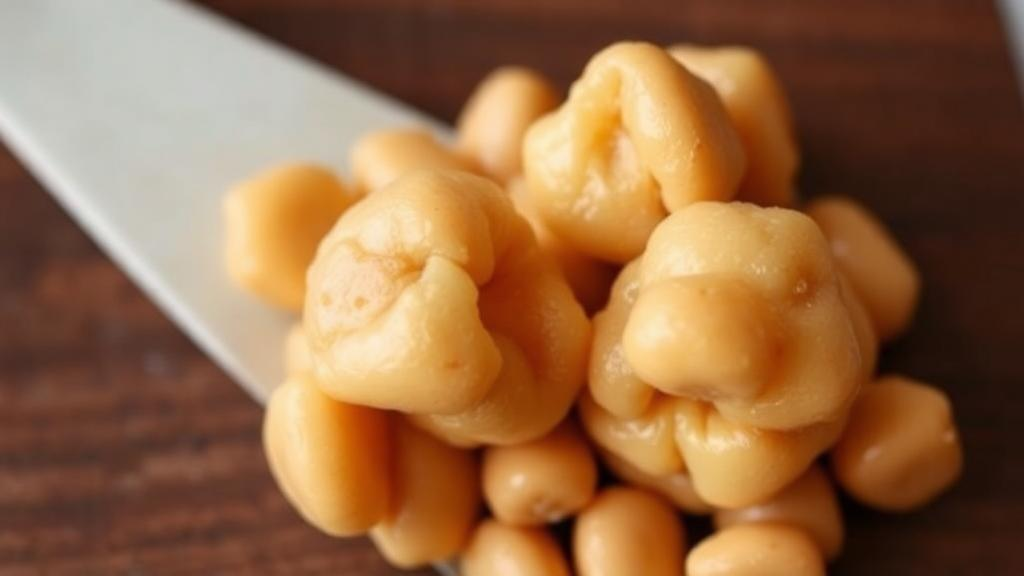
Archaeologists working at the Yongsan-dong site on the southern Korean Peninsula have identified amorphous charcoal lumps dating to approximately AD 200–400 as the remains of processed soybeans, offering what researchers describe as some of the earliest material evidence for a culinary practice that would eventually give rise to one of Korea’s most iconic foods: fermented soybean paste. The study, published in Archaeological and Anthropological Sciences by Minkoo Kim of Chonnam National University and Gong-Sun Song of the Honam Institute of Cultural Heritage, combines microscopic examination, stable isotope analysis, and experimental charring to argue that these unassuming blackened masses were once compacted soybean dough, an intermediate stage in the production of fermented bean paste.
The identification of processed plant foods is one of the most stubborn challenges in archaeobotany. Whole seeds and grains survive charring in recognizable form, preserving the diagnostic shapes of seed coats, embryos, and internal cell structures that allow specialists to assign remains to species. But once ancient cooks crushed, ground, or kneaded their ingredients, that diagnostic architecture was destroyed. What remains after charring is an amorphous lump of fused plant tissue, a feature that archaeologists often record generically as charcoal or food residue and move past. The Yongsan-dong lumps could easily have been dismissed as shapeless burnt debris had the researchers not subjected them to a battery of analytical tests.
Microscopic examination of the lumps revealed that they consisted exclusively of soybean tissue, with no evidence of other plant materials mixed in. This monocultural composition was itself informative. A lump of accidental kitchen waste or general fuel residue would be expected to contain a heterogeneous mixture of plant matter. Instead, the material was uniformly soybean, suggesting deliberate processing of a single ingredient. The researchers then turned to stable isotope analysis, measuring the ratios of carbon-13 to carbon-12 and nitrogen-15 to nitrogen-14 in the charred remains. Carbon isotope values in plants reflect the photosynthetic pathway of the species concerned, and soybean, as a C3 plant with a distinctive isotopic signature, could be distinguished from C4 crops such as millet. Nitrogen isotope values added a further line of evidence, since legumes like soybean fix atmospheric nitrogen through their symbiotic relationship with soil bacteria, giving them characteristically low nitrogen isotope ratios compared with plants that depend on soil nitrogen alone.
Isotopic data alone could not settle the question of how the soybeans had been processed, so the team turned to experiment. Under controlled laboratory conditions, they carbonized whole soybeans as well as soybean-based food products, replicating the charring that occurs when food is accidentally burnt or discarded into a fire. The morphological changes that whole beans undergo during carbonization are well documented: seeds swell, crack, and distort in predictable ways. The ancient lumps did not match the appearance of charred whole beans. Instead, the experimental results indicated that the archaeological material had been shaped into a dough-like form before it was charred, meaning the soybeans had been crushed and reconstituted into a compact mass prior to their encounter with fire.
The closest modern analogue for such a product is meju, the traditional Korean fermented soybean block that serves as the foundation for doenjang, Korea’s fermented soybean paste, and for kanjang, its soy sauce. In the traditional production process, whole soybeans are boiled, crushed, and formed into dense blocks that are then allowed to ferment, during which naturally occurring molds and bacteria break down proteins and generate the deep savory flavors, the umami compounds, that define Korean fermented foods. The researchers are careful to note a crucial limitation: fermentation itself cannot be directly demonstrated in the charred remains. Microbial activity leaves no morphological trace that survives carbonization, and the lumps could in principle represent an unfermented dough product. What the evidence does establish is that the processing step, the transformation of whole beans into compact masses, existed by the early centuries AD.
To test whether the Yongsan-dong lumps were an isolated curiosity or part of a broader pattern, the researchers extended their investigation to similar amorphous remains from four additional archaeological sites on the southern Korean Peninsula. The comparative analysis corroborated the interpretation, suggesting that the practice of processing soybeans into lumps was established across the region as early as AD 200, with related remains continuing into the following centuries. This chronological and geographic spread places the practice squarely within the period of early state formation on the peninsula, the era of the Samhan polities that preceded the Three Kingdoms, when agricultural intensification and social stratification were transforming Korean society.
The functional logic of processing soybeans into compact masses is compelling from the standpoint of food storage. Whole dried soybeans store reasonably well, but they are vulnerable to pests, moisture, and spoilage, and they require lengthy cooking before consumption. Crushing the beans and forming them into dense blocks reduces their volume, concentrates their nutrients, and creates a product that can be stored for extended periods and reconstituted as needed. Fermentation, when it occurs, adds a further preservation benefit by producing acids and antimicrobial compounds that inhibit spoilage organisms, while simultaneously generating the amino acids and flavor compounds that make fermented paste such a potent seasoning. In other words, the same process that kept food edible through lean seasons also made it delicious, a convergence of necessity and pleasure that characterizes many of the world’s great fermented food traditions.
Historical and ethnographic sources enrich this material picture. Early Korean historical texts, including the Samguk Sagi, the twelfth-century history of the Three Kingdoms, contain references to fermented soybean products, and later ethnographic documentation records the central place of jang, the family of fermented soybean condiments, in Korean household economy. Traditional meju production was a domestic activity, typically carried out by households in late autumn, with soybean blocks hung from rafters to ferment over the winter. The archaeological lumps suggest that the technological and culinary knowledge underpinning this tradition was already in place well over a millennium before such documentary records, pushing the deep history of Korean fermented foods back to the early centuries of the Common Era.
The study also speaks to broader questions in the archaeology of food. Soybean is a legume of remarkable nutritional value, rich in protein and, through its biological nitrogen fixation, beneficial to the soils in which it is grown. Archaeobotanical work has traced soybean cultivation in East Asia over thousands of years, but the archaeological record of how ancient peoples transformed the raw bean into food has remained thin, dominated by finds of whole seeds that say little about cuisine. By demonstrating that amorphous charred lumps can be identified to species and assigned to processing stages through the combined application of microscopy, stable isotope analysis, and experimental charring, the researchers offer a methodological template that other archaeobotanists can apply to shapeless plant remains elsewhere in the world.
The social dimensions of the find are equally intriguing. Fermented condiments occupy a special position in Korean foodways, functioning not merely as flavorings but as markers of household identity, seasonal rhythm, and, in stratified societies, status. Previous research on foodways in the ancient Baekje Kingdom has shown that feasting and culinary practice were entangled with social differentiation, and the emergence of a paste-making technology in the early centuries AD may reflect both the agricultural surpluses and the developing tastes of increasingly complex societies. Whether the Yongsan-dong lumps represent everyday household provisioning, communal food preparation, or something more ceremonial cannot be determined from the charred evidence alone. What can be said is that nearly two millennia ago, communities on the southern Korean Peninsula were already manipulating soybeans in ways that their descendants would refine into a culinary tradition that continues to shape Korean identity, and global appetites, today.
Subject of Research: Archaeobotanical identification of processed soybean remains from ancient Korean sites and their implications for legume storage and culinary practices
Article Title: Processed soybean remains from ancient Korean sites: archaeobotanical insights into legume storage and culinary practices
Article References: Kim, M., & Song, G.-S. (2026). Processed soybean remains from ancient Korean sites: archaeobotanical insights into legume storage and culinary practices. Archaeological and Anthropological Sciences, 18(11), Article 213. https://doi.org/10.1007/s12520-026-02580-9
Image Credits: AI Generated
DOI: 10.1007/s12520-026-02580-9
Keywords: soybean, archaeobotany, fermented soybean paste, meju, stable isotope analysis, Korea, food storage, culinary practices, charred plant remains, Yongsan-dong, legume processing, ancient foodways
Cite Scienmag News
Courtney Benton. (October 7, 2026). Charred Soybean Lumps Reveal 1,800-Year-Origins of Korea’s Fermented Paste Tradition. Scienmag. https://scienmag.com/charred-soybean-lumps-reveal-1800-year-origins-of-koreas-fermented-paste-tradition/
Courtney Benton. "Charred Soybean Lumps Reveal 1,800-Year-Origins of Korea’s Fermented Paste Tradition." Scienmag, 7 October 2026, https://scienmag.com/charred-soybean-lumps-reveal-1800-year-origins-of-koreas-fermented-paste-tradition/. Accessed 7 October 2026.
Courtney Benton. "Charred Soybean Lumps Reveal 1,800-Year-Origins of Korea’s Fermented Paste Tradition." Scienmag. October 7, 2026. https://scienmag.com/charred-soybean-lumps-reveal-1800-year-origins-of-koreas-fermented-paste-tradition/


