


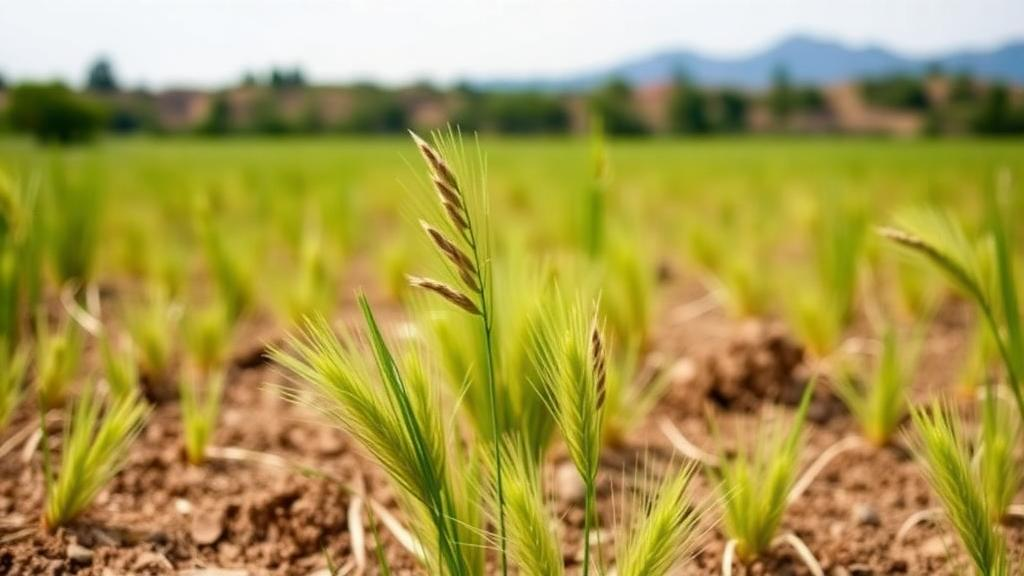
In the drought-prone Bundelkhand region of central India, where summer temperatures can climb to 49 degrees Celsius and nearly all of the year’s roughly 908 millimeters of rain falls in just four monsoon months, a nine-year field experiment has delivered some of the clearest evidence yet that the right perennial grass can rebuild a broken landscape. Researchers at the ICAR-Indian Grassland and Fodder Research Institute in Jhansi set out to answer a deceptively simple question: if you plant degraded semi-arid farmland with perennial grasses, which species actually restores the soil best, and does it matter whether you irrigate? Their answer, published in the open-access journal Discover Soil, carries practical weight for the roughly one-quarter of Earth’s land surface now classified as degraded.
The team, led by Mukesh Choudhary and Mahendra Prasad, compared four perennial grasses over nine consecutive growing seasons from 2015-16 to 2023-24: guinea grass (Megathyrsus maximus), a tri-specific hybrid (TSH), the bajra-napier hybrid (BNH), and the hardy rangeland grass Cenchrus ciliaris. Each species was grown under two contrasting moisture regimes, rainfed and irrigated, in a factorial randomized block design with three replications. The starting point was a sandy clay loam classified as a Typic Haplustept, with soil organic carbon of just 5.0 grams per kilogram in the top 15 centimeters, available nitrogen of 170 kilograms per hectare, and the low fertility typical of a region battered by recurrent drought, shallow undulating soils, and potential evapotranspiration of 2,565 millimeters per year.
The headline finding is that guinea grass emerged as the standout restoration champion. Under irrigation it produced a mean green fodder yield of 85.9 tonnes per hectare and dry fodder yield of 20.4 tonnes per hectare, increases of 37.0 and 28.3 percent over rainfed conditions. More importantly for soil health, irrigated guinea grass plots recorded the highest total organic carbon of any treatment, 9.56 grams per kilogram in the surface soil, along with the greatest hot water soluble carbon (146.13 milligrams per kilogram), particulate organic carbon (6.12 grams per kilogram), labile carbon (371.75 milligrams per kilogram), and soil microbial biomass carbon (365.83 micrograms per gram). These values exceeded the tri-specific hybrid, bajra-napier hybrid, and Cenchrus ciliaris by margins ranging from 2 percent to as much as 234 percent depending on the indicator.
Across all species, irrigation proved a powerful amplifier of both productivity and soil recovery. Green fodder yields rose by 11.9 to 44.7 percent under irrigation compared with rainfed conditions, and dry yields by 5.5 to 34.4 percent. Below ground, irrigation lifted total organic carbon by about 5 percent, hot water soluble carbon by roughly 19 percent, particulate organic carbon by about 12 percent, labile carbon by around 6 percent, and microbial biomass carbon by approximately 23 percent. Carbon buildup relative to the experiment’s starting conditions ranged from 3 to 41 percent under rainfed management and climbed to 5 to 49 percent with irrigation, with guinea grass and the tri-specific hybrid consistently at the top of that range. Available nitrogen, phosphorus, and potassium followed the same pattern, with guinea grass under irrigation increasing nutrient availability by 5.8 to 16.6 percent relative to its rainfed counterpart.
To move beyond single measurements, the researchers deployed two composite metrics. The carbon management index, which combines a carbon pool index with a lability index against a reference fallow soil, exceeded 185 under guinea grass in both moisture regimes, a value well above the threshold of 100 that signals sustainable soil management. Under irrigation, guinea grass posted a carbon management index 21, 45, and 75 percent higher than the tri-specific hybrid, bajra-napier hybrid, and Cenchrus ciliaris respectively. The team also introduced a restoration efficiency index, a weighted composite integrating productivity, soil fertility, microbial health, and soil carbon dynamics, with biological recovery and carbon restoration weighted at 0.30 each. Guinea grass scored above 80 percent, the study’s threshold for high restoration efficiency, in both rainfed (86.7 percent) and irrigated (84.8 percent) conditions, while Cenchrus ciliaris languished at the bottom.
Interestingly, the tri-specific hybrid revealed a different kind of strength. Although its absolute yields and carbon metrics trailed guinea grass, it suffered the smallest penalty when the irrigation was switched off: its irrigated green fodder yield of 78.6 tonnes per hectare was only 12.0 percent above its rainfed yield, and its dry yield just 5.5 percent higher. That drought resilience translated into moderate restoration efficiency under rainfed conditions, with a carbon management index of at least 150 and a restoration efficiency index above 60 percent. The authors’ practical recommendation therefore splits by context: guinea grass for maximizing biomass and soil carbon restoration wherever water allows, and the tri-specific hybrid as the more reliable choice for purely rainfed systems.
The study also probed the quality and vertical distribution of the carbon being accumulated. The recalcitrant index, the proportion of carbon resistant to acid hydrolysis, varied only narrowly, from 95.91 to 97.13 percent, with Cenchrus ciliaris and the bajra-napier hybrid tending toward slightly higher values. The authors interpret the lower recalcitrant index under guinea grass and the tri-specific hybrid not as a weakness but as evidence of active carbon cycling, with abundant labile fractions turning over rapidly in these biologically vigorous rhizospheres. In soils this depleted, they argue, carbon sink strength is limited primarily by the quantity of carbon inputs rather than by the soil’s capacity to stabilize them. Stratification ratios, comparing surface to subsurface carbon pools, ranged from 0.89 to 1.22 and trended higher under irrigation, consistent with litter, fine root turnover, and rhizodeposition enriching the upper 15 centimeters of the profile.
Correlation and network analyses added a systems-level view of how restoration proceeds. Soil organic carbon correlated almost perfectly with total organic carbon (r = 1.00) and very strongly with microbial biomass carbon (r = 0.97), particulate organic carbon (r = 0.95), labile carbon (r = 0.95), and the carbon management index (r = 0.95). Microbial biomass carbon itself tracked available nitrogen at r = 0.99. Within the correlation network, built from significant correlations of r at or above 0.85, the variables with the greatest connector importance were the carbon management index, labile carbon, microbial quotient, particulate organic carbon, and microbial biomass carbon, marking them as the most informative sentinels of recovery. The restoration efficiency index behaved differently, correlating negatively with these indicators, which the authors attribute to the mathematical structure of the composite index rather than any biological trade-off, and they candidly flag indicator redundancy and the author-defined weighting scheme as limitations requiring validation in independent datasets.
The broader significance is considerable. Land degradation undermines food security, biodiversity, and climate resilience worldwide, and restoring degraded lands is embedded in the United Nations Sustainable Development Goals. Perennial grasses work as restoration agents because their deep, persistent root networks pump carbon below ground year after year, stabilize aggregates, reduce erosion, and feed the microbial communities that drive nutrient cycling. This trial shows that species choice and water availability jointly determine how fast that recovery happens, and it offers farmers and land managers in semi-arid regions a concrete, evidence-based menu: guinea grass where biomass and carbon gains are the priority, the tri-specific hybrid where drought risk dominates. The authors caution that the study covered a limited set of species in a single semi-arid environment, that the persistence of these gains under future climate variability remains untested, and that microbial community dynamics, greenhouse gas fluxes, and economic feasibility were beyond its scope. Still, after nine years of monitoring, the message from Bundelkhand is unusually clear: the humblest of crops, a well-chosen perennial grass, may be among the cheapest and most effective tools humanity has for putting carbon, fertility, and life back into exhausted soil.
Subject of Research: Long-term comparative evaluation of perennial grass species for restoring soil carbon and fertility in degraded semi-arid agroecosystems under rainfed and irrigated conditions
Article Title: Comparative assessment of perennial grasses for restoring degraded semi-arid agroecosystems under contrasting moisture regimes
Article References: Choudhary, M., Prasad, M., Dixit, A. K., Kantwa, S. R., Mahawer, S. K., & Palsaniya, D. R. (2026). Comparative assessment of perennial grasses for restoring degraded semi-arid agroecosystems under contrasting moisture regimes. Discover Soil, 3(1), Article 182. https://doi.org/10.1007/s44378-026-00342-6
Image Credits: AI Generated
DOI: 10.1007/s44378-026-00342-6
Keywords: perennial grasses, soil restoration, soil organic carbon, semi-arid agroecosystems, carbon management index, restoration efficiency index, guinea grass, land degradation, soil microbial biomass, irrigation, fodder productivity, Bundelkhand
Cite Scienmag News
Alan Morgan. (October 7, 2026). Nine-Year Field Trial Reveals Which Perennial Grasses Best Restore Degraded Semi-Arid Soils. Scienmag. https://scienmag.com/nine-year-field-trial-reveals-which-perennial-grasses-best-restore-degraded-semi-arid-soils/
Alan Morgan. "Nine-Year Field Trial Reveals Which Perennial Grasses Best Restore Degraded Semi-Arid Soils." Scienmag, 7 October 2026, https://scienmag.com/nine-year-field-trial-reveals-which-perennial-grasses-best-restore-degraded-semi-arid-soils/. Accessed 7 October 2026.
Alan Morgan. "Nine-Year Field Trial Reveals Which Perennial Grasses Best Restore Degraded Semi-Arid Soils." Scienmag. October 7, 2026. https://scienmag.com/nine-year-field-trial-reveals-which-perennial-grasses-best-restore-degraded-semi-arid-soils/


