


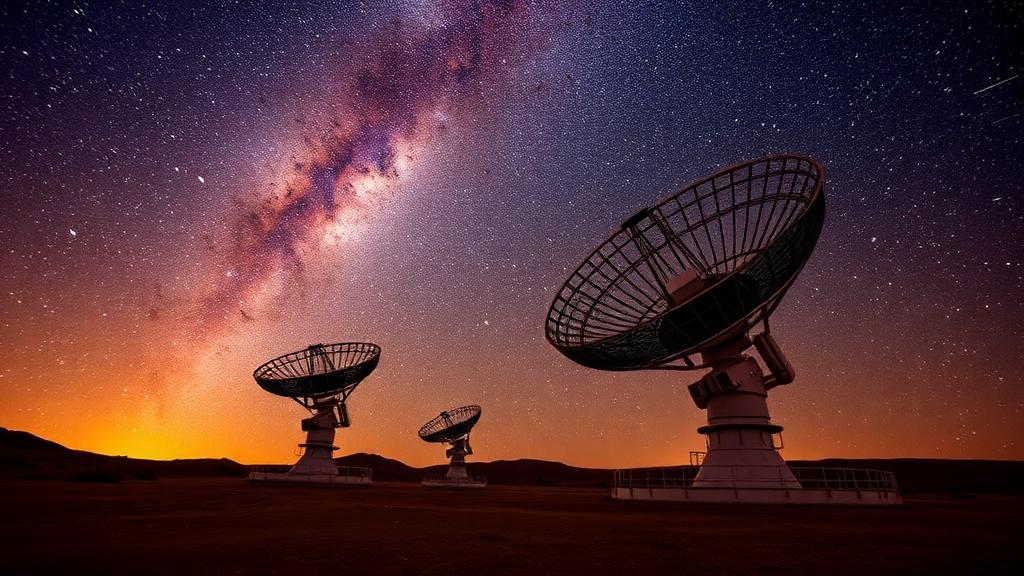
Deep in the semi-arid expanse of the Karoo, a remote region of South Africa’s Northern Cape, some of the most sensitive radio telescopes ever built are now scanning the southern sky for signals from the early universe. Yet according to new research published in the Journal of Science Communication, the arrival of the MeerKAT array and the Square Kilometre Array’s SKA-Mid telescope does not mark the beginning of astronomy in this landscape. It marks the latest chapter in a story of sky-watching that stretches back thousands of years, told by communities descended from the San, whose ancestors observed, named and interpreted the heavens long before radio receivers or optical observatories existed.
The research, conducted by South African specialist in engagement, communication and stakeholder management Anton Binneman, reflects on roughly a decade of meetings with elders and knowledge holders from Indigenous communities descended from the San. The work took shape in the context of the construction of MeerKAT and the development of SKA-Mid, two major telescope projects in the South African Karoo, and formed part of the environmental and social impact assessment required before these facilities could be built. Rather than treating Indigenous knowledge as a static relic to be catalogued, the study set out to understand how it has changed, what has survived, and how it might enter into genuine dialogue with modern science.
One of the central findings challenges a widespread assumption about traditional knowledge: that it is frozen in time, preserved unchanged from some distant past. Binneman’s work demonstrates the opposite. Indigenous narratives, like the communities that tell them, evolve continuously, incorporating new linguistic, religious and social elements, and today even scientific ones. Stories are retold in changing languages, adapted to new circumstances, and reinterpreted by each generation. What survives is not a fixed text but a living relationship with the sky, one that has bent and reshaped itself under the pressures of colonialism, industrialisation and Westernisation without disappearing entirely.
The practical trigger for the research was the international SKA Observatory’s requirement to assess the environmental and social impact of its new telescope. As part of that process, Binneman investigated the ethnoastronomical knowledge of the communities living around the site. To map what remained of this knowledge and how it had transformed over time, workshops were organised in seven locations around the SKA site. These gatherings involved around 52 elders and knowledge holders recognised as such by their own communities, ensuring that the people consulted carried genuine standing and authority in local eyes.
A crucial entry point for these conversations was the Bleek and Lloyd archive, a remarkable nineteenth-century collection that recorded many San narratives, including stories about the sky, in the late 1800s. During the workshops, participants were shown images of celestial objects together with stories drawn from this archive. The prompt was simple and open-ended: tell us what you see and what stories you know about this object. The activities also included evening observations of the sky itself, and when elders were unable to attend the workshops in person, the team conducted home visits and interviews instead, extending the reach of the study beyond the formal meeting rooms.
Binneman is careful to note that the archive could not simply be used as it stood. The collection is strongly shaped by the beliefs of the white researchers who created it at the time, embedding colonial-era assumptions in its very structure. Instead of treating it as an authoritative record of an authentic past, the project used it as a starting point for dialogue with the communities themselves. The archive supplied fragments and prompts; the living memory of the elders supplied meaning, correction and continuity. This methodological choice, treating historical material as a conversation partner rather than a final authority, became a foundation of the approach that emerged from the work.
The findings reveal a highly selective pattern of continuity. Knowledge connected to everyday life has remained far more vivid than complex cosmological narratives. Venus, for example, is still remembered in the region as boer se horlosie, the farmer’s clock, because its appearances in the morning and evening sky traditionally marked the beginning and end of daily activities. This is astronomy in its most practical and durable form, tied to the rhythms of work and survival rather than to abstract theory. It demonstrates how the most functionally embedded elements of sky knowledge resist erosion even as more elaborate narratives fade.
Elsewhere, only fragments have survived. The Milky Way is still called Hemelstraat, the road in the sky, but few people now connect the name with the old |Xam story of the girl who threw ashes into the heavens so that a little light would be made. Binneman observes that older generations still remember these stories, whereas among younger people they are no longer part of living, practised knowledge. Yet this does not mean the stories have simply vanished. They continue to exist, he explains, but their form has adapted in response to colonialism, industrialisation and Westernisation. The narratives persist as cultural material capable of being reawakened, reinterpreted and passed on in new forms.
Out of this decade of engagement grew the Dialogical Knowledge Renewal Model, the study’s central contribution. The approach deliberately does not attempt to recover a supposedly authentic tradition, an idea the research treats as both impossible and misguided given how knowledge actually evolves. Instead, it brings three sources into structured dialogue: historical archives such as Bleek and Lloyd, the living memory of community elders, and contemporary scientific astronomy. Crucially, the model then returns the results of that process to the local area, so that communities benefit directly from the renewed knowledge rather than merely supplying raw material for outside researchers.
The practical outcomes in the Karoo are already visible. The project has contributed to the training of local astronomy guides and to the development of astrotourism in the region, creating economic and educational pathways rooted in the area’s own heritage. But Binneman emphasises that the impact is also symbolic, and perhaps more profound. Recognising the region’s long history of observing the sky helps communities see the SKA not as the arrival of astronomy in a place where it had never existed, but as a new part of their own history. As he puts it, the work restores dignity to people, because the first astronomers were not those who built MeerKAT or the SKA. In the shadow of dishes tuned to the cosmic dawn, the oldest astronomy of the Karoo is being written back into the record.
Subject of Research: Indigenous San ethnoastronomy and cultural memory in the Square Kilometre Array construction area in South Africa
Article Title: The SKA Project: Just the latest chapter in a story thousands of years old
Article References: The SKA Project: Just the latest chapter in a story thousands of years old. (n.d.). Original publication
Image Credits: AI Generated
DOI: Not provided
Keywords: SKA Observatory, MeerKAT, San people, ethnoastronomy, Indigenous knowledge, Karoo, cultural memory, Bleek and Lloyd archive, science communication, astrotourism, radio astronomy, South Africa
Cite Scienmag News
Grant Pearson. (October 7, 2026). SKA Telescopes Reveal Living Legacy of the World’s First Astronomers. Scienmag. https://scienmag.com/ska-telescopes-reveal-living-legacy-of-the-worlds-first-astronomers/
Grant Pearson. "SKA Telescopes Reveal Living Legacy of the World’s First Astronomers." Scienmag, 7 October 2026, https://scienmag.com/ska-telescopes-reveal-living-legacy-of-the-worlds-first-astronomers/. Accessed 7 October 2026.
Grant Pearson. "SKA Telescopes Reveal Living Legacy of the World’s First Astronomers." Scienmag. October 7, 2026. https://scienmag.com/ska-telescopes-reveal-living-legacy-of-the-worlds-first-astronomers/


