


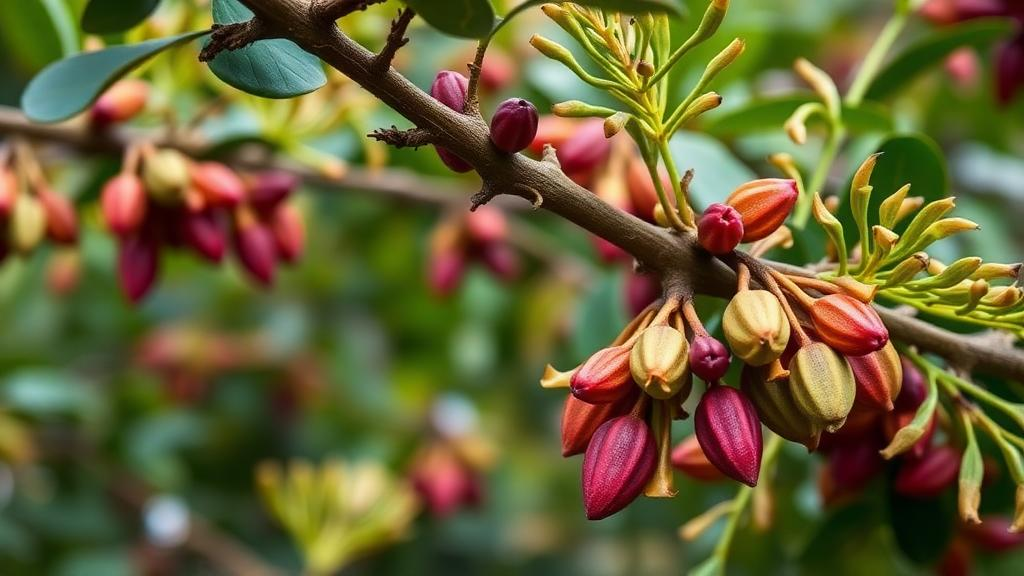
Deep in Ghana’s humid cocoa belt, an unassuming parasite is rewriting the rules of tree nutrition. A new field study of smallholder cocoa farms has found that the hemiparasitic mistletoe Tapinanthus bangwensis does far more than weaken the branches it colonises: it systematically reshapes the distribution of mineral nutrients inside its host, depleting some essential elements while leaving others to accumulate to unusual levels. The findings, published in Discover Plants, suggest that one of West Africa’s most persistent cocoa pests is also a hidden driver of foliar nutrient imbalance, with direct consequences for how farmers and agronomists interpret leaf tests and fertiliser recommendations.
Mistletoes are among the most widespread canopy-dwelling parasitic plants in the world. Unlike fully parasitic species, hemiparasites such as T. bangwensis retain the ability to photosynthesise, but they rely on haustorial connections to tap into the vascular tissues of their hosts, drawing water, dissolved minerals and carbon compounds through these physiological lifelines. Because mistletoes transpire at exceptionally high rates, they maintain powerful water potential gradients that pull xylem sap preferentially through their own tissues rather than through the leaves of the host branch. Over time, this can turn the parasite into a mineral nutrient trap, accumulating elements at concentrations equal to or greater than those found in the foliage it feeds upon.
In cocoa, this interaction matters enormously. The crop depends on a carefully balanced supply of nitrogen, phosphorus, potassium, calcium, magnesium and a suite of micronutrients to sustain canopy growth, energy metabolism, stomatal regulation and the transport of assimilates that ultimately fill cocoa pods. Conventional nutrient management in cocoa systems rests on two pillars: soil fertility assessment and foliar nutrient diagnosis. Soil analyses indicate what is available for uptake, while leaf analyses provide an integrated snapshot of the tree’s actual nutritional status. The implicit assumption is that leaf chemistry largely mirrors soil supply. The new study shows that a parasite can break that assumption.
The scale of the mistletoe problem in West African cocoa is substantial. Surveys in Cameroon have reported infestation incidences exceeding 40 percent in some cocoa-growing communities, with the mistletoe Phragmanthera lapathifolia among the most common offenders. In Ghana, previous work has estimated that roughly 14 percent of all cocoa trees carry mistletoe, and more than 70 percent of those infestations involve T. bangwensis. Farmers readily recognise the visible symptoms, including branch weakening and dieback, but the nutritional consequences of infestation have remained poorly quantified, particularly in perennial tropical crops where nutrient cycling is complex and slow to respond to intervention.
To address this gap, a research team led by Michael Ansong of Kwame Nkrumah University of Science and Technology sampled fifteen smallholder cocoa farms across five communities in the Ahafo Ano North and Sefwi Wiawso districts of Ghana between May and July 2024. The farms, which averaged 0.90 hectares, sit within the humid cocoa belt on predominantly Ferralsols and Acrisols, receiving between roughly 1,300 and 1,750 millimetres of rain annually. On each farm, the researchers selected a pair of mature cocoa trees: one visibly infested with at least one active T. bangwensis plant attached to a main or secondary branch, and one confirmed uninfested after careful canopy inspection. The paired trees were matched for stem diameter, height, productive stage, canopy condition and shade environment, minimising confounding variation between the two members of each comparison.
Sampling was deliberately precise. From each infested tree, the team collected four mature, fully expanded cocoa leaves from the branch bearing the mistletoe, taken close to the attachment point and free of disease, herbivory or senescence. Four comparable leaves were taken from the same canopy positions on the uninfested partner tree, and four mature mistletoe leaves were harvested from the same infested branch. Each sample type was composited at the tree level. A single composite soil sample per farm, drawn from the 0 to 20 centimetre depth at five representative positions, characterised background farm fertility. All plant and soil samples were analysed at the university’s Soil Science Laboratory using standard methods: Kjeldahl digestion for nitrogen, molybdenum-blue colorimetry for phosphorus, EDTA titration for calcium and magnesium, turbidimetry for sulphur, flame photometry for potassium, and atomic absorption spectroscopy for iron, copper, zinc and manganese.
The results revealed a strikingly selective pattern of nutrient redistribution rather than a blanket depletion. Infested cocoa leaves contained significantly lower concentrations of nitrogen, phosphorus, potassium and copper than leaves from their uninfested partners. These are nutrients with high physiological stakes: nitrogen and phosphorus drive canopy development and energy metabolism, potassium governs stomatal regulation and assimilate transport, and copper, though needed only in trace amounts, is essential for enzyme activity, photosynthetic electron transport and oxidative stress defences. In contrast, infested leaves showed significantly higher concentrations of calcium and magnesium, while sulphur, iron, zinc and manganese showed no significant differences. The parasite, in other words, does not simply starve its host; it reorganises the host’s internal nutrient economy.
The elevated calcium and magnesium in infested leaves point to a plausible mechanism rooted in water relations. Because mistletoes transpire so vigorously, water arriving through the host branch is diverted through parasite tissues, reducing the flow that would otherwise deliver dissolved minerals to host leaves. Calcium and magnesium are relatively immobile once deposited in leaf tissues, so under this altered flow regime they can accumulate in older foliage rather than being redistributed to actively growing regions of the canopy. The mistletoe leaves themselves told a complementary story: they contained significantly higher concentrations of phosphorus, potassium, calcium, magnesium, sulphur and manganese than the host leaves on the same branch, confirming their role as nutrient-enriched sinks. Differences in nitrogen, iron, copper and zinc between parasite and host were not statistically significant.
Crucially, the team went beyond simple paired comparisons. Using nutrient-specific linear mixed-effects models, with infestation status and the corresponding soil nutrient as fixed effects and farm identity as a random intercept, they tested whether the infestation signal persisted once measured farm-level soil fertility was taken into account. It did. Soil phosphorus, calcium, magnesium, copper and zinc were significant predictors of the corresponding leaf nutrients, confirming that background fertility matters, but infestation remained significantly associated with lower leaf nitrogen, phosphorus, potassium and copper and higher leaf calcium and magnesium even after soil covariates were included. Soil sulphur, iron and manganese were not significant predictors of their leaf counterparts. Measured soil nutrients explained part, but not all, of the variation in cocoa leaf chemistry, leaving parasite-mediated redistribution as an independent and influential factor.
The practical implications are considerable. If low nutrient concentrations in infested cocoa leaves were caused purely by poor soil, fertiliser would correct them. But because the parasite acts as a sink that diverts nutrients after the host has already absorbed them, fertiliser alone is unlikely to restore balance while active mistletoe remains attached. The authors argue that foliar diagnosis in infested trees should always be interpreted alongside infestation status, and that soil fertility management will be most effective when combined with early detection, timely pruning and complete removal of active parasite tissues. For smallholder farmers, where fertiliser access is limited and mistletoe control demands labour-intensive manual pruning, that combined strategy may determine whether cocoa canopies, and the beans they produce, reach their full potential. The study also cautions that its farm-level soil sampling, one composite per farm, cannot capture tree-specific nutrient supply, and that future work with tree-level soil data, wider chemical characterisation and yield measurements would strengthen the soil-leaf-parasite picture. What is already clear, however, is that a parasite long treated as a visible nuisance is also an invisible accountant, quietly rewriting the nutrient ledgers of the trees it inhabits.
Subject of Research: Nutrient allocation between hemiparasitic mistletoe and its cocoa host trees
Article Title: Hemiparasitic mistletoe, Tapinanthus bangwensis, alters nutrient allocation in cocoa host-parasite systems
Article References: Ansong, M., Musah, S. A., Owusu, P., & Boadu, K. B. (2026). Hemiparasitic mistletoe, Tapinanthus bangwensis, alters nutrient allocation in cocoa host-parasite systems. Discover Plants, 3(1), Article 446. https://doi.org/10.1007/s44372-026-00936-y
Image Credits: AI Generated
DOI: 10.1007/s44372-026-00936-y
Keywords: mistletoe, Tapinanthus bangwensis, cocoa, hemiparasitic plants, nutrient allocation, foliar diagnosis, soil fertility, Ghana, host-parasite interaction, plant physiology, smallholder farms, mineral nutrition
Cite Scienmag News
Alan Morgan. (October 7, 2026). Mistletoe quietly drains cocoa trees of key nutrients, Ghana study reveals. Scienmag. https://scienmag.com/mistletoe-quietly-drains-cocoa-trees-of-key-nutrients-ghana-study-reveals/
Alan Morgan. "Mistletoe quietly drains cocoa trees of key nutrients, Ghana study reveals." Scienmag, 7 October 2026, https://scienmag.com/mistletoe-quietly-drains-cocoa-trees-of-key-nutrients-ghana-study-reveals/. Accessed 7 October 2026.
Alan Morgan. "Mistletoe quietly drains cocoa trees of key nutrients, Ghana study reveals." Scienmag. October 7, 2026. https://scienmag.com/mistletoe-quietly-drains-cocoa-trees-of-key-nutrients-ghana-study-reveals/


