


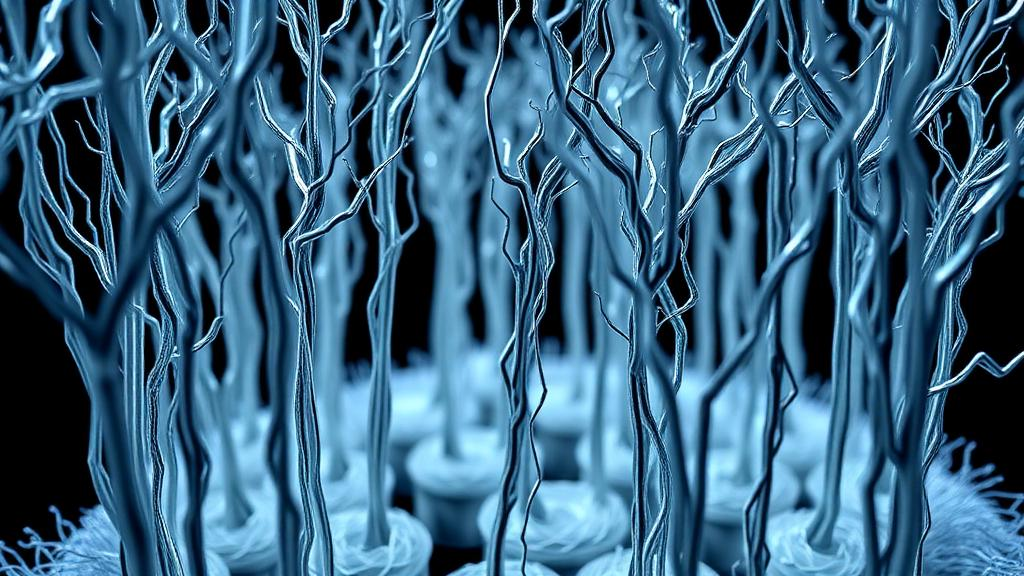
Reaching the summit of a mountain rarely demands a single path. Climbers can approach the same peak from different valleys, following routes that look nothing alike on a map yet deliver them to precisely the same point. A new study published in National Science Review suggests that the same principle governs one of nanotechnology’s most delicate manufacturing challenges: growing a forest of carbon nanotubes with exactly the height, density and alignment that an engineer specifies. Using an artificial intelligence framework that works backward from a desired structure to the conditions that produce it, researchers have shown that several genuinely different processing recipes can converge on the same structural target, a finding that could reshape how scientists think about controlled synthesis at the nanoscale.
Carbon nanotubes are hollow cylinders of carbon atoms with walls only one atom thick in their most extreme form, yet they possess remarkable mechanical strength, thermal conductivity and electrical properties. When millions of them grow simultaneously on a substrate, they rise in parallel like blades of grass, forming what researchers call an array or, more evocatively, a nanotube forest. The way this forest stands, how tall it grows, how tightly packed the individual tubes are, and how well they align with one another, determines how the material performs in real devices. Thermal interface materials rely on dense, well-aligned arrays to channel heat away from hotspots in electronics. Energy storage electrodes benefit from high surface area and controlled porosity. Flexible electronics demand forests that can bend and recover without collapsing. In each case, the macroscopic usefulness of the material traces directly back to those three structural descriptors: height, density and alignment.
The trouble is that these descriptors cannot be tuned independently. Growing nanotube forests typically relies on chemical vapour deposition, a process in which a carbon feedstock gas decomposes on catalytic nanoparticles, allowing tubes to grow upward from the surface. Water-assisted chemical vapour deposition, the variant used in this study, introduces controlled amounts of water vapour to keep the catalyst active and extend growth. But the process is a web of interdependent variables. Raising the growth temperature might accelerate catalysis and increase height, while simultaneously altering how quickly the catalyst particles sinter or deactivate, which in turn changes tube density. Adjusting gas flows, treatment times, or the timing of water injection can shift several structural features at once. A modification that nudges height toward its target may push density or alignment further away, forcing researchers into laborious trial-and-error cycles. The scale of the search space is staggering: with eight processing variables and even ten candidate settings per variable, the number of possible combinations reaches one hundred million.
To tame this complexity, the research team, drawn from Huazhong University of Science and Technology and Beihang University, developed an AI-assisted inverse-design framework. Inverse design flips the usual logic of materials synthesis. Instead of running an experiment and measuring what comes out, the researcher specifies the outcome first, the desired height, density and alignment, and asks an algorithm to find the processing conditions most likely to deliver it. The team began by assembling an experimental database of two hundred distinct recipes for water-assisted chemical vapour deposition, each recording the full set of processing conditions alongside the structural features of the resulting array. A neural network then absorbed this dataset, learning the intricate mapping from processing space to structural space, including the nonlinear couplings that make manual optimization so difficult.
On top of this learned model, the researchers deployed an optimization algorithm that searches processing space in reverse, proposing recipes predicted to hit a prescribed structural target. Crucially, the framework was designed not to find one answer but many. For each of three distinct structural targets, repeated computational searches generated two hundred candidate solutions. Rather than accepting the single best-scoring recipe, the team deliberately selected three candidates whose processing conditions differed substantially from one another. This is where the mountain analogy becomes more than a metaphor: the optimization landscape contains many peaks that satisfy the same structural criteria, and a navigator equipped with a learned map can explore routes far from the well-worn trail surrounding a familiar recipe.
The experimental validation was rigorous. Each of the three selected recipes for each target was tested in three independent growth batches, producing twenty-seven validation runs in total. Of these, twenty-six achieved structural descriptor matching scores above ninety-five percent, meaning the measured height, density and alignment of the grown arrays came within a few percent of the prescribed targets. The consistency across independent batches matters as much as the scores themselves, because it demonstrates that the AI-identified recipes are not statistical flukes but reproducible synthesis protocols. For all three targets, the framework had successfully converted a specification into working laboratory instructions, and it had done so through multiple, demonstrably different routes.
Yet the story acquires its most intriguing twist at smaller length scales. When the researchers examined the nanotubes themselves under electron microscopy, the forests that looked identical at the array level turned out to be built from different trees. For one target, the three successful routes produced arrays with closely matched overall features, but the mean outer diameters of the individual nanotubes measured approximately 3.8, 4.8 and 7.2 nanometres respectively. The wall structures of the tubes, whether single-walled or multi-walled and how many concentric layers they contained, also differed between routes. Similar forests, in other words, need not contain identical trees. This observation carries practical weight: applications sensitive to nanotube diameter or wall number, such as electronic transport or optical absorption, may respond differently to arrays that satisfy the same coarse structural specification.
The broader implication is a shift in what inverse synthesis aims to accomplish. Traditional optimization seeks a single best recipe, but this work demonstrates that the goal can be reframed as identifying a family of experimentally accessible alternatives, each satisfying the same structural target while differing in the practical demands they place on a laboratory. One route might use a temperature that a particular furnace reaches easily; another might favour gas flows that are cheaper or safer. The AI framework functions as a navigation aid built from accumulated experimental knowledge, and its learned relationship between processing and structure can be reused to screen additional targets without repeating the full experimental investment. The initial database of two hundred recipes remains a significant cost, and extending the approach to other catalysts, feedstocks or growth methods would require new experimental data and model retraining, but within its trained domain the framework offers a reusable map of synthesis space.
For a field that has long treated nanotube growth as something of an artisanal craft, the study offers a glimpse of a more flexible future, one in which engineers specify the structure they need and choose among several validated paths to reach it, constrained only by the equipment and materials at hand. The work, led by first author Lei Zhu, a doctoral student at Huazhong University of Science and Technology, with Professor Ming Xu as corresponding author, suggests that the one hundred million possible combinations of processing variables are not an obstacle but an opportunity: hidden within that vast space lie many recipes for the same material, and artificial intelligence is now capable of finding them, testing them against reality, and revealing that even at the nanoscale, there is more than one way to grow a forest.
Subject of Research: AI-assisted inverse design of carbon nanotube array synthesis by chemical vapour deposition
Article Title: AI finds different recipes for carbon nanotube forests with matching structures
Article References: AI finds different recipes for carbon nanotube forests with matching structures. (n.d.). Original publication
Image Credits: AI Generated
DOI: Not provided
Keywords: carbon nanotubes, inverse design, artificial intelligence, chemical vapour deposition, nanomaterials, machine learning, materials synthesis, nanotube arrays, neural networks, National Science Review, nanotechnology, structural optimization
Cite Scienmag News
Denise Maddox. (October 7, 2026). AI Discovers Multiple Growth Recipes That Build Identical Carbon Nanotube Forests. Scienmag. https://scienmag.com/ai-discovers-multiple-growth-recipes-that-build-identical-carbon-nanotube-forests/
Denise Maddox. "AI Discovers Multiple Growth Recipes That Build Identical Carbon Nanotube Forests." Scienmag, 7 October 2026, https://scienmag.com/ai-discovers-multiple-growth-recipes-that-build-identical-carbon-nanotube-forests/. Accessed 7 October 2026.
Denise Maddox. "AI Discovers Multiple Growth Recipes That Build Identical Carbon Nanotube Forests." Scienmag. October 7, 2026. https://scienmag.com/ai-discovers-multiple-growth-recipes-that-build-identical-carbon-nanotube-forests/


