


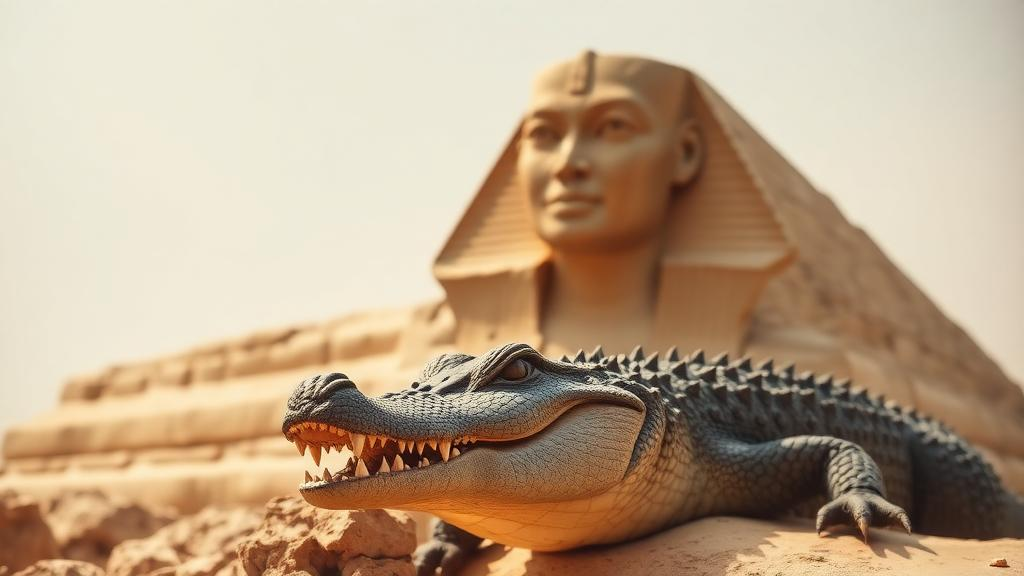
A remarkable new chapter in the story of crocodile evolution has emerged from one of the most iconic monuments on Earth. Palaeontologists have identified a previously unknown species of extinct gavial, a long-snouted relative of today’s gharials, from fossils recovered in the 1920s from the Mokattam Formation of Egypt. The new species, named Herugavialis cairensis, carries an extraordinary historical coincidence: the rocks in which it was preserved are the very same limestones that were quarried to build the Great Sphinx of Giza. And in a twist that has delighted researchers, the fossil crocodile shares another feature with the monument, because just as the Sphinx is famously missing the tip of its nose, the skull of Herugavialis is missing the tip of its snout.
The discovery, published in the journal Royal Society Open Science, is the product of an international collaboration involving researchers from the United Kingdom, Sweden, Germany and Egypt, led by Dr Paul Burke of the Swedish Museum of Natural History in Stockholm. The team applied modern analytical techniques to museum specimens that had been waiting for more than a century to reveal their true identity. Their findings not only establish a new species but also reshape scientific understanding of how gavial crocodiles diversified across the ancient Mediterranean, a region that today hosts no crocodiles at all.
Gavials are among the most distinctive of all crocodilians, characterized by their exceptionally long, thin snouts, an adaptation for catching fish. Today the group is reduced to just two living species, the gharial, Gavialis gangeticus, and the so-called false gharial, Tomistoma schlegelii, both of which are restricted to freshwater environments on the Indian subcontinent and in Southeast Asia. The fossil record, however, tells a very different story. Gavials once enjoyed a near-global distribution spanning more than 100 million years, and many extinct species thrived in shallow marine environments, swimming in coastal seas far from the rivers their descendants now inhabit.
The fossils that led to the new species were recovered in the 1920s from the Mokattam Formation, a geological unit approximately 45 million years old that dates to the Middle Eocene epoch. At that time, much of what is now Egypt lay beneath a warm, shallow sea teeming with marine life. Among the specimens collected was a nearly complete skull, which early researchers assigned to the genus Tomistoma because of its superficial resemblance to the false gharial. For decades, the material sat within the existing framework of crocodylian classification, its distinctiveness hidden beneath a broad external similarity.
That changed with the application of contemporary palaeontological methods, most notably computed tomography scanning, which allows scientists to peer inside fossil skulls without damaging them. By visualizing internal anatomical structures that are invisible from the surface, and by re-examining the external morphology in detail, the research team identified several clear differences separating the Mokattam fossils from Tomistoma. These differences were sufficient to justify not only a new species but a new genus, Herugavialis, defined by a suite of cranial features documented in the new study, which the authors describe as providing new insights into gavialoid diversity in the Mediterranean region.
One feature in particular captured the researchers’ imagination. The skull of Herugavialis is relatively well preserved overall, but the tip of its snout is missing, lost either before or during preservation. Given the famous damaged nose of the Great Sphinx, carved from the same Eocene limestones of the Giza plateau, the parallel was irresistible. According to Professor Philip Mannion of University College London, who co-led the study, the team decided to name the new crocodile after the Egyptian god Heru, who was possibly the inspiration for the iconic monument itself. The species name cairensis references Cairo, the city beside which both the fossil and the Sphinx were found.
The naming choice weaves together deep time and human history in an unusual way. The Mokattam Formation limestones were quarried extensively in antiquity, supplying the building material for monuments that still define Egypt’s cultural landscape. Every block of stone removed from those quarries carried with it the possibility of fossils, the remains of creatures that swam in the Eocene sea tens of millions of years before the first human hands shaped the rock. Herugavialis cairensis thus becomes a rare example of a fossil species whose geological home and archaeological fame are physically inseparable.
Herugavialis was not the only crocodile patrolling the waters of ancient Egypt. The shallow marine environments that covered much of the region during the Eocene were also home to at least two other species of gavials, indicating a surprisingly rich crocodylian community in a single marine setting. This diversity challenges any simple picture of gavials as exclusively freshwater specialists and underscores how much ecological breadth the lineage once possessed. Multiple long-snouted crocodiles coexisting in the same coastal ecosystem suggests fine partitioning of resources, much as fish-eating predators in modern tropical waters divide habitats and prey among themselves.
The broader pattern emerging from the fossil record is one of dramatic fluctuation. As Dr Burke explains, throughout much of the last 50 million years the Mediterranean region hosted a high diversity of crocodiles, including gavials, but that diversity rose and fell over time in ways that appear to correspond to changes in global temperature and sea level. Warm periods with high sea levels expanded the shallow marine habitats that gavials favor, while cooler intervals and falling seas contracted them. The story ended decisively approximately 6 million years ago, when the drying of the Mediterranean, an event known as the Messinian salinity crisis, eliminated all crocodiles from the region, leaving it, uniquely among warm-climate seas, without any living crocodylian fauna.
The recognition of Herugavialis cairensis demonstrates the continuing value of historical museum collections and the transformative power of new analytical tools. Specimens collected nearly a century ago, described with the methods of their day and filed under familiar names, can yield entirely new species when revisited with CT scanning and modern comparative frameworks. For the researchers, the discovery is also a reminder that the stones beneath some of humanity’s most famous monuments preserve their own deep histories, written in the bones of animals like a long-snouted crocodile that, like the Sphinx it shares its rock with, has lost the tip of its nose to the ages.
Subject of Research: A new extinct gavial crocodile species from Eocene Egypt identified through CT-based cranial analysis
Article Title: New crocodile species discovered in rocks used to build the Great Sphinx
Article References: New crocodile species discovered in rocks used to build the Great Sphinx. (n.d.). Original publication
Image Credits: AI Generated
DOI: Not provided
Keywords: Herugavialis cairensis, gavial, crocodile, Great Sphinx, Mokattam Formation, Egypt, Eocene, paleontology, CT scanning, Mediterranean, Tomistoma, Royal Society Open Science
Cite Scienmag News
Violet Maxwell. (October 7, 2026). Extinct crocodile with a missing snout tip emerges from the stones of the Great Sphinx. Scienmag. https://scienmag.com/extinct-crocodile-with-a-missing-snout-tip-emerges-from-the-stones-of-the-great-sphinx/
Violet Maxwell. "Extinct crocodile with a missing snout tip emerges from the stones of the Great Sphinx." Scienmag, 7 October 2026, https://scienmag.com/extinct-crocodile-with-a-missing-snout-tip-emerges-from-the-stones-of-the-great-sphinx/. Accessed 7 October 2026.
Violet Maxwell. "Extinct crocodile with a missing snout tip emerges from the stones of the Great Sphinx." Scienmag. October 7, 2026. https://scienmag.com/extinct-crocodile-with-a-missing-snout-tip-emerges-from-the-stones-of-the-great-sphinx/


