


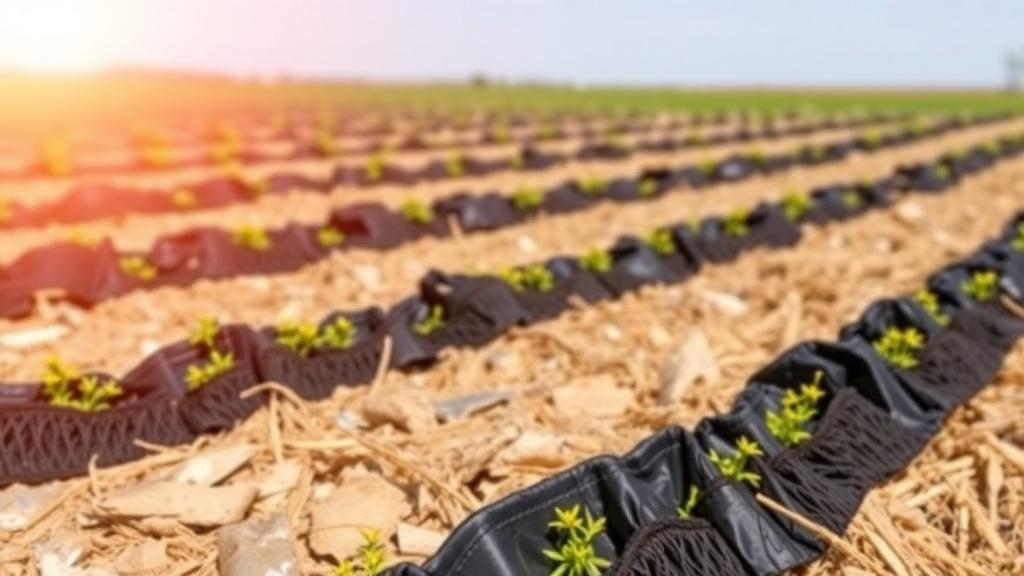
In the semi-arid farmlands of western Iran, where every millimeter of rainfall must be made to count, a humble oilseed crop is getting a technological assist that could reshape how dryland farmers think about biofuel feedstocks. Camelina, an ancient oilseed sometimes called false flax, has long been prized for its ability to thrive on marginal land with minimal inputs, producing oil rich in omega-3 fatty acids and increasingly attractive as a sustainable source of biodiesel and industrial lubricants. Now, a new field study published in BMC Plant Biology by researchers at Razi University in Kermanshah reports that a simple combination of plastic mulch and carefully calibrated nitrogen fertilizer can substantially raise both the oil yield of the crop and the productivity of the scarce rainfall it depends on.
The research team, led by Ali Nouri together with Hassan Heidari and Farzad Mondani from the Department of Plant Production and Genetics, set out to answer a question that matters enormously for rain-fed agriculture: how can farmers squeeze more oil out of the same amount of precipitation? Their answer came from a rigorously designed field experiment conducted at two locations, Kermanshah and Kangavar, using a split-plot arrangement within a randomized complete block design with three replications. This statistical architecture allowed the researchers to isolate the effects of two factors independently and to test whether they interact, a crucial consideration when combining soil management practices with nutrient inputs.
The experimental design was straightforward but comprehensive. Nitrogen fertilizer, supplied as urea, was applied at four levels: zero, 40, 80, and 120 kilograms of nitrogen per hectare. Plastic mulch, meanwhile, was evaluated in three configurations: no mulch at all, mulch placed over the plants themselves, and mulch laid directly on the soil surface. This distinction between covering the plants and covering the ground is more than a technicality. Mulch on soil works primarily by suppressing evaporation, trapping soil moisture beneath a physical barrier and moderating soil temperature, whereas mulch over plants alters the crop’s microclimate in ways that can affect transpiration and light interception. By testing both, the team could determine which strategy delivered the greatest physiological benefit to camelina under rain-fed conditions.
The results were unambiguous. Increasing nitrogen application and deploying plastic mulch, whether on the soil or over the plants, led to consistent increases in rainfall productivity, protein yield, oil yield, and the content of chlorophyll b, the photosynthetic pigment that harvests light in plant chloroplasts. The highest values for protein yield, oil yield, and chlorophyll b were all recorded in plots receiving 120 kilograms of nitrogen per hectare combined with plastic mulch laid on the soil. At the opposite extreme, the untreated control plots, which received no nitrogen and no mulch, produced the lowest values across all three measures. The pattern suggests that water conservation and nutrient supply act synergistically: neither input alone unlocks the crop’s full potential, but together they create conditions in which camelina can convert both sunlight and scarce moisture into oil far more efficiently.
One of the most striking physiological findings concerned leaf relative water content, a measure of how well hydrated plant tissue remains under field conditions. In plots receiving 120 kilograms of nitrogen per hectare, leaf relative water content was 12.6 percent higher than in the control treatment. This matters because water status is tightly linked to photosynthetic performance: when leaf tissue dries, stomata close, carbon dioxide uptake falls, and the biochemical machinery of photosynthesis slows. Higher relative water content indicates that the mulched, well-fertilized plants were under less drought stress, allowing them to sustain carbon fixation through the growing season and channel more of that fixed carbon into seed production and oil accumulation.
The study also documented changes in the plants’ stress biochemistry. Proline, an amino acid that accumulates in plant tissues as a compatible solute during water stress, was elevated in the treatments associated with better overall performance, and the researchers linked the improved oil yields to a suite of favorable physiological traits including rainfall productivity, chlorophyll b content, and proline dynamics. Carotenoid levels, another class of photosynthetic and photoprotective pigments, rose alongside nitrogen and mulch treatments. Together, these indicators paint a picture of plants that were better equipped to capture light, protect their photosynthetic apparatus, and maintain cellular function under the moisture limitations inherent to rain-fed farming.
Nutrient uptake told a parallel story. Raising the nitrogen level and applying plastic mulch led to higher concentrations of nitrogen, phosphorus, and potassium in the camelina seeds, along with greater leaf relative water content. This is significant for more than agronomic bookkeeping. Seed nitrogen translates directly into protein content, which affects the value of the meal left over after oil extraction as an animal feed. Phosphorus and potassium play central roles in energy transfer and enzyme regulation, and their enhanced accumulation in seeds suggests that improved soil moisture under mulch made these nutrients more available for uptake by roots. Water and nutrient cycling in dryland soils are deeply intertwined: nutrients move to root surfaces largely in the water film of moist soil, so conserving moisture effectively fertilizes the crop indirectly by keeping nutrient transport pathways open.
The concept of rainfall productivity sits at the heart of the study’s practical significance. In regions where crops depend entirely on precipitation rather than irrigation, the yield of a field is ultimately limited by how efficiently each unit of rain is converted into harvestable product. By measuring rainfall productivity alongside oil yield, the researchers framed their findings in terms that matter to dryland farmers and to anyone concerned with water-limited food and fuel production. The combination of soil-surface plastic mulch and 120 kilograms of nitrogen per hectare maximized this conversion efficiency, meaning the same seasonal rainfall yielded more oil per hectare than under any other treatment combination tested.
For the biofuel and biodiesel sectors, the implications are noteworthy. Camelina has attracted attention as a low-input oilseed that can be grown on land unsuitable for food crops, reducing competition between fuel and food production. Its short growing season and tolerance of cold and drought make it a candidate for rotation with wheat in dryland systems. However, yields in water-limited environments have often been modest, limiting the crop’s economic appeal. Demonstrating that a relatively inexpensive intervention, plastic sheeting on the soil, combined with an optimized nitrogen rate can lift oil yield and protein yield simultaneously addresses both the energy and the co-product value chains. The researchers’ recommendation is specific: for conditions similar to those at their Iranian field sites, plastic mulch on the soil with nitrogen at 120 kilograms per hectare is the treatment of choice for achieving the highest camelina oil yield.
Caveats remain, as they always do in field research conducted at two sites within a single climatic zone. The optimal nitrogen rate and mulch configuration could shift under different rainfall patterns, soil types, or economic conditions, and the environmental footprint of plastic mulch, including questions of removal and disposal, is a consideration the broader literature continues to debate. The study received no specific grant funding, and the authors declare no competing interests. Yet the core message is robust and immediately actionable: in dryland agriculture, managing water and nutrients together, rather than in isolation, is the key to unlocking the productivity of crops like camelina. As demand grows for vegetable oils that do not compete with food production, findings like these offer a concrete path toward making marginal rainfall yield more oil, one covered hectare at a time.
Subject of Research: Effects of plastic mulch and nitrogen fertilizer on oil yield and rainfall productivity of rain-fed camelina
Article Title: Improving rainfall productivity and oil yield in camelina through the use of plastic mulch and nitrogen
Article References: Nouri, A., Heidari, H., & Mondani, F. (2026). Improving rainfall productivity and oil yield in camelina through the use of plastic mulch and nitrogen. BMC Plant Biology. https://doi.org/10.1186/s12870-026-10086-8
Image Credits: AI Generated
DOI: 10.1186/s12870-026-10086-8
Keywords: camelina, plastic mulch, nitrogen fertilizer, rainfall productivity, oil yield, dryland agriculture, biodiesel, chlorophyll b, proline, soil moisture, urea, Razi University
Cite Scienmag News
Alan Morgan. (October 6, 2026). Plastic Mulch and Nitrogen Team Up to Boost Camelina Oil Yields in Drylands. Scienmag. https://scienmag.com/plastic-mulch-and-nitrogen-team-up-to-boost-camelina-oil-yields-in-drylands/
Alan Morgan. "Plastic Mulch and Nitrogen Team Up to Boost Camelina Oil Yields in Drylands." Scienmag, 6 October 2026, https://scienmag.com/plastic-mulch-and-nitrogen-team-up-to-boost-camelina-oil-yields-in-drylands/. Accessed 6 October 2026.
Alan Morgan. "Plastic Mulch and Nitrogen Team Up to Boost Camelina Oil Yields in Drylands." Scienmag. October 6, 2026. https://scienmag.com/plastic-mulch-and-nitrogen-team-up-to-boost-camelina-oil-yields-in-drylands/


