


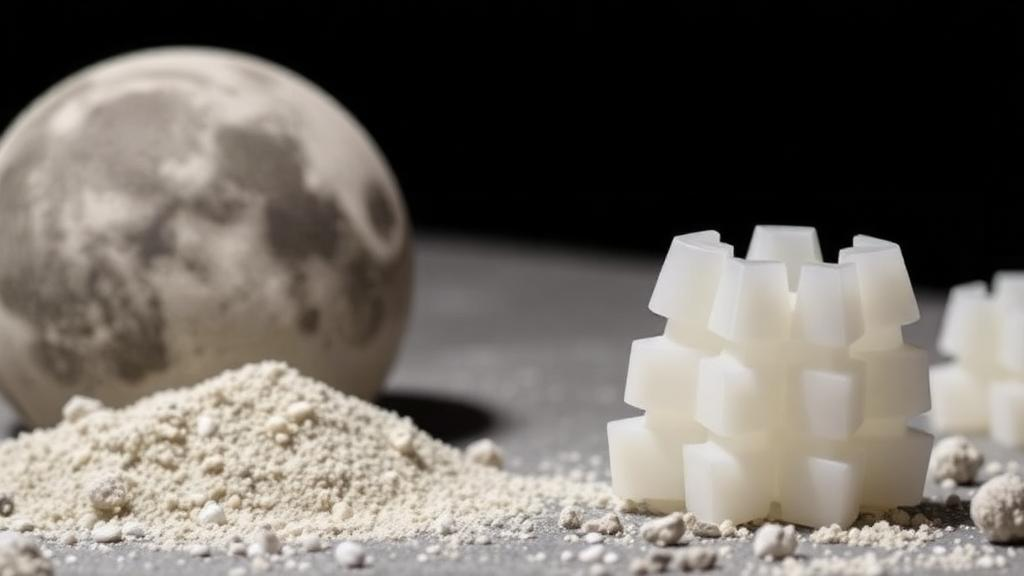
Getting anything to the moon is brutally expensive. By some estimates, launching a single kilogram of material to the lunar surface can cost upwards of one million dollars, a figure that instantly rules out any plan to ship the raw ingredients of a permanent human habitat from Earth. That economic reality has pushed engineers and mission planners toward a simple but powerful idea: use what the moon already provides. The lunar surface is blanketed in regolith, the fine, sharp-edged dust and rocky shards produced by billions of years of meteorite bombardment, and it is available in effectively unlimited quantities. A new study from Concordia University now shows how that abundant local resource can be combined with recycled high-performance plastic to 3D print functional components directly on the moon, offering one of the first demonstrations of a closed-loop manufacturing approach for off-world construction.
The research, conducted by Farshad Malekpour, MASc 2026, and Mehdi Hojjati, a professor in Concordia’s Department of Mechanical, Industrial and Aerospace Engineering, was published in the journal Composites Part B: Engineering. The team set out to answer a question that sits at the heart of lunar in-situ resource utilization, or ISRU: can a space-grade polymer be recycled and blended with simulated moon soil to produce printed parts that actually perform under load? Their answer, demonstrated through a series of carefully controlled experiments, was yes, with important caveats about the trade-offs involved.
The material at the center of the study is poly(ether ketone ketone), commonly abbreviated PEKK, a high-performance thermoplastic prized in aerospace applications for its strength, thermal stability and resistance to harsh environments. Crucially, the PEKK used in the demonstrations was not virgin material. It had been recycled from a previously printed sacrificial structure, proving that this demanding engineering polymer can be processed and reused while retaining its thermal and mechanical properties. The researchers recycled the material three times and observed no significant degradation or loss of structural and mechanical performance, a result with major implications for missions where every gram of feedstock must be conserved and nothing can be wasted.
The recycling process itself was methodical. Collected PEKK scrap was shredded, milled into a powder, heat dried and then mixed with a commercially available lunar regolith simulant, a terrestrial stand-in designed to mimic the mineralogy and particle characteristics of actual moon soil. The resulting composite was extruded into filament and fed into a 3D printer, where it was formed into standard test shapes and into a sacrificial structure: a strong, lightweight, sponge-like configuration engineered to deform and absorb energy under load and then recover its original shape without damage. Sacrificial structures of this kind are not meant to be permanent load-bearing elements. Instead, they are designed to take the hit, so to speak, absorbing stresses the way the landing mechanism of a lunar module would have to cushion the shock of touchdown on the moon’s surface.
With the printed parts in hand, the researchers subjected them to a battery of mechanical and thermal tests. Samples were stretched, bent and compressed to measure how the composite responded to the kinds of stresses a real lunar component would encounter. Some specimens were also heat-treated to see how this additional processing step affected performance, an important consideration because any manufacturing process on the moon will have limited access to post-processing equipment. The team even printed a functional wrench from the same composite material, a small but symbolic demonstration that the blend can produce recognizable, practical tools rather than only test coupons.
The results revealed several genuine advantages of adding regolith to the polymer. The recycled composite showed strong thermal stability, and microscopic examination found the regolith particles evenly distributed throughout the plastic matrix, indicating a well-mixed, homogeneous material. Perhaps most significantly, the addition of regolith simulant lowered the temperature at which PEKK crystallized during heating, making the heat treatment process more efficient. On the moon, where energy is scarce and every watt counts, a material that crystallizes at a lower temperature translates directly into reduced power demands and faster processing cycles. The regolith also helped reduce shrinkage and warping during heat treatment, an advantage the researchers describe as especially important for manufacturing in an environment with little to no access to equipment for further processing. A warped part on Earth is a nuisance; a warped part on the moon may be an unusable one.
The composite was not without its weaknesses. The printed material exhibited more internal porosity than unmixed PEKK, and that porosity made the composite more brittle. Brittleness is a meaningful concern for components expected to absorb impact energy, since a material that cracks rather than deforms fails in a less forgiving way. The researchers note, however, that the recycled plastic itself was not degraded, meaning the brittleness stems from the regolith particles and the voids they introduce rather than from any breakdown of the polymer through repeated recycling. This distinction matters for mission design: it suggests engineers can plan around the composite’s limitations by reserving it for applications where energy absorption and dimensional stability matter more than maximum toughness, while keeping pure recycled polymer for parts that demand it.
What makes the study notable in the broader landscape of space manufacturing research is its circularity. Many proposed ISRU techniques envision using lunar soil as a bulk construction material, for example in sintered bricks or concrete-like structures, but few have demonstrated a closed loop in which a high-performance, space-grade polymer is recycled multiple times and combined with regolith in a single workflow. Hojjati says the study is among the first to demonstrate such a closed-loop approach, combining the recycling of PEKK with lunar regolith in this way. In a circular system, a sacrificial structure printed for one mission phase could be shredded, reprocessed and printed again for the next, with regolith extending the feedstock each cycle. The economics are compelling: every kilogram of locally sourced or recycled material is a kilogram that does not need to be launched from Earth at a cost that can reach seven figures.
The implications extend beyond the moon. Thermoplastic recycling of this kind could apply to any long-duration space mission where manufacturing scrap accumulates, from orbital fabrication facilities to Mars habitats, and the principle of reinforcing recycled polymers with locally gathered mineral fillers is adaptable to planetary surfaces beyond the lunar environment. The researchers are careful to frame the technology as still very new, and the study published on 25 July 2026 represents an early experimental demonstration rather than a flight-ready process. Real lunar regolith differs from simulants in ways that could affect printing behavior, and the porosity and brittleness observed in the composite will need to be addressed before such parts could be trusted in critical applications.
Even so, the work offers a promising pathway toward efficient use of scarce materials in space exploration, the researchers note. As space agencies and commercial partners move from brief sortie missions toward sustained lunar presence, the ability to print, use, recycle and reprint components from a blend of moon dust and recovered engineering polymer could transform the logistics of living off-world. The Concordia study provides a concrete, tested demonstration that the loop can close: a printed sacrificial structure becomes powder, the powder becomes filament, the filament becomes a wrench, and the moon itself supplies the filler. For a species hoping to stay on the lunar surface rather than merely visit, that kind of resourcefulness may prove to be the difference between an outpost that endures and one that never gets built.
Subject of Research: Recycled PEKK thermoplastic and lunar regolith composites for 3D-printed lunar infrastructure
Article Title: Simulated moon soil and recyclable thermoplastics could help build future space infrastructure, study shows
Article References: Simulated moon soil and recyclable thermoplastics could help build future space infrastructure, study shows. (n.d.). Original publication
Image Credits: AI Generated
DOI: Not provided
Keywords: lunar regolith, 3D printing, PEKK, thermoplastics, in-situ resource utilization, recycling, space manufacturing, Concordia University, additive manufacturing, sacrificial structures, lunar habitat, composites
Cite Scienmag News
Denise Maddox. (October 6, 2026). Moon Dust Meets Recycled Space-Grade Plastic in New Lunar 3D Printing Study. Scienmag. https://scienmag.com/moon-dust-meets-recycled-space-grade-plastic-in-new-lunar-3d-printing-study/
Denise Maddox. "Moon Dust Meets Recycled Space-Grade Plastic in New Lunar 3D Printing Study." Scienmag, 6 October 2026, https://scienmag.com/moon-dust-meets-recycled-space-grade-plastic-in-new-lunar-3d-printing-study/. Accessed 6 October 2026.
Denise Maddox. "Moon Dust Meets Recycled Space-Grade Plastic in New Lunar 3D Printing Study." Scienmag. October 6, 2026. https://scienmag.com/moon-dust-meets-recycled-space-grade-plastic-in-new-lunar-3d-printing-study/


