


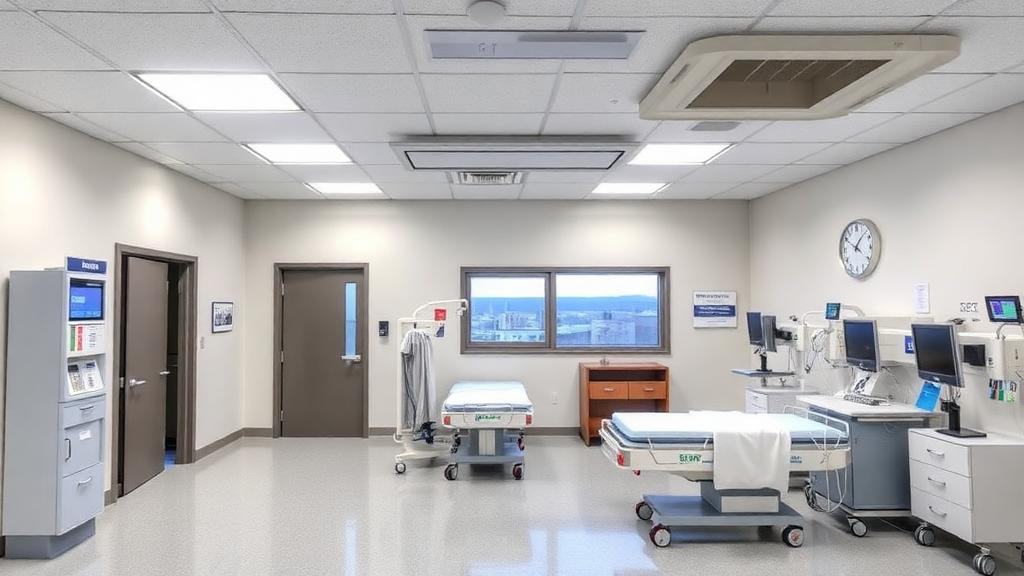
The State University of New York has placed a major bet on the future of healthcare education, and it has chosen Binghamton University as one of the places to make it. On October 1, SUNY Chancellor John B. King Jr. joined Binghamton President Anne D’Alleva, along with faculty, staff, and students, to announce a $10 million investment establishing a Nursing Simulation Center of Excellence at the university’s Innovative Simulation and Practice Center, known as the ISPC, at Decker College of Nursing and Health Sciences in Johnson City, New York. The designation makes Binghamton the second SUNY institution to hold the title, joining the University at Buffalo, and signals a systemwide commitment to simulation as a core pillar of how the next generation of nurses, therapists, and public health professionals will be trained.
The investment package is structured as a partnership between the state system and the campus. Of the $10 million total, $5 million comes in the form of direct SUNY capital awards, with Binghamton University contributing the remaining funds. According to the announcement, the money will be used to expand simulation space and experiences at two key facilities: the Health Sciences Building, which houses Decker College, and the Binghamton University Clinical Center at Park, a site currently undergoing renovation. Plans also call for the addition of an artificial intelligence and virtual reality simulation room with associated immersive experiences, along with the purchase of new equipment and human-patient simulators, the sophisticated robotic mannequins that can breathe, speak, and respond physiologically to student interventions.
Chancellor King framed the investment as a win for students and communities alike. “Today, the State University of New York at Binghamton joins Buffalo as a SUNY Nursing Simulation Center of Excellence. We’re making these investments because we know simulation is a win-win for our students, for our communities,” King said. He also emphasized that the center will serve a broader purpose beyond student training: “We’re also going to create flexible pathways in simulation education, so that folks can learn more about operating a sim center, managing simulations, and how to use simulation in education.” That focus on faculty development and professional training is central to what distinguishes a Center of Excellence designation from a simple facilities upgrade.
President D’Alleva thanked Governor Kathy Hochul, Chancellor King, and the SUNY Board of Trustees for directing resources to the ISPC. “The experiences students gain in the ISPC are an invaluable part of their education and prepare them for real-world scenarios,” she said. “Decker College students graduate with confidence and skills that enable them to stand out among their peers and make a difference in their patients’ lives.” D’Alleva also credited Assemblywoman Donna Lupardo, whose legislation on expanding clinical simulation programs has, in the university’s view, materially benefited its ability to teach the next generation of healthcare providers.
Simulation-based education rests on a straightforward but powerful pedagogical idea: students learn complex clinical skills faster and more safely when they can practice in environments where mistakes carry no risk to real patients. High-fidelity human-patient simulators can be programmed to present cardiac arrest, respiratory distress, obstetric emergencies, or pediatric crises, allowing learners to assess, intervene, and communicate under realistic time pressure. When a scenario ends, structured debriefing sessions let faculty and students dissect every decision, turning errors into teachable moments rather than adverse events. This cycle of deliberate practice, immediate feedback, and reflection is the same evidence-based model that aviation and other high-stakes industries have used for decades to build expertise and reduce human error.
At Binghamton, that model is woven through the entire curriculum rather than confined to a single course. “Decker College integrates simulation and practice experiences into the curricula for all our degree programs: nursing, occupational therapy, physical therapy, speech-language pathology, and public health,” explained Patti Reuther, the college’s assistant dean of simulation and practice and Binghamton’s director of interprofessional education, who led the chancellor and president on a tour of the facility. “This enables us to provide standardized experiences that all students should encounter before graduation, address gaps in clinical experiences, and offer opportunities to practice navigating difficult conversations and complex situations.”
Reuther added that simulation serves an assessment function as well as a training one. “Simulation also allows us to assess whether students are meeting educational benchmarks while building confidence and competence in essential skills and clinical judgment,” she said. Standardization is a key technical advantage: because every student encounters the same carefully scripted scenarios, faculty can measure competence against consistent benchmarks in a way that variable clinical placements cannot always guarantee. During the tour of the 15,000-square-foot ISPC, King and D’Alleva observed students engaged in simulation and practice experiences and met with nursing and physical therapy students, including Dana Kurthy, a third-year physical therapy student, and Dalila Hernandez, a senior nursing student who works at the center.
Binghamton’s credentials in this field are well established. Simulation has been an integral part of a Decker education for nearly two decades, and in 2017 the university became the first and only SUNY institution to earn accreditation from the Society for Simulation in Healthcare, the field’s leading accrediting body. Dean Mario R. Ortiz of Decker College pointed to that depth of expertise as the foundation for the new designation. “Decker College has highly-trained faculty and experts in healthcare simulation education and operations, and a demonstrated commitment to systemwide collaboration through our partnership in the SUNY Nursing Simulation Fellowship,” Ortiz said. “Being designated a SUNY system Center of Excellence will build on and expand our role as a system leader in simulation education.”
Ortiz described the center’s mission in explicitly systemic terms, positioning Binghamton as an engine for producing educators, not just clinicians. “By focusing on faculty training and professional development, our center will establish an exemplar model for developing a robust pipeline of healthcare educators with expertise in simulation-based education,” he said. That pipeline matters because simulation education requires a specialized skill set: designing valid scenarios, operating simulators and audiovisual capture systems, facilitating debriefings, and evaluating learner performance reliably. As demand for simulation grows across SUNY’s 64 campuses, trained faculty and simulation operations specialists will be the bottleneck, and Binghamton’s Center of Excellence is intended to help relieve it.
The designation also carries significant policy weight at the state level. It advances signature legislation signed by Governor Hochul in May 2023, which permits nursing students to complete up to one-third of their clinical training through high-quality simulation experiences, a change designed to expand training capacity without compromising quality. The investment is expected to expand SUNY’s capacity to support the growth of healthcare education across Binghamton University and the broader system, and, by leveraging Binghamton’s expertise and the center’s focus on faculty development, to help advance the governor’s stated goal of growing New York’s healthcare workforce by 20 percent. The announcement event drew a range of state and university leaders, including Valerie Grey, SUNY senior vice chancellor for academic health and hospital affairs; Kaitlyn Bertleff, SUNY associate vice chancellor for healthcare workforce and strategic initiatives; Rose Olsen, Southern Tier regional representative for Governor Hochul; Senator Lea Webb, a 2004 Binghamton graduate; Assemblywoman Lupardo, who holds a master’s degree from the university; and Sara Wozniak, Decker College associate dean and a three-time Binghamton alumna. Together, the designation and the funding position the Johnson City campus as a model for how simulation can scale across a public university system at a moment when healthcare workforce shortages make every well-trained graduate count.
Subject of Research: Nursing simulation-based healthcare education and a SUNY Center of Excellence designation at Binghamton University
Article Title: Binghamton University’s Innovative Simulation and Practice Center named a SUNY Nursing Simulation Center of Excellence
Article References: Binghamton University’s Innovative Simulation and Practice Center named a SUNY Nursing Simulation Center of Excellence. (n.d.). Original publication
Image Credits: AI Generated
DOI: Not provided
Keywords: nursing education, healthcare simulation, SUNY, Binghamton University, Decker College of Nursing and Health Sciences, human-patient simulators, virtual reality, artificial intelligence, clinical training, faculty development, healthcare workforce, Society for Simulation in Healthcare
Cite Scienmag News
Courtney Benton. (October 6, 2026). SUNY Pours $10 Million Into Binghamton’s Nursing Simulation Hub as New Center of Excellence. Scienmag. https://scienmag.com/suny-pours-10-million-into-binghamtons-nursing-simulation-hub-as-new-center-of-excellence/
Courtney Benton. "SUNY Pours $10 Million Into Binghamton’s Nursing Simulation Hub as New Center of Excellence." Scienmag, 6 October 2026, https://scienmag.com/suny-pours-10-million-into-binghamtons-nursing-simulation-hub-as-new-center-of-excellence/. Accessed 6 October 2026.
Courtney Benton. "SUNY Pours $10 Million Into Binghamton’s Nursing Simulation Hub as New Center of Excellence." Scienmag. October 6, 2026. https://scienmag.com/suny-pours-10-million-into-binghamtons-nursing-simulation-hub-as-new-center-of-excellence/


