


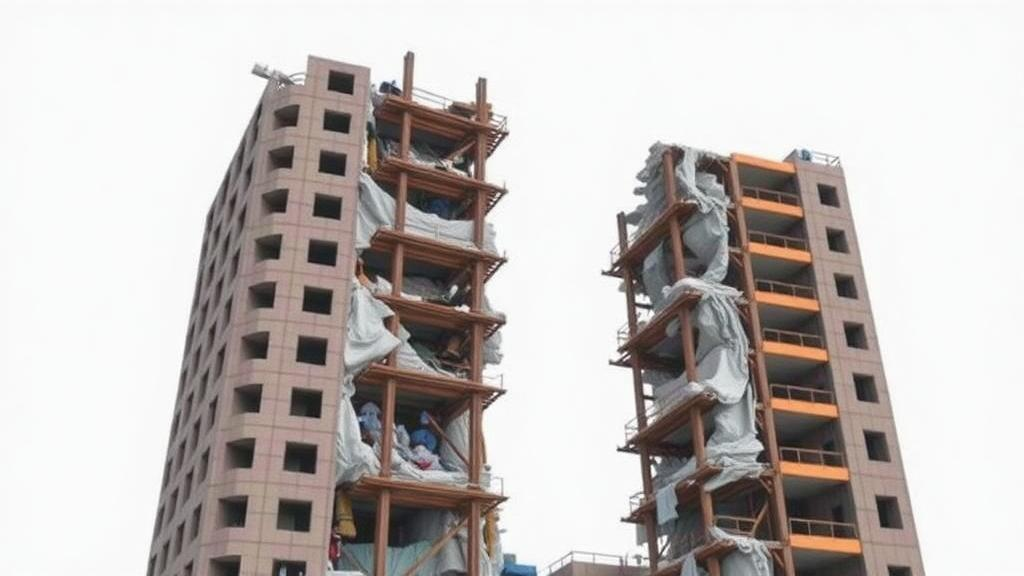
When a major earthquake strikes a city, the most dangerous places are often not the buildings that have completely collapsed, but the ones left standing in a half-ruined state. These precarious structures, with floors sagging and walls fractured, become the primary targets of urban search-and-rescue teams, who must tunnel beneath and around them to reach trapped survivors. To stabilize these ruins, rescuers install emergency rescue supports—typically timber posts, wedges, and shoring towers—between the ground and the damaged structure. Yet the engineering of these supports has long been based on static rules of thumb rather than a rigorous understanding of what happens when a damaged building and its temporary supports are shaken together by aftershocks. A new study published in the Bulletin of Earthquake Engineering by Defeng Xu, Feifei Sun, Qing Xu, Yuqing Gao, Songhang He and colleagues now offers the most detailed numerical framework to date for analyzing exactly this coupled system, and its findings carry direct implications for how rescue operations are planned in the critical hours and days after a mainshock.
The central challenge the researchers confronted is one of computational bookkeeping as much as physics. A realistic simulation of a building’s collapse produces a ruin whose geometry, stress state, and velocity field are the accumulated result of thousands of nonlinear events: cracks opening, concrete crushing, rebar yielding, blocks sliding. If engineers want to then ask how a rescue support interacts with that ruin, they cannot simply start from a fresh model of the damaged building, because the internal mechanical fields—the locked-in stresses and residual deformations that make the ruin behave the way it does—would be lost. The team’s answer is a FEM-integrated, FDEM restart-based re-editing methodology. In essence, they run a finite-discrete element simulation of the building’s collapse up to the semi-ruined state, then restart the analysis from that saved state, editing the model to reconstruct the specific semi-ruined configuration and to embed emergency rescue supports into the scene, all while preserving the collapse-state mechanical fields in the retained ruin domain. This restart-and-edit trick is what makes the approach physically consistent: the ruin that the supports brace is the same ruin that the simulation produced, with its history intact.
The combined finite-discrete element method, or FDEM, is well suited to this task because it can represent both the continuum behavior of structural materials and the discrete, block-by-block motion that follows fracture. First developed in the late 1990s with combined single and smeared crack models, FDEM has since become a workhorse for collapse analysis of masonry and reinforced concrete structures, complementing pure finite element approaches that struggle once a structure breaks into independent pieces. By integrating finite element modeling of the intact portions with discrete element treatment of fractured zones, the new methodology captures the full trajectory from standing building to stabilized ruin within a single computational lineage. The authors’ earlier work on the secondary collapse of bottom frame masonry structures in a semi-ruined state, published in Scientific Reports in 2024, laid the groundwork; the present study extends that framework to include the rescue supports themselves as active mechanical participants rather than passive background objects.
Two distinct interaction mechanisms govern how a support engages a ruin, and the methodology treats both explicitly. The first is surface-to-surface frictional contact, in which a timber cap or wedge presses against a concrete or masonry surface and transmits load through friction, allowing a limited degree of sliding along the interface. The second is nail-connected anchorage, in which nails driven into the timber and bearing against the ruin create a stiffer, more constrained connection that resists relative movement. These are not academic distinctions. Field shoring guides issued by the U.S. Department of Homeland Security and the U.S. Army Corps of Engineers describe both styles of installation, and rescuers choose between them based on judgment about the condition of the bearing surfaces. Until now, however, no numerical framework has been able to quantify how that choice alters the dynamic response of the entire coupled system during aftershock shaking.
To demonstrate the methodology, the team selected a representative and highly consequential building type: a bottom frame–masonry structure in a semi-ruined configuration, braced with emergency rescue timber supports. This construction class—open, flexible commercial or parking space at ground level with stiff masonry walls above—is notorious for poor seismic performance and features prominently in earthquake fatality statistics. The researchers subjected the coupled ruin-support model to four typical post-mainshock input motions, spanning near-fault, far-field, long-period, and pulse-like ground shaking, reflecting the reality that aftershocks and late-arriving surface waves can differ dramatically in character from the mainshock itself. Long-period ground motions, which are particularly damaging to tall or flexible structures, have been documented in prior studies to drive extended collapse behavior in high-rise frames, and the new analysis shows they pose a similar threat to braced ruins.
The results deliver a clear and somewhat counterintuitive message: the coupled response of a braced ruin is more sensitive to the mode of contact between support and ruin than to moderate variations in the layout of the supports themselves. In other words, how the support touches the building matters more than exactly where a handful of additional posts are placed. Surface-to-surface frictional contact, despite permitting slip, leads to higher frictional and hysteretic energy dissipation across the interface and better overall stability of the system. The friction acts as a built-in damper, converting seismic energy into heat and permanent micro-deformation at the contact surface instead of allowing it to accumulate as kinetic energy in the ruin. Nail-connected anchorage, by contrast, constrains the interface more rigidly, which can transfer demand into stress concentrations and reduce the system’s capacity to dissipate energy gracefully.
The nature of the ground motion proved equally decisive. Long-period and pulse-like motions induced greater interface slip, greater stress transfer between ruin and supports, and higher energy demand at the interfaces than near-fault and far-field motions of comparable intensity. This finding matters operationally because aftershock sequences are not simply scaled-down repetitions of the mainshock; they can include long-duration, long-period shaking that resonates with the flexible, damaged geometry of a semi-ruined structure. A shoring scheme that performs adequately under a short, sharp aftershock may be pushed toward interface failure under a slower, rolling motion. The study’s interface-based metrics—peak relative displacement, peak transferred stress, and interface energy—give engineers and researchers three quantitative handles on this risk, corresponding respectively to deformation compatibility, local stress demand, and interfacial energy dissipation.
These three indices deserve particular attention because they translate an abstract simulation into decision-relevant quantities. Peak relative displacement measures how much the support and the ruin slide or separate at their contact, a direct proxy for loss of bearing and the onset of instability. Peak transferred stress indicates whether the local bearing surface—often cracked concrete or loose masonry—can sustain the forces the support delivers without punching through or crumbling. Interface energy quantifies the cumulative dissipation at the contact, revealing whether the connection is absorbing seismic input or merely passing it along until something breaks. Together they form a compact evaluation toolkit for case-oriented assessment of specific rescue scenarios, something that generic design codes for temporary works have never provided. The methodology thus bridges a persistent gap between the structural engineering of collapse, a mature research field with a rich literature on progressive collapse and seismic fragility, and the practitioner domain of urban search-and-rescue shoring, which has historically relied on field guides, experience, and wood design specifications rather than dynamic analysis.
The broader significance of this work lies in its potential to make rescue operations safer and more evidence-based. Urban search-and-rescue is a race against time, and factors affecting rescue speed have been studied extensively, yet the structural side of the risk equation—the probability that a braced ruin suffers secondary collapse during operations—has remained largely outside quantitative analysis. By providing a physically consistent numerical framework in which real ruin configurations, real support arrangements, and real aftershock motions can be combined, the methodology opens the door to pre-computed stability charts, scenario-specific shoring recommendations, and even training simulations for rescue teams. The authors note that the framework is designed for representative post-collapse rescue scenarios rather than universal prediction, an honest limitation that reflects the enormous variability of real ruins. Still, the demonstration that contact mode dominates over moderate layout variation suggests a practical rule: rescuers should invest effort in the quality and type of the support-ruin interface, favoring frictional connections where energy dissipation is needed, and treating long-period aftershock scenarios with heightened caution. As earthquake-prone cities continue to grow and past events from Turkey to Nepal have shown, the hours after a mainshock are when engineering meets urgency—and now, at last, the two can be modeled together.
Subject of Research: Numerical simulation of the seismic interaction between semi-collapsed building ruins and emergency rescue supports during aftershocks
Article Title: Numerical simulation methodology for seismic response analysis of coupled building ruins and emergency rescue supports
Article References: Xu, D., Sun, F., Xu, Q., Gao, Y., & He, S. (2026). Numerical simulation methodology for seismic response analysis of coupled building ruins and emergency rescue supports. Bulletin of Earthquake Engineering. https://doi.org/10.1007/s10518-026-02680-w
Image Credits: AI Generated
DOI: 10.1007/s10518-026-02680-w
Keywords: earthquake engineering, building collapse, emergency rescue supports, FDEM, secondary collapse, shoring, aftershocks, masonry structures, frictional contact, seismic simulation, urban search and rescue, interface energy
Cite Scienmag News
Violet Maxwell. (October 6, 2026). New Simulation Method Shows How Shoring Keeps Half-Collapsed Buildings Standing After Earthquakes. Scienmag. https://scienmag.com/new-simulation-method-shows-how-shoring-keeps-half-collapsed-buildings-standing-after-earthquakes/
Violet Maxwell. "New Simulation Method Shows How Shoring Keeps Half-Collapsed Buildings Standing After Earthquakes." Scienmag, 6 October 2026, https://scienmag.com/new-simulation-method-shows-how-shoring-keeps-half-collapsed-buildings-standing-after-earthquakes/. Accessed 6 October 2026.
Violet Maxwell. "New Simulation Method Shows How Shoring Keeps Half-Collapsed Buildings Standing After Earthquakes." Scienmag. October 6, 2026. https://scienmag.com/new-simulation-method-shows-how-shoring-keeps-half-collapsed-buildings-standing-after-earthquakes/


