


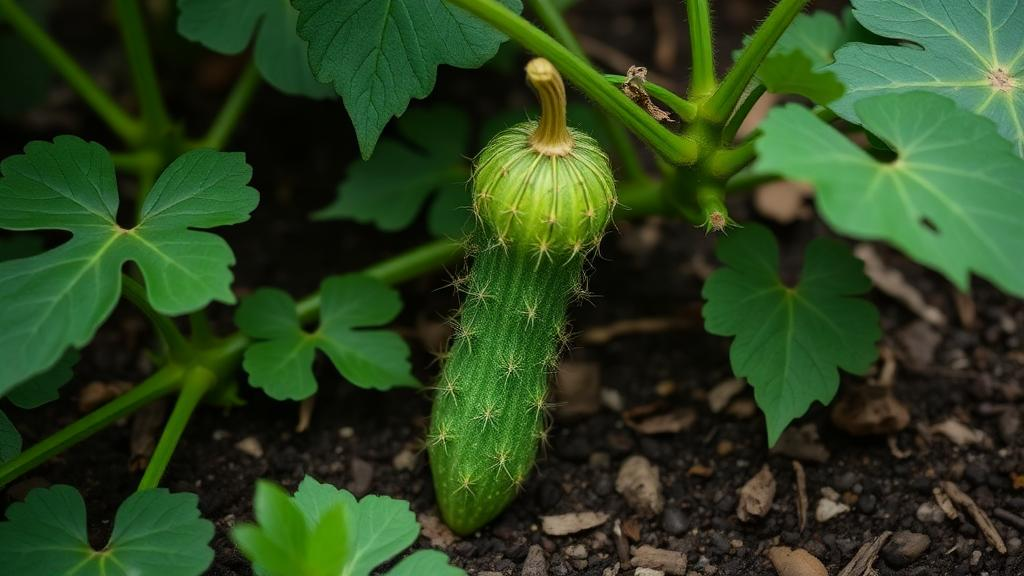
Deep in the flooded lowland forests of eastern Assam, botanists have confirmed the presence of a spiny-fruited wild cucumber that has never before been recorded in the state. The species, Cucumis hystrix, was documented during two years of systematic surveys in the Bherjan-Borajan-Padumoni Wildlife Sanctuary, a compact protected area of just 7.21 square kilometres in Tinsukia district. The finding, published in Discover Plants by Daimalu Baro of Tinsukia College and Amal Bawri of the North Eastern Institute of Ayurveda and Folk Medicine Research, adds a new entry to the flora of Assam and underlines how much botanical diversity can still hide inside small, fragmented forest patches.
The gourd family, Cucurbitaceae, is one of the most economically important lineages of flowering plants on Earth. According to the taxonomic framework used by the researchers, it comprises roughly 100 genera and 1,069 species distributed across temperate and tropical regions. Most members are prostrate or climbing herbs and shrubs equipped with spirally curled tendrils, the signature climbing organ that allows them to scramble over forest understorey vegetation. The family includes crops of global significance, and several species, among them Cucumis melo and Hodgsonia macrocarpa, are also used in traditional medicine across Asia. Yet the wild relatives of these cultivated forms are increasingly threatened, because overharvesting in natural habitats pushes many of them toward extinction.
Assam has a long but discontinuous history of botanical exploration. In the landmark Flora of Assam, published in 1938, Kanjilal and his co-workers reported five genera and 26 species with one variety of Cucurbitaceae from the state. Decades later, Barooah and Ahmed updated that picture, listing 37 species under 20 genera. After that, the authors note, there was a long gap in floristic and conservation work on the gourd family in Northeast India. That gap matters, because wild cucurbits are not merely botanical curiosities; they carry genetic traits such as disease resistance and drought tolerance that plant breeders may one day need for the crops that feed the world.
The study area itself is unusual. Bherjan-Borajan-Padumoni Wildlife Sanctuary is not a single block of forest but a combination of three distinct patches, Bherjan, Borjan and Padumoni, lying between latitudes 27 and 27.4 degrees north and longitudes 95 and 95.5 degrees east. The vegetation is classified as tropical wet evergreen rainforest, almost entirely closed under a continuous tree canopy. Despite its small size, the sanctuary shelters rare and endangered animals such as the Assamese macaque, the hoolock gibbon and the capped langur, along with notable birds including the streak-throated woodpecker, the greater yellownape, the lesser flameback and the osprey. Botanically, it hosts species such as the giant dipterocarp Dipterocarpus macrocarpus and the locally significant Ixora bawae.
To capture that diversity in a quantifiable way, the researchers laid three belt transects of 300 by 50 metres at random in each part of the sanctuary as permanent plots. Within each plot, five quadrats of 10 by 10 metres were randomly established for tree species, and inside those, two smaller quadrats of 5 by 5 metres captured shrubs, saplings and seedlings, while two quadrats of 1 by 1 metre recorded herbs. This nested phytosociological design allowed the team to sample every vertical layer of the forest, from the canopy down to the forest floor, where many climbing cucurbits begin their lives.
Specimens of all plant species encountered were collected together with photographs, and herbarium material was prepared using standard taxonomic methods. Voucher specimens were deposited at the herbarium of the North Eastern Institute of Ayurveda and Folk Medicine Research, each with a collection number and accession number. Identification was carried out by consulting the relevant literature and herbarium collections at Indian herbaria including ARUN, ASSAM, BSHC and CAL, and was confirmed through the original species descriptions, known as protologues, and images of type specimens held at CAL, E and K. Detailed morphological examination took place both in the field and in the laboratory, a double-check that is essential when a record claims to be new for a state.
The surveys, conducted between 2024 and 2025, yielded twelve species in ten genera of Cucurbitaceae from the sanctuary. The list reads like a catalogue of the family’s architectural range. Actinostemma tenerum, a slender climber with ovate to sagittate-ovate leaves and white flowers borne in racemes, fruits in small oblong-ellipsoid capsules. Coccinia grandis, the familiar ivy gourd, was found in semievergreen forest and along forest margins. Cucumis melo, the wild melon, crept through open forest areas, while Diplocyclos palmatus, with its palmately five-lobed leaves and globose indehiscent fruits, climbed through open woodland. Trichosanthes costata and Trichosanthes tricuspidata, both snake gourd relatives with elaborate white flowers and ribbed or oblong fruits, were recorded in mixed and evergreen forest respectively.
Two of the most spectacular finds are giants of the climbing world. Hodgsonia macrocarpa forms vines up to 20 to 30 metres long, with three-lobed leaves and enormous fruits reaching 15 to 18 centimetres in diameter, densely covered in grey hairs. Indofevillea khasiana, a robust branched climber recorded in the Borjan range, bears leathery, broadly ovate-cordate leaves up to 26 centimetres long and distinctive oblong fruits with a thick woody rind that hang in clusters on the stalk. The genus Thladiantha was represented twice, by T. cordifolia in evergreen forest and T. hookeri, whose stems can stretch 2 to 10 metres through the canopy. Luffa aegyptiaca, the wild luffa whose mature fruits become strongly fibrous, rounded out the inventory.
The headline discovery, Cucumis hystrix, is a monoecious scandent climber with angular, scabrous, hirsute stems and ovate to triangular-ovate leaves that are irregularly five-lobed. Its male and female flowers are both solitary in the leaf axils, with yellow corollas, and its ellipsoid-oblong fruits, 4 to 5 centimetres long, are covered in spine-like protuberances 2 to 4 millimetres long, the feature that gives the species its name. The plant was collected in the Bherjan range at about 130 metres above sea level, flowering and fruiting between August and January. A careful search of the literature and of herbarium specimens across Indian collections verified that the taxon had never been reported for Assam before. Its known distribution spans Meghalaya’s Garo Hills, Karnataka, Tripura, Nepal, Bangladesh, Myanmar, Thailand and southwest China, but within Assam it appears, so far, to be confined to this single sanctuary.
The conservation implications are stark. Of the 20 genera and 37 species recorded for Assam, the presence of 12 species and ten genera inside one small sanctuary is considered significant by the authors, and three of the species found there, Indofevillea khasiana, Thladiantha cordifolia and Thladiantha hookeri, are regarded as rare in the state. The sanctuary is under pressure from expanding tea gardens and oil fields, major anthropogenic drivers of habitat change in the region. The researchers argue that urgent conservation measures are needed, including the identification of prioritised areas for in-situ conservation within protected areas, so that wild gourds, including the newly confirmed spiny cucumber, can survive in the forest habitats where their genetic legacy has evolved over millennia.
Subject of Research: Floristic diversity of the gourd family Cucurbitaceae in a small Assam wildlife sanctuary, including a new state record
Article Title: Diversity of Cucurbitaceae Juss. in Bherjan-Borajan-Padumoni Wildlife Sanctuary, Assam, with Cucumis hystrix Chakrav. as a new addition to the state flora
Article References: Baro, D., & Bawri, A. (2026). Diversity of Cucurbitaceae Juss. in Bherjan-Borajan-Padumoni Wildlife Sanctuary, Assam, with Cucumis hystrix Chakrav. as a new addition to the state flora. Discover Plants, 3(1), Article 445. https://doi.org/10.1007/s44372-026-00894-5
Image Credits: AI Generated
DOI: 10.1007/s44372-026-00894-5
Keywords: Cucurbitaceae, Cucumis hystrix, Assam, Bherjan-Borajan-Padumoni Wildlife Sanctuary, floristic survey, plant taxonomy, biodiversity, new state record, conservation, Northeast India, wild crop relatives, herbarium
Cite Scienmag News
Margaret Porter. (October 6, 2026). Spiny Wild Cucumber Found in Tiny Assam Sanctuary Becomes New State Record. Scienmag. https://scienmag.com/spiny-wild-cucumber-found-in-tiny-assam-sanctuary-becomes-new-state-record/
Margaret Porter. "Spiny Wild Cucumber Found in Tiny Assam Sanctuary Becomes New State Record." Scienmag, 6 October 2026, https://scienmag.com/spiny-wild-cucumber-found-in-tiny-assam-sanctuary-becomes-new-state-record/. Accessed 6 October 2026.
Margaret Porter. "Spiny Wild Cucumber Found in Tiny Assam Sanctuary Becomes New State Record." Scienmag. October 6, 2026. https://scienmag.com/spiny-wild-cucumber-found-in-tiny-assam-sanctuary-becomes-new-state-record/


