


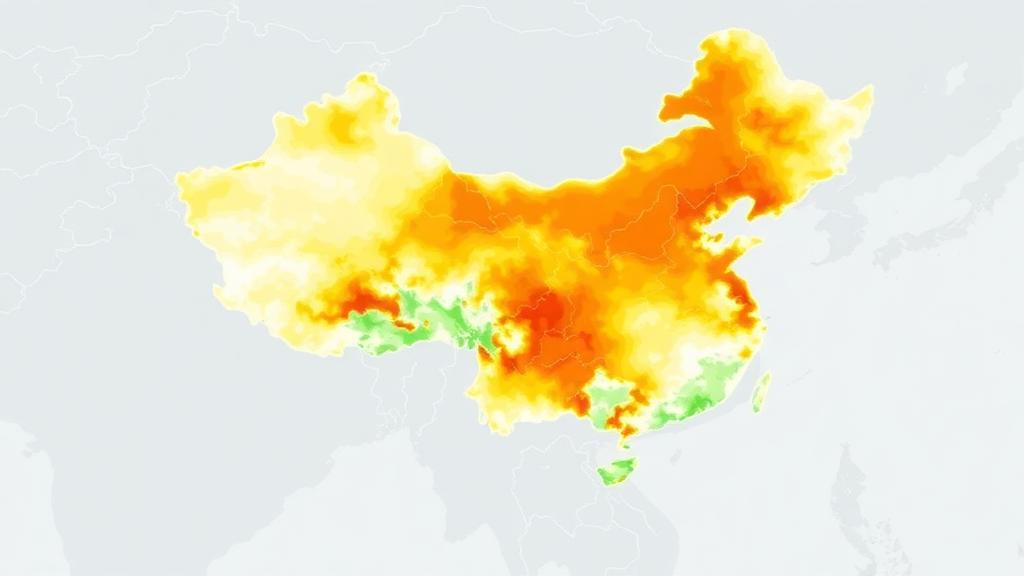
Drought is rarely a single-number problem. When water managers ask how bad a drought was, they must grapple with at least three intertwined questions at once: how long did the dry spell last, how much water deficit accumulated over that period, and how intense was the worst moment of the event? A new study published in Theoretical and Applied Climatology tackles exactly this multivariate puzzle for Guangxi, a subtropical region in southern China where karst landscapes, seasonal monsoons, and dense agricultural production collide in ways that make drought planning unusually difficult. Led by Weipeng Shen of the China Institute of Water Resources and Hydropower Research, the research team combined a national drought index with sophisticated probability tools to map where and when compound drought risk is greatest, and their findings suggest that the region’s western and central areas face a distinctly harsher drought regime than the rest of the autonomous region.
The study rests on the Meteorological Composite Index, or MCI, the official drought-monitoring metric used by the China Meteorological Administration under the national meteorological drought grade standard. Unlike simpler indices that rely on precipitation alone, the MCI blends daily records of precipitation, air temperature, wind speed, relative humidity, and sunshine duration into a single value that captures how atmospheric demand for water stacks up against supply. The researchers applied this index to daily meteorological data spanning 1961 to 2020 from seven representative stations across Guangxi, giving them six decades of drought history to dissect. From the daily MCI series, they used run theory, a technique borrowed from the analysis of time-series extremes, to identify individual drought events and extract three characteristic variables for each one: duration, measured in days; severity, the cumulative deficit accumulated while the index remained below the drought threshold; and peak, the single most extreme value reached during the event.
Once these three variables were extracted, the team confronted the central limitation of traditional drought analysis. Univariate methods treat duration, severity, and peak as if they were independent, fitting a separate frequency curve to each and reporting return periods one variable at a time. But drought characteristics are strongly correlated, and ignoring that correlation can badly distort risk estimates. To capture the dependence structure, the researchers fitted five candidate marginal distribution functions to each variable and then linked them using five Copula functions, mathematical constructs that describe how multiple random variables co-vary without imposing restrictive assumptions about their individual distributions. The fitting results were themselves informative: drought duration and severity across the Guangxi stations were best described by the Lognormal distribution, while drought peak followed the Gamma distribution, a pattern consistent with the skewed, heavy-tailed nature of drought variables observed worldwide.
The correlation analysis revealed just how tightly these drought dimensions are bound together. Drought duration showed the strongest relationship with drought severity, with Kendall’s tau, a rank-based measure of association, ranging from 0.66 to 0.72 across the seven stations. In practical terms, longer droughts in Guangxi are almost reliably more severe droughts, which means that any risk assessment based on duration alone will implicitly carry much of the severity signal while missing the independent contribution of intensity. Peak intensity, by contrast, behaved more independently, which is precisely why the multivariate framework matters: two droughts of identical duration and severity can pose very different threats to reservoirs and crops depending on whether their worst deficit arrived as a brief, brutal spike or a slow, grinding accumulation.
The spatial patterns that emerged from the analysis are striking. Baise, in northwestern Guangxi, recorded the longest annual average drought duration and the highest average severity of any station, at 127 days and 129 respectively, while Laibin, in the central part of the region, posted the single most extreme event in the record, with a drought lasting 194 days and reaching a severity of 416. Together, these results point to western and central Guangxi as the epicenters of long-duration, high-severity drought, a finding that aligns with the region’s vulnerability to rainless stretches between monsoon pulses and the limited water-holding capacity of its karst terrain. For planners, the message is that drought preparedness in these areas must be designed around events that are not merely frequent but exceptionally persistent.
Seasonality added another layer to the picture. Autumn and winter accounted for the highest proportions of drought days across the region, while summer showed a comparatively lower share, reflecting the seasonal rhythm of the East Asian monsoon, which concentrates rainfall in the warm months and leaves the cooler half of the year exposed. The station-level extremes were telling: Laibin recorded the highest proportion of autumn drought days at 11.6 percent, and Baise topped the winter ranking at 13.2 percent. Because autumn is a critical period for late-season crop maturation and winter matters for overwintering vegetation and reservoir recharge, these seasonal hotspots translate directly into agricultural and water-supply exposure that a purely annual analysis would smooth over.
The heart of the study lies in its return-period analysis, where the Copula-based joint distributions were used to answer the question that water managers actually face: how likely is a drought that is simultaneously long and severe, or severe and intense? The results showed that univariate return periods at each station consistently fell between two multivariate bounds: the joint return period, which describes the probability of exceeding specified values of both variables together, and the co-occurrence return period, which describes the probability of exceeding either one. This sandwich structure means that single-variable statistics can either overstate or understate the true compound risk depending on which combination of characteristics a given water system is most sensitive to. Among the three pairwise combinations tested, the duration-severity pairing produced a larger joint return period but a smaller co-occurrence return period than the other two, while the duration-peak and severity-peak combinations yielded joint return periods that were relatively close to each other even as their co-occurrence return periods diverged considerably, underscoring how differently each pairing encodes compound risk.
Perhaps the most actionable outcome is the regional differentiation of joint drought risk. Wuzhou, in the east, emerged as more prone to droughts combining long duration with high severity, the profile most threatening to multi-season water storage. Guilin, in the northeast, showed elevated risk of droughts pairing high severity with high peaks, the signature of intense, rapidly intensifying water deficits. Laibin, in the center, was identified as prone to droughts combining long duration with high peaks, a particularly punishing combination in which a prolonged dry spell also contains episodes of acute intensity. These distinct risk fingerprints mean that a one-size-fits-all drought mitigation strategy for Guangxi would be poorly matched to the actual hazards: reservoir operation rules, crop insurance design, and emergency water allocation plans each need to be tuned to the specific compound drought profile of their locality.
Methodologically, the study demonstrates why Copula-based multivariate analysis is rapidly becoming the standard for drought risk assessment, both in China and internationally. The approach preserves the full dependence structure among drought characteristics, allows flexible choice of marginal distributions, and produces return-period estimates that map directly onto the engineering decisions that infrastructure and agriculture depend on. As climate change alters precipitation regimes and increases atmospheric evaporative demand across much of Asia, the frequency and compound character of drought events are expected to shift, making robust multivariate baselines like the one constructed here essential reference points for detecting and attributing those changes. The authors note that their findings provide a reference basis for regional drought risk assessment and drought mitigation management, and the six-decade MCI record they have assembled for Guangxi offers exactly the kind of long, physically grounded dataset needed to stress-test future projections.
For the wider scientific community, the Guangxi case study carries lessons well beyond its borders. Karst regions across southern China and Southeast Asia share the same combination of thin soils, fast-draining bedrock, and monsoon variability that makes droughts there simultaneously hard to predict and devastating when they arrive. By showing that drought duration, severity, and peak must be analyzed jointly rather than in isolation, and that the compound risk landscape varies sharply from one station to the next, the study provides a template that drought-prone regions worldwide can adapt. The work was supported by the Guangxi Key Research and Development Program and a key research project on water resource allocation in the Beibu Gulf, reflecting the practical urgency that provincial authorities attach to understanding and managing the region’s evolving drought hazard.
Subject of Research: Multivariate statistical analysis of meteorological drought characteristics using the MCI index and Copula functions in Guangxi, China
Article Title: Multivariate Joint Distribution Characteristics of Meteorological Drought Based on the Meteorological Composite Index (MCI): A Case Study of Guangxi, China
Article References: Shen, W., Qiao, C., Zhu, C., Lu, F., Tang, G., Zheng, X., Tao, C., & Zhang, W. (2026). Multivariate Joint Distribution Characteristics of Meteorological Drought Based on the Meteorological Composite Index (MCI): A Case Study of Guangxi, China. Theoretical and Applied Climatology, 157(10), Article 625. https://doi.org/10.1007/s00704-026-06562-8
Image Credits: AI Generated
DOI: 10.1007/s00704-026-06562-8
Keywords: meteorological drought, MCI, Copula functions, Guangxi, drought severity, drought duration, return period, run theory, multivariate analysis, drought risk assessment, climate variability, China
Cite Scienmag News
Violet Maxwell. (October 6, 2026). Copula Statistics Reveal Hidden Drought Risks in Southern China. Scienmag. https://scienmag.com/copula-statistics-reveal-hidden-drought-risks-in-southern-china/
Violet Maxwell. "Copula Statistics Reveal Hidden Drought Risks in Southern China." Scienmag, 6 October 2026, https://scienmag.com/copula-statistics-reveal-hidden-drought-risks-in-southern-china/. Accessed 6 October 2026.
Violet Maxwell. "Copula Statistics Reveal Hidden Drought Risks in Southern China." Scienmag. October 6, 2026. https://scienmag.com/copula-statistics-reveal-hidden-drought-risks-in-southern-china/


