


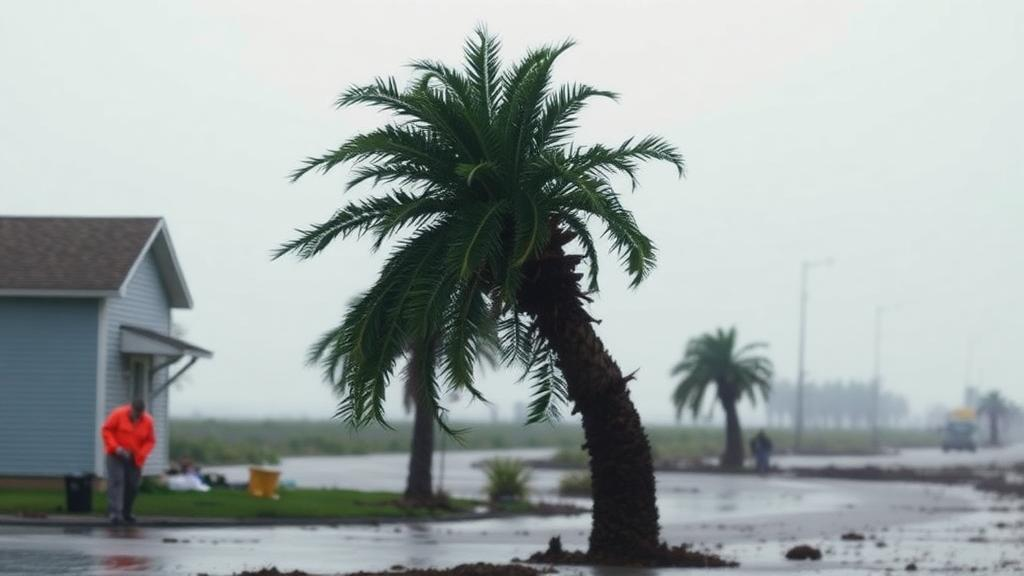
Wind is everywhere in disaster management, yet almost never all of it. Hurricanes tear coastlines apart, wildfires race through wind-driven grasslands, and polluted air drifts across borders, and these are the wind hazards that dominate emergency plans, scientific journals, and international frameworks. But a new open-access review in Theoretical and Applied Climatology argues that the disaster management field has quietly ignored an entire second family of wind-related risks: the invisible meteorological processes that shape hazards before they ever become headlines. The study, authored by Kyoo-Man Ha of Rabdan Academy in Abu Dhabi, proposes that governments and international organizations must supplement their familiar, externally visible hazard management with what he calls internal meteorological process management, a shift that could reshape how the world prepares for everything from dust devils to collapsing pollinator populations.
The starting point of the analysis is a deceptively simple observation: hazards are not evenly distributed across the globe, and neither is attention. Some regions have built deep expertise in the one or two threats they face most often, while other potential hazards go unmanaged entirely. The all-hazards approach, formally born in the late 1970s when the United States National Governors’ Association articulated the principles of comprehensive emergency management, was meant to fix exactly this blind spot. The idea was that governments at every level should prepare for and respond to all kinds of hazards rather than treating each threat in isolation. In practice, the United States could not fully implement the approach until the 1980s, and even then regions clashed over how to apply it, with law enforcement officials and firefighters sometimes disagreeing within the same jurisdiction about how a common plan should work.
Today, the vocabulary of all-hazard management, sometimes called multi-hazard, all-risk, or societal resilience management, appears in national strategies around the world, and globalization has spread emergency management information across borders faster than ever. Yet the review finds that the field still has not addressed the concept comprehensively. Researchers have repeatedly shown that existing practices fall short on interagency coordination, resource allocation, decision-making, stakeholder communication, policy implementation, and institutional learning. Alternative proposals, such as emphasizing functional management of communication and transportation systems across all hazards, have helped, but the gap persists. Among all hazard families, the review argues, wind is where the gap is widest, because practitioners discuss air pollution, hurricanes, and wildfires while disregarding wind direction as a meteorological driver, pollinator decline as an ecological disturbance, and localized indigenous wind phenomena such as gap winds and dust devils.
The scientific framing here matters. The study treats all wind hazards as climatological hazards generated by atmospheric processes rather than as isolated variables. Damaging winds arise from interactions among boundary-layer dynamics, surface roughness, land-sea thermal contrasts, synoptic circulation, convective instability, and wind-field variability. Wind itself is simply air moving from high-pressure to low-pressure areas, and the larger the pressure difference, the faster it moves, but that moving air also carries pollutants, moisture, heat, and pollen. Recent climate science has reinforced how much long-term atmospheric circulation patterns, shifting thermal gradients, and regional climate variability control the frequency, intensity, and geography of hazardous wind events, which means effective management must combine short-term meteorological forecasting with long-term climate adaptation. Empirical and modeling studies now allow intensity, persistence, direction, and circulation patterns to be quantitatively analyzed through observational datasets, synoptic climatology, and numerical modeling, giving hazard managers a far more robust scientific foundation than a decade ago.
To organize the evidence, the review distinguishes two analytical categories. External hazard-oriented management addresses the observable hazards within the current boundary of wind: air pollution, hurricanes, and wildfires. Internal meteorological process management addresses the unexpected or unobservable processes behind them, including wind direction as a driver, wind-related ecological disturbance, and location-specific wind systems that modify rather than constitute hazards. Conceptually, these are treated as a linked sequence rather than equivalent categories: meteorological drivers shape the conditions under which hazards emerge, hazards produce direct physical impacts or ecological disturbances, and those disturbances in turn modify vulnerability and subsequent risk. The method behind the paper was a structured narrative review, supported by the PRISMA 2020 flow diagram, that systematically identified, screened, and synthesized English-language literature spanning climatology, meteorology, engineering, emergency management, and public policy, with iterative thematic coding applied across three units of analysis: international organizations, developed countries, and developing countries.
The results reveal a field that performs well on the visible half of the problem. At the international level, the Sendai Framework for Disaster Risk Reduction 2015-2030, backed by the United Nations Office for Disaster Risk Reduction, encourages all-hazard management across all sectors, while the Paris Agreement targets the climate change that drives air pollution. International non-governmental organizations have pushed early action, from the Cameroon Red Cross prioritizing emergency preparedness to Emirates Nature-WWF in the United Arab Emirates promoting rapid air quality improvement and Fire and Emergency New Zealand responding quickly to pollution events. In developed countries, the United States has built hurricane and flood capability, with Hurricane Katrina in 2005 exposing the failures of fragmented all-hazard planning and Hurricane Sandy in 2012 demonstrating the payoff of prior planning, incident command systems, coordination, and leadership. European nations, despite the rarity of tropical systems there, have managed the health and social consequences of extratropical cyclones such as Vince in 2005 and subtropical storm Alpha in 2020, delivering humanitarian logistics from mental to physical health services.
Developing countries tell a parallel story centered on fire. Africa has been described as a wildfire continent, with roughly 70 percent of the 400 million hectares burned worldwide each year located in African savannas and grasslands, and those fires, many too small for satellite detection, disrupt the global atmosphere, carbon cycle, and ecosystems. South American nations including Brazil, Argentina, Chile, and Uruguay, frequently threatened by heatwave- and drought-driven wildfires and major timber exporters besides, have invested in advanced weather technology and land-use planning, while Southeast Asian countries have long battled wildfires in the Lower Mekong Basin. Yet across all three stakeholder groups, the review finds, internal meteorological processes are managed only through improvised alternatives rather than systematic frameworks, leaving the underlying drivers of wind-related risk largely unexamined.
Why bother closing that gap? The review identifies three major benefits of genuine all-hazard management. First, it provides a robust reference for all stakeholders across every phase of the emergency management cycle, from prevention and preparedness through response and recovery. Second, it enables cooperation among stakeholders who otherwise work in silos, including governments, businesses, voluntary organizations, mass media, and local communities, building professional networks that hazard-specific management rarely achieves. Third, it accumulates disaster response capacity for local communities, a process that helped create the professional emergency management profession itself in the twenty-first century. Focusing only on visible risks, the paper warns, misses crucial opportunities for early detection, forecasting, prevention, and recovery. Wildfire research makes the point concretely: air stability, wind direction, and wind speed are key factors controlling ember movement, fire intensity, and fire spread, so monitoring those meteorological processes directly improves forecasts and emergency response before dangerous conditions fully materialize.
The policy implications are deliberately framed as directions to test rather than mandates to impose. Drawing on the principle of progressiveness from the Emergency Management Institute’s 2007 principles of disaster management, the review suggests that practitioners could use fine-scale wind direction patterns, wind-driven pollinator decline, and localized indigenous wind knowledge to identify subtle signals, anticipate cascading impacts, and inform early warning indicators. Emergency managers might assess whether micro-level wind direction data supports interagency collaboration during wind-related incidents; institutions could explore incorporating pollinator-wind interactions into climate adaptation and biodiversity monitoring; and local authorities might test whether indigenous wind knowledge strengthens land-use planning and community risk education. The author is explicit that these recommendations are complementary possibilities, not conclusions requiring immediate revision of the Sendai Framework or other international instruments, and that feasibility must be evaluated within existing risk assessment, early warning, and preparedness programs while accounting for different institutional capacities and regional hazard contexts.
The review also acknowledges its own limits. It did not explore the complex interrelationships between wind hazards and other natural or anthropogenic hazards, and language and accessibility constraints, including the exclusion of non-English publications and reliance on paywalled literature, may have underrepresented regions with different approaches to wind hazard management. Still, as what the author describes as a pioneering attempt to study all-wind-hazard management comprehensively, the paper offers a conceptual framework that connects climatology, disaster risk reduction, and emergency management from a single analytical viewpoint. The next steps it proposes are practical: tabletop exercises, seminars, drills, and eventually full-scale exercises that test whether incorporating both external hazards and internal meteorological processes improves coordination under broader wind-hazard scenarios. If those tests succeed, the humble daily movement of air, the same force that carries pollen between plants and shapes local winds known only to the communities that live with them, could finally take its place alongside the hurricane in the world’s disaster plans, reducing human loss, economic damage, and the mental stress that follows in the wake of every wind-driven catastrophe.
Subject of Research: All-hazard management of wind hazards and internal meteorological processes in disaster risk reduction
Article Title: All-hazard management approach for wind
Article References: Ha, K.-M. (2026). All-hazard management approach for wind. Theoretical and Applied Climatology, 157(10), Article 624. https://doi.org/10.1007/s00704-026-06559-3
Image Credits: AI Generated
DOI: 10.1007/s00704-026-06559-3
Keywords: wind hazards, all-hazard management, disaster risk reduction, meteorology, climatology, emergency management, Sendai Framework, wildfires, hurricanes, air pollution, pollinator decline, resilience
Cite Scienmag News
Violet Maxwell. (October 6, 2026). Rethinking Wind Disasters: Why Emergency Managers Overlook Half the Story. Scienmag. https://scienmag.com/rethinking-wind-disasters-why-emergency-managers-overlook-half-the-story/
Violet Maxwell. "Rethinking Wind Disasters: Why Emergency Managers Overlook Half the Story." Scienmag, 6 October 2026, https://scienmag.com/rethinking-wind-disasters-why-emergency-managers-overlook-half-the-story/. Accessed 6 October 2026.
Violet Maxwell. "Rethinking Wind Disasters: Why Emergency Managers Overlook Half the Story." Scienmag. October 6, 2026. https://scienmag.com/rethinking-wind-disasters-why-emergency-managers-overlook-half-the-story/


