


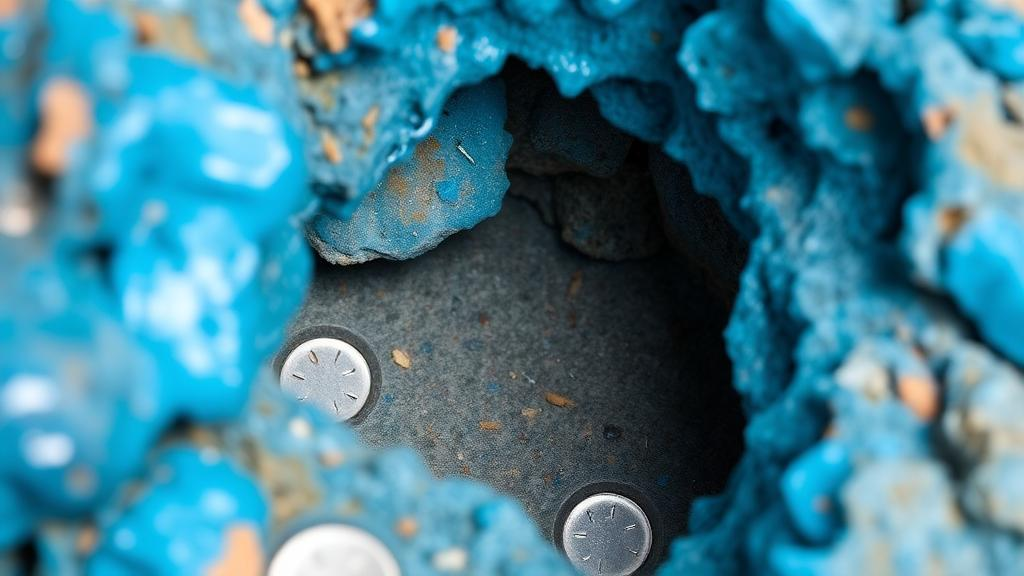
Deep beneath the hills of Ziyang in Sichuan Province, China, an unusual blue-green mineral is quietly rewriting how archaeologists understand the fate of organic remains at Palaeolithic sites. At the Mengxihe site, a rare locality that has yielded stone tools, animal bones, and even botanical material such as acorn shells, researchers have documented the formation of vivianite, a secondary iron phosphate mineral that only crystallizes under very specific chemical conditions. A new study published in Archaeological and Anthropological Sciences by Fengjiao Wang, Yali Wang, and Lei Mou presents the first systematic characterization of vivianite from this site and demonstrates that the mineral’s presence is far more than a curiosity. It is a chemical fingerprint of the burial environment, one that may allow archaeologists to predict where organic materials survive and where they have long since vanished.
Vivianite, chemically a hydrated iron phosphate, is well known to mineralogists for its striking coloration, which shifts from nearly colorless when freshly formed to deep blue or green as iron in its structure oxidizes. The mineral forms in waterlogged, oxygen-poor settings where dissolved iron and phosphate are abundant, conditions typical of lake bottoms, bogs, and saturated soils. In archaeological contexts, vivianite has been found adhering to bones, textiles, and even human remains, with famous occurrences including the Neolithic Iceman recovered from the Tyrolean Alps and the waterlogged Roman deposits at Vindolanda in northern England. Its presence has long been treated as a sign of anaerobic burial, but the Mengxihe study goes further by linking the mineral’s occurrence to measurable contrasts in soil chemistry across the same cultural layer.
The researchers analyzed vivianite associated with three distinct kinds of substrates at the site: acorn shells, fragments of bone, and the surfaces of soil aggregates known as peds. This association is itself significant, because it ties the mineral directly to the decomposition of organic matter. When plant or animal material degrades in an anoxic environment, it releases phosphate into the surrounding pore water. At the same time, the decay of organic matter consumes oxygen and drives the chemical reduction of iron oxides in the sediment, releasing ferrous iron. When these two ingredients meet in sufficient concentrations, and when competing anions such as sulfate are scarce, vivianite crystallizes. In other words, every speck of vivianite at Mengxihe marks a microenvironment where organic material once decayed under waterlogged, reducing conditions.
To identify and characterize the mineral, the team employed a trio of complementary analytical techniques. Scanning electron microscopy coupled with energy-dispersive spectroscopy, or SEM-EDS, revealed that the vivianite occurs as fine microcrystalline aggregates built from irregular short prismatic to pseudocubic crystallites. The elemental composition is dominated by iron and phosphorus, the defining constituents of the mineral, with minor amounts of manganese ranging from 0.3 to 1.4 weight percent. Raman spectroscopy provided molecular-level confirmation, detecting the characteristic vibrational modes of the phosphate groups. Notably, the Raman peaks showed shifts and broadening compared with those of well-crystallized reference vivianite, a signature of structural disorder at the nanoscale.
X-ray diffraction corroborated this picture. The diffraction patterns matched vivianite but displayed the broadened reflections characteristic of nanocrystalline material, meaning the crystals are extremely small and imperfectly ordered. This degree of crystallinity carries information in itself. Rapid precipitation from supersaturated pore waters, or formation in the presence of organic molecules that interfere with crystal growth, tends to produce such poorly ordered phases. The authors interpret the nanocrystalline character as evidence that the vivianite formed under specific local geochemical conditions rather than through slow, equilibrated diagenesis. The manganese substitution in the structure further suggests that the pore waters carried a modest dissolved manganese load, consistent with strongly reducing conditions in which manganese oxides, like iron oxides, dissolve.
The most consequential part of the study is the geochemical comparison between sediments that contain vivianite and those that do not. The researchers collected soil samples from zones proximal to and distal from the vivianite occurrences and analyzed a suite of chemical parameters. The results revealed systematic contrasts. Sediments near the vivianite showed higher concentrations of water-soluble phosphate, substantially reduced sulfate levels, near-neutral pH, and elevated organic carbon content. Crucially, the grain-size distributions of the two sediment groups remained comparable, which rules out simple sedimentological differences as the cause of the chemical contrasts. The differences must instead reflect localized geochemical processes operating within the deposit.
Each of these chemical signals fits the known requirements for vivianite precipitation. Elevated water-soluble phosphate indicates an abundant supply of dissolved phosphorus, liberated from decaying organic matter such as the acorns and bones with which the mineral is associated. Low sulfate is critical because in sulfate-rich settings, bacterial sulfate reduction generates sulfide ions that bind iron into iron sulfide minerals, effectively starving vivianite of its iron supply. Where sulfate is scarce, iron remains available to combine with phosphate instead. Near-neutral pH favors the stability of ferrous iron in solution, and high organic carbon both fuels the microbial respiration that maintains anoxic conditions and supplies the phosphate itself. Together, these parameters describe a self-reinforcing chemical niche in which organic decay, iron reduction, and phosphate precipitation proceed hand in hand.
For the archaeology of Mengxihe, these findings have direct interpretive value. The site is unusual among Palaeolithic localities in preserving botanical remains at all, since seeds, nuts, and wood normally decay rapidly after burial. The study shows that the heterogeneous preservation of organic material within the cultural layer is not random but is governed by the distribution of the geochemical conditions that favor vivianite formation. Where those conditions held, organic matter was incorporated into a chemical environment that slowed its destruction; where they did not, decay proceeded to completion. Vivianite thus serves as a map marker, pointing archaeologists to the pockets of enhanced preservation within an otherwise ordinary deposit.
The broader implications extend well beyond a single site in Sichuan. If vivianite and its associated geochemical signatures can be used as proxies, archaeologists could screen sediments for phosphate, sulfate, organic carbon, and pH to identify zones of organic preservation before committing resources to fine-grained excavation or fragile-material conservation. This would be especially valuable at waterlogged Palaeolithic sites, where organic artifacts and ecofacts are the most informative and the most perishable classes of evidence. The approach also contributes to reconstructing ancient burial environments in general terms, since the redox conditions recorded by vivianite speak to water tables, sedimentation rates, and the original character of the landscape in which early humans lived and deposited their refuse.
The Mengxihe study also connects archaeology to a much wider scientific conversation. Vivianite has become a subject of intense interest in environmental engineering, where it is studied as a means of recovering phosphorus from wastewater, and in limnology, where its formation in lake sediments controls the cycling of nutrients. Research on the mineral’s oxidation to metavivianite, its stability fields, and the influence of organic ligands on its growth continues to refine the framework that archaeologists can borrow. What the Mengxihe work demonstrates is that this body of knowledge can be turned back onto the archaeological record with real effect. A mineral once noted merely as a blue stain on old bones now offers a quantitative, testable window into the chemistry of burial, and with it, a better chance of understanding and protecting the fragile traces of the deep human past.
Subject of Research: Vivianite formation and soil geochemistry as indicators of burial environments at the Mengxihe Palaeolithic site, China
Article Title: Soil chemistry and vivianite formation in archaeological contexts: evidence from the Mengxihe Palaeolithic site, China
Article References: Soil chemistry and vivianite formation in archaeological contexts: evidence from the Mengxihe Palaeolithic site, China. (n.d.). https://doi.org/10.1007/s12520-026-02577-4
Image Credits: AI Generated
DOI: 10.1007/s12520-026-02577-4
Keywords: vivianite, Mengxihe site, Palaeolithic archaeology, soil chemistry, geochemistry, burial diagenesis, iron phosphate mineral, organic preservation, Raman spectroscopy, X-ray diffraction, SEM-EDS, Sichuan China
Cite Scienmag News
Courtney Benton. (October 6, 2026). Blue Mineral Clues Reveal How a Stone Age Site Preserved Its Secrets. Scienmag. https://scienmag.com/blue-mineral-clues-reveal-how-a-stone-age-site-preserved-its-secrets/
Courtney Benton. "Blue Mineral Clues Reveal How a Stone Age Site Preserved Its Secrets." Scienmag, 6 October 2026, https://scienmag.com/blue-mineral-clues-reveal-how-a-stone-age-site-preserved-its-secrets/. Accessed 6 October 2026.
Courtney Benton. "Blue Mineral Clues Reveal How a Stone Age Site Preserved Its Secrets." Scienmag. October 6, 2026. https://scienmag.com/blue-mineral-clues-reveal-how-a-stone-age-site-preserved-its-secrets/


