


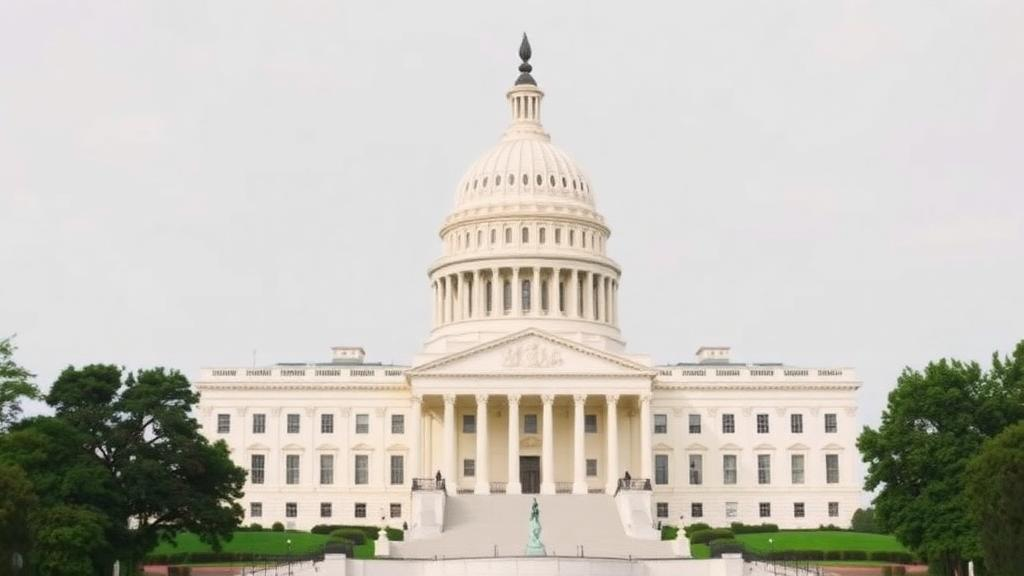
More than a third of adults in the United States cannot name all three branches of the federal government, and fewer than half can identify four of the five rights protected by the First Amendment, according to the 2026 Annenberg Constitution Day Civics Survey released by the Annenberg Public Policy Center (APPC) of the University of Pennsylvania. The annual survey, conducted in advance of Constitution Day on September 17, offers one of the most consistent longitudinal snapshots of what Americans actually know about the constitutional architecture that governs their lives, and the 2026 edition suggests that foundational civic knowledge remains stubbornly incomplete for a large share of the public.
The survey was fielded from August 6 to 9, 2026, among a nationally representative sample of 1,034 U.S. adults ages 18 and older. It was conducted for APPC by the independent research company SSRS on the SSRS Opinion Panel Omnibus, with a margin of sampling error of plus or minus 3.5 percentage points at the 95 percent confidence level. Data from the two previous years were collected on APPC’s own research panels, the Institutions of Democracy panel in 2024 and the Annenberg Science and Public Health panel in 2025, allowing the research team to track changes in constitutional knowledge across three consecutive years.
On the most basic structural question, 65 percent of respondents could name the executive, legislative, and judicial branches of government when asked in an open-ended format. That figure is not a statistically significant change from 2025, when 70 percent could name all three, or from 2024, when the figure stood at 65 percent. In practical terms, this means that 35 percent of American adults, roughly one in three, were unable to identify the complete set of institutions that make, enforce, and interpret federal law. Because the question was open-ended rather than multiple choice, respondents could not rely on recognition memory and had to retrieve the branches from their own knowledge, a demanding cognitive task that tends to produce lower scores than recognition-based formats.
Knowledge of the First Amendment showed one statistically significant shift from the prior year. When asked to name the specific rights guaranteed by the First Amendment, 73 percent of respondents cited freedom of speech, a significant decline from the 79 percent who named it in 2025, though statistically indistinguishable from the 74 percent recorded in 2024. Freedom of speech remains the only First Amendment right identified by more than half of Americans. The remaining four rights clustered well below that threshold: 43 percent named freedom of religion, 31 percent named freedom of assembly, and 29 percent named freedom of the press. Just 12 percent named the right to petition the government, the least-known of the five protections.
The cumulative picture is striking. Only 9 percent of respondents correctly named all five First Amendment protections, while 24 percent could not name a single one. A quarter of respondents, 25 percent, incorrectly cited the right to bear arms as a First Amendment right, conflating the Second Amendment with the First. This pattern of misattribution is a recurring feature of civics survey research and illustrates how constitutional knowledge is often stored as a loose association of familiar phrases rather than as an organized map of the document’s structure. The First Amendment protects speech, religion, assembly, press, and petition; the right to keep and bear arms belongs to an entirely separate amendment ratified four years later.
Kathleen Hall Jamieson, director emerita of the Annenberg Public Policy Center, framed the stakes bluntly. Ignorance is costly, she said, because people cannot protect and cherish rights that they do not know they have. Her observation captures the central rationale for the annual survey: constitutional rights depend in part on citizens recognizing when those rights are implicated, whether in a courtroom, at a school board meeting, or in encounters with government authority. A public unfamiliar with the scope of the First Amendment is less equipped to invoke it, and a public unsure of how the three branches interact is less able to evaluate claims about checks and balances in political debate.
The survey also probed public understanding of several constitutional provisions that have featured prominently in recent litigation and political controversy. On birthright citizenship, three-quarters of respondents, 76 percent, correctly said that children born in the United States and subject to its jurisdiction are U.S. citizens even if neither of their parents is a citizen. This principle, rooted in the citizenship clause of the Fourteenth Amendment, has been the subject of ongoing court battles, making the finding particularly relevant to current constitutional debates. A strong majority also understands that constitutional protections extend beyond citizens: 56 percent of U.S. adults said it is very or somewhat inaccurate to claim that people in the country illegally have no rights under the Constitution, while 44 percent said that claim is accurate. The Supreme Court has long held that the Constitution’s core protections are written in terms of persons rather than citizens and therefore apply to people in the United States regardless of immigration status.
Questions about institutional mechanics produced generally stronger results. A large majority, 83 percent, knew that when a president vetoes legislation, the bill becomes law if two-thirds of the members in each house of Congress vote to override the veto, a correct statement of the override provision in Article I. Similarly, 69 percent knew that a 5-4 Supreme Court decision is the law and must be followed. Among the rest, 18 percent incorrectly said such a decision is sent back to Congress for reconsideration and 12 percent said it goes back to the federal court of appeals, misconceptions that misread how judicial review operates. On the question of constitutional interpretation, 60 percent correctly identified the Supreme Court as having the final responsibility for determining whether a presidential action is constitutional when the president and the Court disagree. However, 17 percent assigned that final authority to Congress, 4 percent to the president, and 19 percent were not sure, indicating that the principle of judicial supremacy remains imperfectly understood.
Knowledge of federalism was more fragile. Asked what the Tenth Amendment says about the relationship between the states and the federal government, exactly half of respondents, 50 percent, correctly said that powers not granted to the federal government are reserved to the states or the people. About one in eight, 13 percent, inverted the principle, saying that states have only the powers granted to them by the Constitution, and more than a third, 37 percent, were not sure which reading is correct. The Tenth Amendment, ratified in 1791 as part of the Bill of Rights, states that the powers not delegated to the United States by the Constitution, nor prohibited by it to the states, are reserved to the states respectively, or to the people. The amendment anchors the division of authority in the American federal system, and the survey suggests that a substantial portion of the public either misunderstands or cannot articulate that division.
The Annenberg Public Policy Center releases the survey each year ahead of Constitution Day, which commemorates the signing of the Constitution on September 17, 1787. Alongside the survey, APPC supports civics education through Annenberg Classroom, which provides free resources for teaching the Constitution, and the Civics Renewal Network, a coalition of 50 nonpartisan, nonprofit organizations offering free, high-quality instructional materials for teachers. Recent additions include a collaborative Constitution Day Hub website and a short film on freedom of the press titled Holding the Line: Journalism and Democracy, part of Annenberg Classroom’s award-winning video series. R. Lance Holbert, director of APPC’s Leonore Annenberg Institute for Civics, said this year’s findings indicate that there is still work to be done in strengthening the citizenry’s knowledge of the U.S. Constitution, adding that an understanding of the nation’s founding documents remains paramount for the long-term health of American democracy. The survey team comprised Matt Levendusky, director of APPC’s Institutions of Democracy division; research analyst Shawn Patterson Jr.; managing director of survey research Ken Winneg; Holbert; and Jamieson. As the findings make clear, the document signed in Philadelphia in 1787 still defines the structure of American government, but for a sizable share of the public its most basic contours remain out of view.
Subject of Research: Civics knowledge among U.S. adults regarding the branches of government and First Amendment rights
Article Title: A third of Americans cannot name the three branches of government
Article References: A third of Americans cannot name the three branches of government. (n.d.). Original publication
Image Credits: AI Generated
DOI: Not provided
Keywords: civics knowledge, U.S. Constitution, First Amendment, three branches of government, Annenberg Public Policy Center, Constitution Day, birthright citizenship, Tenth Amendment, survey research, freedom of speech, civics education, judicial review
Cite Scienmag News
Courtney Benton. (October 6, 2026). One in Three Americans Cannot Name All Three Branches of Government, Survey Finds. Scienmag. https://scienmag.com/one-in-three-americans-cannot-name-all-three-branches-of-government-survey-finds/
Courtney Benton. "One in Three Americans Cannot Name All Three Branches of Government, Survey Finds." Scienmag, 6 October 2026, https://scienmag.com/one-in-three-americans-cannot-name-all-three-branches-of-government-survey-finds/. Accessed 6 October 2026.
Courtney Benton. "One in Three Americans Cannot Name All Three Branches of Government, Survey Finds." Scienmag. October 6, 2026. https://scienmag.com/one-in-three-americans-cannot-name-all-three-branches-of-government-survey-finds/


