


High in the pine-scented forests of Gulmarg, one of Kashmir’s most celebrated mountain resorts, botanists have stumbled upon a plant that should not, according to every official record, exist in India. During routine floristic surveys in the coniferous woodlands of district Baramulla, researchers from the University of Kashmir collected specimens of a bramble that, after months of painstaking comparison with historical literature and herbarium collections across two continents, turned out to be Rubus idaeus Linnaeus subsp. idaeus, the European red raspberry, the very species behind most of the raspberries sold in supermarkets worldwide. The discovery, published as an open-access paper in the journal Discover Plants, marks the first confirmed record of this iconic fruiting shrub growing wild on Indian soil, and it quietly rewrites a corner of the country’s botanical map.
The find matters far beyond a single line added to a checklist. The genus Rubus, which includes raspberries, blackberries, and their many hybrid relatives, is one of the most species-rich lineages in the rose family, Rosaceae, with roughly 1,535 species distributed across the globe. Its center of diversity lies in the temperate Northern Hemisphere, and India’s Himalayan arc hosts a substantial share of that richness, with nearly 75 species recorded nationally. Yet the distribution of these brambles within India is strikingly uneven: the Eastern Himalaya dominates the tally, led by Arunachal Pradesh with 41 species, followed by Sikkim with 30, the Darjeeling district of West Bengal with 26, and Meghalaya with 24. The north-western arm of the range, the Kashmir Himalaya, had until recently yielded only 15 documented taxa, a figure that has now grown with this latest addition.
Why did such a famous plant escape detection for so long? Part of the answer lies in the notorious difficulty of Rubus taxonomy itself. Species in this genus vary enormously in leaf shape, cane armature, and glandularity, and they routinely hybridize, shift their chromosome counts through polyploidy, and even reproduce asexually through seeds via apomixis, a combination that has earned the group comparisons to a taxonomic Gordian knot. Distinguishing one raspberry from another often hinges on minute features: the presence or absence of tiny stalked glands, the texture of bark on second-year canes, the shape of stipules at the base of leaf stalks. Without expert examination, a wild European raspberry could easily be mistaken for a close relative already known from the region.
That is precisely the trap the Kashmir team had to navigate. The region had recently gained two other Rubus records: Rubus idaeus subsp. strigosus, the North American raspberry, and the invasive Armenian blackberry, Rubus armeniacus. When the researchers encountered unfamiliar brambles in Gulmarg, the obvious suspicion was that they had found yet another population of the strigosus subspecies, which was reported from India only in 2024. Instead, detailed scrutiny of the first-year canes, leaf characters, and inflorescences revealed something subtly but decisively different. The new plants were entirely free of the stipitate glands that pepper the canes, stipules, petioles, pedicels, and sepals of their American cousin, and their bark remained smooth and light brown with age rather than peeling away in papery strips.
To confirm the identification, the team followed the full apparatus of modern plant taxonomy. Fresh specimens were collected, pressed, dried, and deposited as voucher material at the University of Kashmir Herbarium, where they now carry the accession number KASH-47347. The researchers consulted the original 1753 species description digitized by the Biodiversity Heritage Library, combed through classical monographs of the genus, and examined digital images of historical herbarium sheets held at the herbaria in Berlin and Kew, including specimens bearing barcodes from both institutions. Macroscopic features were photographed with digital cameras in the field, while the fine diagnostic structures, sepals, petals, stamens, and carpels, were imaged under a Leica stereozoom microscope. A distribution map was assembled in ArcGIS, pinning the population to an elevation of 2,671 meters at coordinates 34 degrees 02 minutes 44.43 seconds north, 74 degrees 23 minutes 10.34 seconds east.
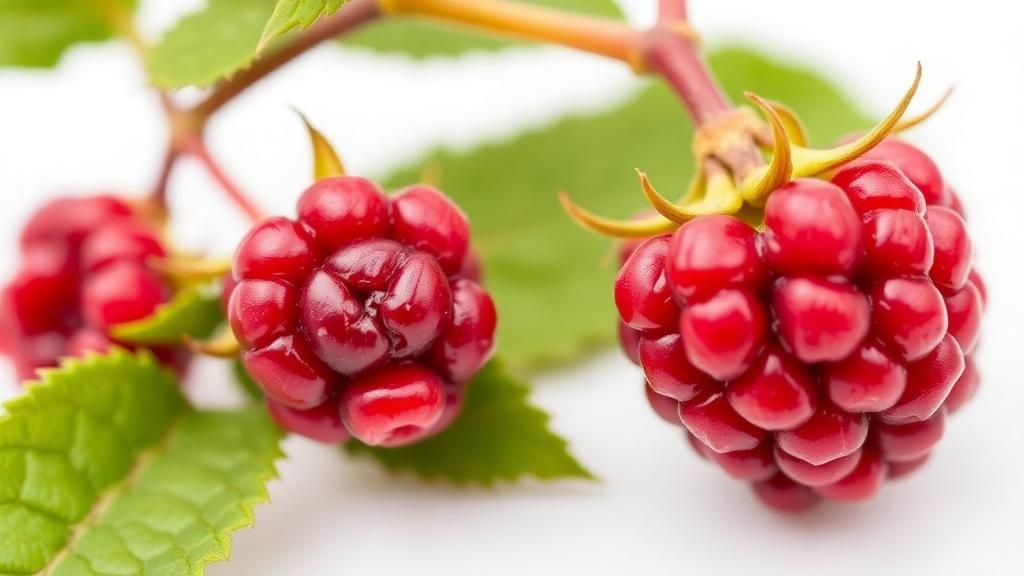
The resulting taxonomic portrait describes a deciduous shrub with erect, largely hairless, eglandular stems bearing sparse, erect prickles. Its leaves are pinnately compound with three to five leaflets, green and smooth above, densely woolly beneath, with ovate to oblong-ovate blades, heart-shaped bases, serrated margins, and pointed tips. The flowers, a centimeter to a centimeter and a half across, appear in short terminal racemes between June and July, with white, spatulate petals and stamens that never quite reach the length of the petals. By July and August these give way to the familiar aggregate fruits, each an assembly of 5 to 27 juicy drupelets that ripen to a vivid red, measuring up to 17.5 millimeters across. The plants grow in the shade of moist temperate coniferous forest dominated by the West Himalayan pine Pinus wallichiana, and along forest edges and grassy slopes.
The biogeographical implications are intriguing. Rubus idaeus subsp. idaeus is native to Europe and northern Asia, with a natural range that also extends into North America and parts of South America, but India had never figured in its wild distribution. The only earlier Indian records referred to cultivated plants: experimental plantings maintained under controlled conditions at Sher-e-Kashmir University of Agricultural Sciences and Technology in Leh, Ladakh, and historical cultivation in the Nilgiri Hills of Tamil Nadu in Peninsular India. Those garden populations, the authors note, never implied naturalization. The Gulmarg population, by contrast, is growing entirely on its own in a forest understory, suggesting either a long-overlooked native relict or an unrecorded introduction that has managed to establish itself without human assistance. Disentangling those two scenarios is a question the new record now opens for future research.
There is also an urgent conservation dimension. The single known population is small and localized, confined to a shaded coniferous understory in one of Kashmir’s busiest tourist destinations. The researchers report that tourism-driven development, particularly road expansion and the slope instability it triggers, poses a direct threat to the plants’ long-term persistence. A species documented from just one spot, with no information yet on population size, seed set, or regeneration, sits in a precarious position regardless of whether it arrived millennia ago or decades ago. The team calls for targeted surveys of similar moist, shaded habitats across the Kashmir Himalaya and adjacent regions to establish the true extent of the raspberry’s distribution and to gauge the health of its populations before development pressure closes the window.
The discovery also carries economic and scientific promise. Red raspberry is the most commercially important species in the genus worldwide, and its fruits are prized as a functional food, rich in vitamins, minerals, dietary fiber, and phenolic compounds, with documented antioxidant, anti-inflammatory, and antimicrobial properties linked to reduced risk of chronic disease. A wild population growing at nearly 2,700 meters in the north-western Himalaya could represent genetic material adapted to harsh mountain conditions, potentially valuable for breeding programs seeking climate-resilient cultivars, and for understanding how the species’ genomic resources, already extensive in Rubus research, map onto natural variation at the edge of a continental range.
For now, the humble raspberry of European hedgerows has a new and unexpected address. Its appearance in the Kashmir Himalaya is a reminder that even in well-surveyed, heavily visited landscapes, the botanical inventory of the planet remains unfinished, and that careful morphological work, old herbaria, and patient fieldwork can still yield surprises worthy of the front page. Whether the Gulmarg raspberry proves to be a relict of ancient dispersal or a quiet newcomer, its future will depend on how quickly conservationists and land managers act on a record that, until this month, no one knew existed.
Subject of Research: First wild distribution record of the European red raspberry (Rubus idaeus subsp. idaeus) in India, from the Kashmir Himalaya
Article Title: Rubus idaeus L. subsp. idaeus, a new distribution record to the flora of India from Kashmir Himalaya
Article References: Lateef, S., Zargar, S. A., Khuroo, A. A., & Wani, A. A. (2026). Rubus idaeus L. subsp. idaeus, a new distribution record to the flora of India from Kashmir Himalaya. Discover Plants, 3(1), Article 384. https://doi.org/10.1007/s44372-026-00851-2
Image Credits: AI Generated
DOI: 10.1007/s44372-026-00851-2
Keywords: Rubus idaeus, red raspberry, Kashmir Himalaya, new distribution record, Rosaceae, plant taxonomy, Gulmarg, flora of India, biodiversity, coniferous forest, conservation, herbarium
Cite Scienmag News
Margaret Porter. (October 6, 2026). Wild European Red Raspberry Discovered in India for the First Time. Scienmag. https://scienmag.com/wild-european-red-raspberry-discovered-in-india-for-the-first-time/
Margaret Porter. "Wild European Red Raspberry Discovered in India for the First Time." Scienmag, 6 October 2026, https://scienmag.com/wild-european-red-raspberry-discovered-in-india-for-the-first-time/. Accessed 6 October 2026.
Margaret Porter. "Wild European Red Raspberry Discovered in India for the First Time." Scienmag. October 6, 2026. https://scienmag.com/wild-european-red-raspberry-discovered-in-india-for-the-first-time/


