


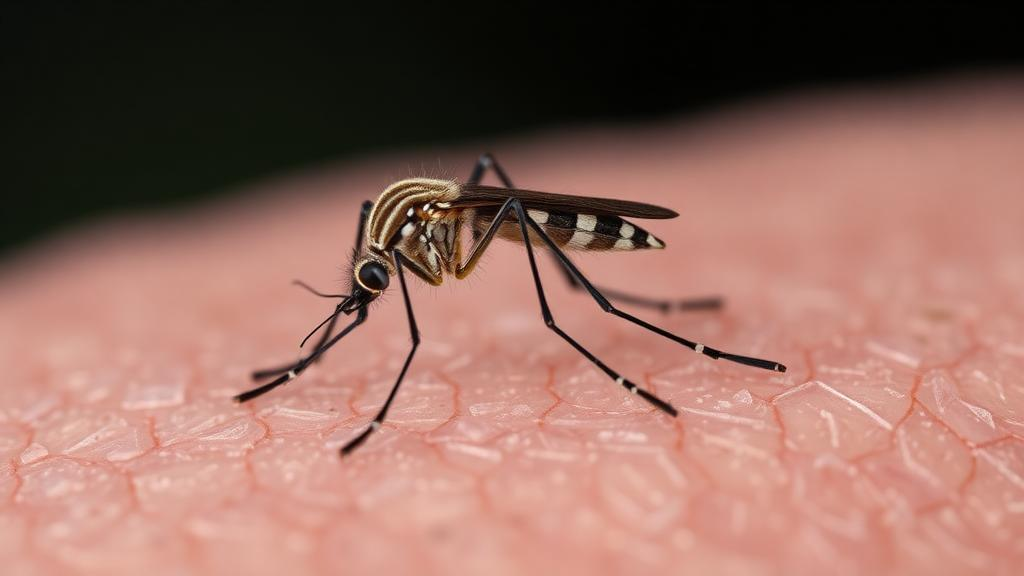
One of the most persistent puzzles in the fight against malaria is why mosquito populations sometimes crash under control pressure and then rebound, while in other settings they seem to tip quietly toward extinction. A new modeling study published in Parasites & Vectors suggests that the answer may lie in a pair of ecological forces that rarely get discussed together: the well-known braking effect of competition among mosquito larvae, and a far more mysterious phenomenon called the Allee effect, in which individuals actually fare worse when populations become very sparse. The research, led by Andrea M. Kipingu of the University of Glasgow and colleagues at the Ifakara Health Institute in Tanzania, argues that understanding how these two forces trade off against each other could reshape how elimination campaigns are designed.
Negative density-dependence is the ecological workhorse of population regulation. As more larvae crowd into the same puddle or container, resources such as food and space become scarce, survival falls, and population growth slows. For malaria mosquitoes of the genus Anopheles, this density-dependent mortality during the larval stages is well documented and has long been built into models of mosquito population dynamics. It explains a familiar and frustrating pattern: when insecticides or larvicides kill off a large share of the mosquito population, the survivors suddenly face far less competition, their offspring survive at higher rates, and numbers bounce back toward the previous equilibrium.
Allee effects work in the opposite direction. Named after the ecologist W. C. Allee, they describe situations in which per-capita fitness declines as population density falls. The classic mechanism is mate limitation: when individuals are so rare that they struggle to find each other, reproduction stalls, and small populations can spiral toward extinction. Allee effects are a cornerstone of conservation biology, where they help explain why tiny populations of endangered species often cannot recover even after threats are removed. But for disease vectors, and for malaria mosquitoes in particular, they have received remarkably little attention. Indeed, no Allee effect has ever been empirically demonstrated in Anopheles populations, even though many aspects of mosquito biology, from the swarming behavior of males to the spatial distribution of breeding sites, make mate limitation biologically plausible.
To explore what would happen if such effects do exist, the team built a stochastic, stage-structured simulation model representing a simplified mosquito life cycle. The model tracked individuals through early and late larval stages and into adulthood, and incorporated the two regulatory processes at different points in the life cycle. Negative density-dependence acted on larval survival, mimicking resource competition during development, while a mate-finding Allee effect acted on total fecundity, reducing the number of eggs produced when adult densities were low. By varying the strength of each process independently and in combination, and by simulating different vector control scenarios, the researchers could ask how the interplay between the two forces shapes population persistence, rebound, and extinction.
The first and perhaps most counterintuitive result is that neither process, considered on its own, had a substantial long-term effect on whether the simulated mosquito populations persisted. Negative density-dependence did substantially alter the equilibrium abundance, the level at which populations settle, but it did not, by itself, push populations toward extinction. Allee effects alone, in this formulation, likewise did not dramatically change long-term outcomes. In other words, each regulatory mechanism in isolation leaves the population with a stable attractor that it can return to after disturbance.
Everything changed when the two processes acted together. As the strength of both negative density-dependence and the mate-finding Allee effect increased, the combined effect accelerated population decline and increased the likelihood of extinction. The mechanism is a kind of ecological pincer movement. Density-dependent competition keeps populations from exploding after a control measure removes competitors, while the Allee effect punishes the population for being small. A population knocked down by intervention cannot rely on the usual release from competition to fuel a rapid recovery, and at the same time its remaining adults struggle to find mates. The result is a downward trajectory that neither force could produce alone.
This interaction has direct implications for how control interventions are timed and sustained. The simulations compared sustained interventions with shorter-term campaigns, using immolating larvicides, larvicides that kill larvae, as the example intervention that reduces the larval population. Sustained interventions were able to push mosquito populations down to abundances low enough that Allee effects became important, and once that threshold was crossed, the probability of extinction rose. Short-term interventions, by contrast, allowed populations to rebound, driven by the negative density-dependence as formulated in the model: relieve the larval crowding, and larval survival improves, allowing numbers to climb back. The modeling thus provides a theoretical rationale for a principle that elimination programs have learned empirically, that consistency and duration of control matter as much as intensity.
The study draws on field experience from large-scale larvicidal control in Dar es Salaam, Tanzania, and the authors acknowledge the late Prosper Chaki, who helped explain the data from that program, as well as technicians and scientists at the Ifakara Health Institute. That grounding in real vector control settings matters, because the practical question the model addresses is not abstract. Malaria elimination campaigns across Africa increasingly rely on combinations of insecticide-treated nets, indoor residual spraying, and larval source management, and they face the recurring problem of populations that persist at low density or resurge once pressure eases. If mate-finding Allee effects operate in wild Anopheles populations, then sustained larviciding could be deliberately pushed harder and longer, not merely to suppress numbers but to drive them below the critical threshold where mating failure takes over and extinction becomes self-reinforcing.
The authors are careful about the limits of their findings. Because Allee effects have not been empirically demonstrated in malaria mosquitoes, the study is explicitly a what-if analysis: it evaluates what the implications would be if such effects exist, rather than claiming that they do. The model is a simplified representation of the mosquito life cycle, and the strength of the Allee effect in any real population would depend on details such as mating swarms, dispersal, and the spatial clustering of breeding sites that the model does not resolve. Empirical work to detect Allee effects in vector populations, perhaps through mark-release-recapture experiments or analyses of mating frequency at low density, would be the natural next step. The work was supported by the European Research Council under the European Union’s Horizon 2020 research and innovation programme, with additional support from the Bill & Melinda Gates Foundation.
Even with those caveats, the conceptual payoff is significant. The study shows that less-studied regulatory processes can identify which stages of the vector life cycle are resilient and which are vulnerable, and that the two can be leveraged together. A control strategy that ignores the possibility of Allee effects may underestimate how close a suppressed population is to elimination and abandon interventions prematurely, forfeiting a chance at local extinction. Conversely, a strategy that understands the trade-off can time and sustain its efforts to exploit the vulnerability of sparse populations. As malaria-endemic countries pursue elimination rather than mere control, models like this one suggest that the final, hardest phase of the campaign may depend not just on killing more mosquitoes, but on understanding the ecology of the few that remain.
Subject of Research: Population dynamics of malaria mosquito vectors and the interaction of negative density-dependence and Allee effects in vector control
Article Title: Implications of the trade-offs between negative density-dependence and Allee effects for vector control
Article References: Kipingu, A. M., Kiware, S., Haydon, D. T., Johnson, P. C. D., & Viana, M. (2026). Implications of the trade-offs between negative density-dependence and Allee effects for vector control. Parasites & Vectors. https://doi.org/10.1186/s13071-026-07634-4
Image Credits: AI Generated
DOI: 10.1186/s13071-026-07634-4
Keywords: Anopheles mosquitoes, malaria, vector control, Allee effects, negative density-dependence, larvicides, population dynamics, simulation model, larval source management, disease elimination, Parasites & Vectors, Tanzania
Cite Scienmag News
Drew Townsend. (October 6, 2026). How Mosquito Mating Habits Could Make or Break Malaria Control Campaigns. Scienmag. https://scienmag.com/how-mosquito-mating-habits-could-make-or-break-malaria-control-campaigns/
Drew Townsend. "How Mosquito Mating Habits Could Make or Break Malaria Control Campaigns." Scienmag, 6 October 2026, https://scienmag.com/how-mosquito-mating-habits-could-make-or-break-malaria-control-campaigns/. Accessed 6 October 2026.
Drew Townsend. "How Mosquito Mating Habits Could Make or Break Malaria Control Campaigns." Scienmag. October 6, 2026. https://scienmag.com/how-mosquito-mating-habits-could-make-or-break-malaria-control-campaigns/


