


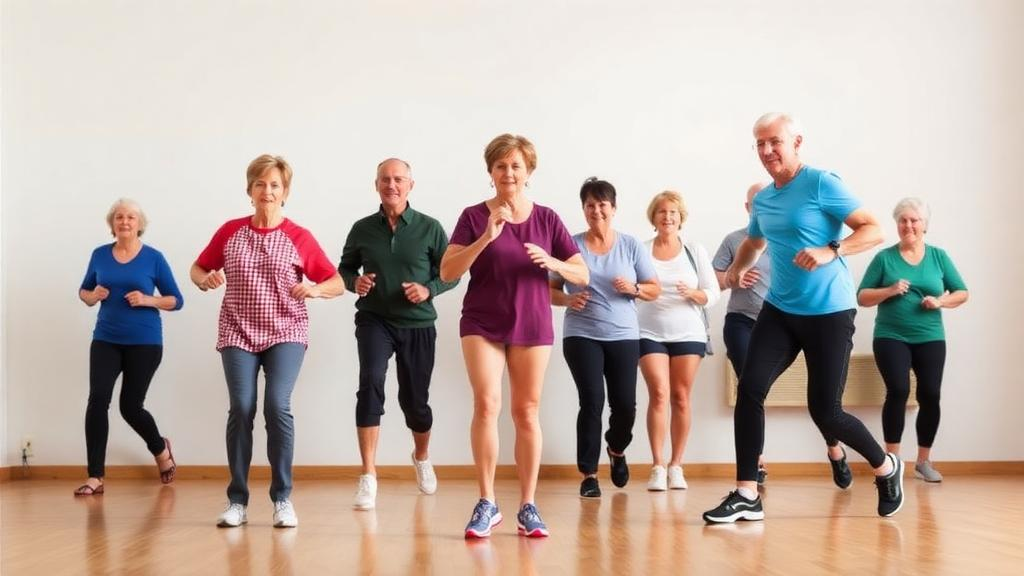
A new study of community-dwelling older adults offers some of the clearest real-world evidence yet that how long people stick with a multicomponent exercise program shapes which aspects of physical fitness actually improve. The research, published in BMC Geriatrics by a team led by Liang-Rong Chen and corresponding author Shao-Hsi Chang of National Taiwan Normal University, followed 260 adults aged 65 and older through structured community exercise classes and tracked seven distinct measures of functional fitness over roughly half a year. The findings suggest that while shorter programs deliver measurable gains, continued participation across two consecutive training phases is linked to more favorable trajectories in balance, lower-body strength and cardiorespiratory endurance.
The study was designed as a pragmatic, non-randomized dynamic cohort study, a design choice that reflects a deliberate trade-off. Rather than assigning volunteers to exercise or no-exercise conditions under laboratory conditions, the researchers observed people taking part in genuine community-based programs, the kind that municipal governments and local organizations actually run. This approach sacrifices some experimental control but captures what happens when older adults join real classes with real schedules, real instructors and real opportunities to drop out. The participants, whose mean age was 73.68 years with a standard deviation of 4.37, were predominantly female, making up 82.7 percent of the analytic sample, a composition typical of community exercise programs in many countries.
What makes the study methodologically interesting is its dynamic cohort structure and its four-point assessment timeline. Functional fitness was measured at baseline (T1), at week 12 (T2), at week 16 after a planned four-week no-training interval (T3), and again at week 28 (T4). Based on their observed exposure, participants were classified into two groups: a 12-week group comprising 166 people, subdivided into Cohort A, who were assessed only from T1 to T2 (56 people), and Cohort B, assessed only from T3 to T4 (110 people), and a 24-week group of 94 participants who completed assessments across all four time points. This structure allowed the researchers to compare temporal change patterns between people whose observed participation spanned one training phase versus both.
The outcome measures came from the Senior Fitness Test battery, a widely used set of field tests validated for older adults. Static balance was assessed with the single-leg stance test with eyes open, dynamic balance with the 8-foot Up-and-Go test, upper-body strength with the arm curl, lower-body strength with the chair stand, upper-body flexibility with the back scratch test, lower-body flexibility with the sit-and-reach test, and cardiorespiratory endurance with the 2-minute step test. Together these tests capture the physical capacities that determine whether an older person can rise from a chair unaided, recover from a stumble, reach a high shelf or climb a flight of stairs without becoming breathless, the everyday abilities that underpin independent living.
To analyze the data, the team used linear mixed models, a statistical framework well suited to repeated-measures designs because it can accommodate unbalanced data from a dynamic cohort while estimating group differences, time effects and, crucially, Group by Time interactions. A significant interaction is the statistical signature the researchers were looking for: it indicates that the pattern of change over time differed between the 12-week and 24-week groups, rather than both groups simply improving in parallel. The models revealed significant time effects for all seven functional fitness outcomes, meaning that across the sample as a whole, fitness changed measurably over the study period regardless of group membership.
The interaction results were more selective, and that selectivity is where the story becomes compelling. Significant Group by Time interactions emerged for four outcomes: static balance (p = 0.023), the chair stand test of lower-body strength (p = 0.001), dynamic balance measured by the Up-and-Go test (p = 0.004), and the 2-minute step test of cardiorespiratory endurance (p = 0.024). In other words, the temporal trajectories of these four capacities differed depending on whether participants were observed across one or both training phases. By contrast, no significant interaction effects appeared for arm curl, back scratch or sit-and-reach, the tests of upper-body strength and flexibility, indicating that temporal change patterns for those measures did not differ between the groups.
The pattern of which outcomes responded to longer participation and which did not is physiologically coherent. Balance, lower-limb strength and aerobic endurance are precisely the capacities that decline fastest with sedentary aging and that respond to progressive, sustained training stimuli. Lower-body strength and dynamic balance depend on repeated loading of the legs and hips, and postural control improves gradually as the neuromuscular system adapts over weeks and months. Cardiorespiratory endurance likewise accumulates with sustained aerobic work. Upper-body strength and flexibility, by contrast, may respond more quickly or plateau earlier, or may be maintained by everyday activities, which could explain why extending participation from 12 to 24 weeks did not produce distinguishable trajectories for those measures in this study.
The authors conclude that observed participation in both the 12-week and 24-week community-based multicomponent exercise programs was associated with temporal changes in functional fitness, and that continued participation across both intervention phases was associated with more favorable temporal patterns in selected lower-limb, balance-related and endurance outcomes. The wording is carefully associational rather than causal. Because the study was non-randomized and participants were classified by observed exposure, it remains possible that people who continued for 24 weeks differed in unmeasured ways from those who participated for a single phase, including in motivation, health status or baseline fitness. Even so, the dynamic cohort design and the planned four-week no-training interval embedded in the timeline give the findings more texture than a simple before-and-after comparison.
For public health planners, the practical implications are hard to ignore. Populations are aging rapidly across much of the world, and falls among older adults carry enormous costs in injury, hospitalization and loss of independence. Multicomponent exercise, which typically blends aerobic, strength, balance and flexibility elements, is widely recommended in clinical guidelines, yet evidence about how intervention duration shapes outcomes in real community settings has remained heterogeneous. This study addresses that gap directly, showing in a pragmatic setting that the benefits of community exercise programs are not uniform across fitness domains and that the domains most critical for fall prevention and daily mobility appear to benefit from sustained participation.
The research also carries a message for individual older adults and their families: the first 12 weeks of a community exercise class may be only the opening chapter. The four outcomes that showed group-dependent trajectories, static balance, dynamic balance, chair-stand strength and step-test endurance, are the very capacities that keep people upright, mobile and aerobically capable in daily life. The study, funded by personal grants from the National Science and Technology Council of Taiwan and approved by the Research Ethics Committee of National Taiwan Normal University, was conducted in accordance with the Declaration of Helsinki with written informed consent from all participants. As community programs worldwide scale up to meet the needs of aging populations, this dynamic cohort study provides a data-driven argument that designing programs to encourage participants to stay beyond the first quarter-year may pay dividends precisely where it matters most.
Subject of Research: Effects of 12-week and 24-week community-based multicomponent exercise programs on functional fitness in older adults
Article Title: Changes in functional fitness among community-dwelling older adults participating in 12-week and 24-week community-based multicomponent exercise programs: a dynamic cohort study
Article References: Chen, L.-R., Chiou, H.-J., Yu, Y.-C., Tsai, M.-C., Liao, Y., & Chang, S.-H. (2026). Changes in functional fitness among community-dwelling older adults participating in 12-week and 24-week community-based multicomponent exercise programs: a dynamic cohort study. BMC Geriatrics. https://doi.org/10.1186/s12877-026-08377-8
Image Credits: AI Generated
DOI: 10.1186/s12877-026-08377-8
Keywords: multicomponent exercise, older adults, functional fitness, dynamic cohort study, balance, cardiorespiratory endurance, Senior Fitness Test, community-based programs, linear mixed models, healthy aging, fall prevention, physical activity
Cite Scienmag News
Beatrice Stafford. (October 6, 2026). Longer Community Exercise Programs Sharpen Balance, Strength and Endurance in Older Adults. Scienmag. https://scienmag.com/longer-community-exercise-programs-sharpen-balance-strength-and-endurance-in-older-adults/
Beatrice Stafford. "Longer Community Exercise Programs Sharpen Balance, Strength and Endurance in Older Adults." Scienmag, 6 October 2026, https://scienmag.com/longer-community-exercise-programs-sharpen-balance-strength-and-endurance-in-older-adults/. Accessed 6 October 2026.
Beatrice Stafford. "Longer Community Exercise Programs Sharpen Balance, Strength and Endurance in Older Adults." Scienmag. October 6, 2026. https://scienmag.com/longer-community-exercise-programs-sharpen-balance-strength-and-endurance-in-older-adults/


