


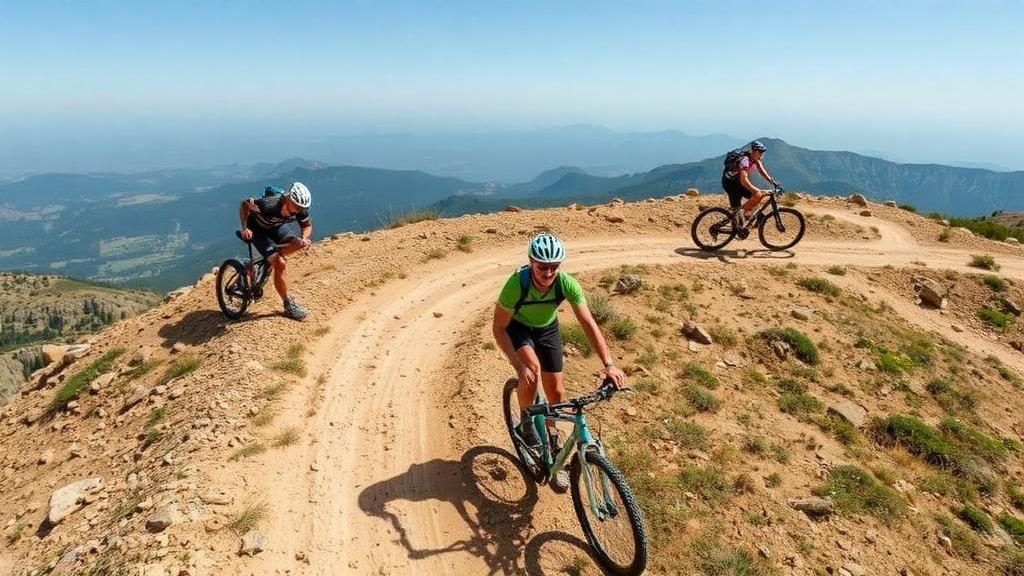
Every weekend, thousands of runners and cyclists surge through the trails of Spain’s Sierra de Guadarrama National Park, one of the most heavily used protected areas in the country thanks to its proximity to Madrid. The boom in trail running and mountain biking has brought economic vitality to surrounding communities, but it has also raised an urgent question for park managers: how much trampling can a Mediterranean mountain ecosystem absorb before the damage becomes permanent? A new year-long field experiment published in iScience offers one of the most detailed answers yet, and its findings are both reassuring and cautionary.
A team of researchers led by Francisco Gómez-Prieto of the Universidad Autónoma de Madrid set up an experimental network of corridors in a forest clearing at roughly 1,300 meters elevation, surrounded by pine stands of Pinus nigra, Pinus pinaster and Pinus sylvestris. The site was deliberately chosen because it resembles terrain already used by sporting events in the park. On flat ground, the team laid out four corridors, two assigned to running and two to cycling, each subdivided into transects receiving either zero, 500 or 1,000 passes. The 500-pass treatment follows the standard trampling protocol of Cole and Bayfield, while 1,000 passes reflects the participation numbers typical of real events held in the park. On two sloped areas of 12.5 and 10 degrees, corridors received 400 passes of running descents, cycling descents and, in one case, cycling ascents.
The treatments were applied over two consecutive days at the end of February 2024 by three participants with an average body mass of 75 kilograms, using standard athletic shoes for running and two mountain bikes, including an electric model on the slopes. Sampling took place before the impact and then in March, June, October and February 2025, tracking soil penetration resistance, vegetation cover and composition, bacterial counts and microarthropod abundance. This design allowed the team to separate the immediate shock of a single mass event from the slower process of ecological recovery across a full Mediterranean year.
The soil results were unambiguous. After 1,000 passes, penetration resistance in the center of the flat corridors reached 4.74 kilograms per square centimeter for running and 5.37 for cycling, both significantly higher than the less-trampled lateral zones. Mountain biking compacted the soil more than running, a pattern the authors attribute to the continuous passage of knobby tires along the same narrow tracks, in contrast to the intermittent and spatially dispersed pressure of footfalls, which become even more scattered at a runner’s longer stride. Strikingly, even a full year after the disturbance, compaction in the impacted centers remained significantly above the levels of adjacent ground, indicating that soil recovery operates on a much slower clock than vegetation.
Vegetation told a different and more hopeful story. Running at 1,000 passes stripped away half of the plant cover in the flat corridors, while cycling removed about 15 percent, and 500 passes of cycling produced no significant loss at all. Yet by June, just three months later, cover in the trampled plots was statistically indistinguishable from pre-impact conditions. The explanation lies in the flora itself: the community was dominated by trampling-tolerant perennial herbs such as Poa bulbosa and Rumex acetosella, low-growing species with narrow leaves and flexible structures. The single shrub recorded, Santolina rosmarinifolia, was rare and escaped visible damage, apparently because runners instinctively avoided its growth form. This resilience contrasts sharply with studies in Australian mountains and semi-arid American grasslands, where recovery often exceeds a year, and it underscores how strongly local plant traits govern vulnerability.
Slope and direction of travel emerged as powerful modifiers of impact. On the inclined corridors, both activities compacted the soil and stripped vegetation during descents, producing denudation comparable to 1,000 passes on flat terrain despite only 400 passes being applied. Ascent cycling, by contrast, caused minimal measurable change, with any small loss in cover fully recovered by June. The authors suggest that steeper gradients channel more force into the surface and that downhill wheels cut ruts which later concentrate water flow and accelerate erosion. This echoes earlier work by Pickering and Growcock showing that slope can matter more than use intensity, and it carries a direct message for race planners: downhill segments on steep ground are where a given number of participants does the most damage.
Not every indicator proved useful. Bacterial colony-forming units per gram of dry soil fluctuated mainly with seasonal moisture rather than with activity type or pass count, and microarthropod abundance, including springtails and mites, showed no clear response to trampling at all. Instead, these soil organisms exploded in October as the Mediterranean summer drought ended, consistent with the on-off influence of humidity on arthropod demography in Mediterranean ecosystems described by Touloumis and Stamou. The authors conclude that only penetration resistance and vegetation cover delivered consistent, interpretable signals, and they recommend these two measures as the backbone of any monitoring program for recreational impacts in comparable environments.
Community-level shifts added a subtle warning. Permutational multivariate analysis revealed that from June onward, plant community composition differed significantly according to impact intensity but not activity type. Denuded patches were recolonized by fast-growing species such as Rumex acetosella, which can displace slower-establishing plants and reshape the original community. Simpson’s diversity index showed post-impact homogenization, likely reflecting the relative rise of trampling-resistant species at the expense of more sensitive ones, although heterogeneity partially returned as other species re-established. Such compositional drift may be invisible in a simple cover measurement but could accumulate over repeated events into a lasting ecological debt.
For the managers of Sierra de Guadarrama and protected areas like it, the study’s practical implications are concrete. Because the impacts observed were largely reversible when the disturbance occurred in winter, before germination and active growth, well-regulated events appear compatible with conservation provided limits of acceptable change are respected and monitoring is in place. The authors recommend avoiding routes with gradients exceeding 15 percent, particularly descents, spacing events on the same trails to allow recovery, steering clear of sensitive seasons such as spring for breeding wildlife or muddy autumn trails, and concentrating use on wide, stable paths. Where sites hold particularly fragile values, outright bans remain a legitimate option, since conservation comes first in many protected areas.
The team is careful to spell out the limits of their findings. The experiment applied a single impact event in winter, whereas most real races take place in spring, when plants are in vulnerable phenological stages and damage could persist far longer. Recovery under repeated, year-round trampling may differ substantially from recovery after one simulated race, and the sloped plots, which were not fenced, suffered vandalism that cut short their monitoring. Participant numbers, moreover, influenced some indicators but were not the dominant driver of damage; route design and event timing mattered more. As e-bikes open previously inaccessible terrain to ever larger numbers of riders, the authors argue that adaptive management, grounded in robust indicators and seasonal awareness, is the key to keeping Mediterranean mountain trails both thrilling to run and alive beneath the wheels.
Subject of Research: Experimental assessment of the ecological impacts and recovery dynamics of trail running and mountain biking in a Mediterranean mountain national park
Article Title: Impacts of trail running and mountain biking: Resilience of a Mediterranean mountain ecosystem
Article References: Gómez-Prieto, F., Tejedo, P., Faucha, M., Escudero, A., Leung, Y.-F., Valladares, F., & Benayas, J. (2026). Impacts of trail running and mountain biking: Resilience of a Mediterranean mountain ecosystem. iScience, 29(10), Article 117721. https://doi.org/10.1016/j.isci.2026.117721
Image Credits: AI Generated
DOI: 10.1016/j.isci.2026.117721
Keywords: trail running, mountain biking, soil compaction, vegetation recovery, Sierra de Guadarrama, protected areas, recreation ecology, Mediterranean ecosystems, trampling, national park management, soil microbiology, slope erosion
Cite Scienmag News
Gavin Prescott. (October 6, 2026). Trail runners and mountain bikers leave surprisingly different marks on a Mediterranean mountain. Scienmag. https://scienmag.com/trail-runners-and-mountain-bikers-leave-surprisingly-different-marks-on-a-mediterranean-mountain/
Gavin Prescott. "Trail runners and mountain bikers leave surprisingly different marks on a Mediterranean mountain." Scienmag, 6 October 2026, https://scienmag.com/trail-runners-and-mountain-bikers-leave-surprisingly-different-marks-on-a-mediterranean-mountain/. Accessed 6 October 2026.
Gavin Prescott. "Trail runners and mountain bikers leave surprisingly different marks on a Mediterranean mountain." Scienmag. October 6, 2026. https://scienmag.com/trail-runners-and-mountain-bikers-leave-surprisingly-different-marks-on-a-mediterranean-mountain/

