


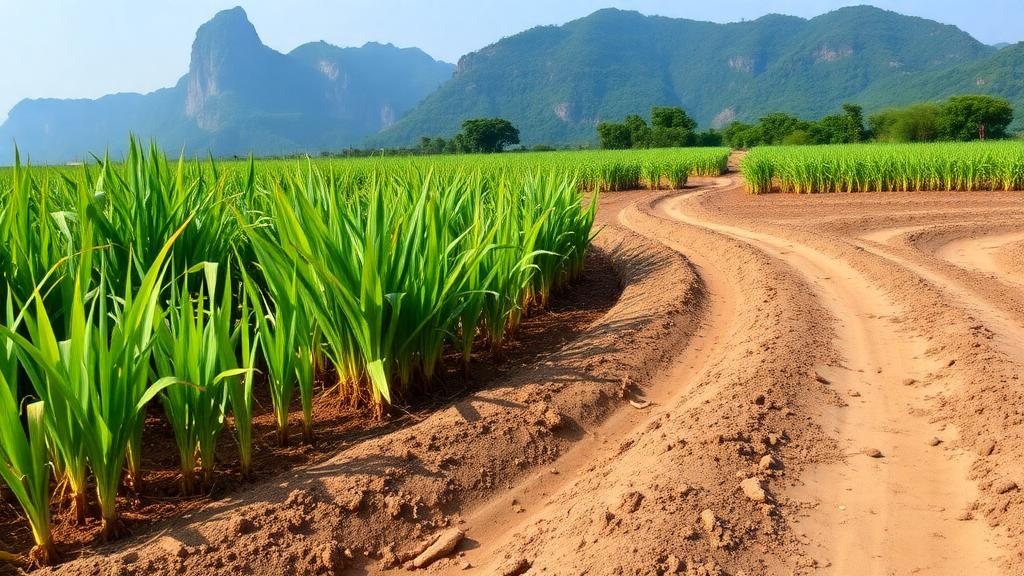
In the red-soiled hills of Guangxi, southern China, where sugarcane fields stretch across a subtropical landscape laced with streams, an invisible chemical signature is moving through the water. A year-long monitoring campaign has now documented just how pervasive that signature is. Researchers collected soil, sediment, and surface water samples every month throughout 2024 in the Nala watershed of Fusui County, targeting sixteen current-use herbicides, and every single one of those compounds turned up in at least one environmental matrix. The findings, published in Environmental Monitoring and Assessment, reveal not only widespread contamination but risk quotients for three herbicides that soar far beyond thresholds generally considered safe for aquatic ecosystems.
The analytical backbone of the study was a modified QuEChERS extraction procedure coupled with ultra-high performance liquid chromatography tandem mass spectrometry, a combination that allows trace-level quantification of multiple pesticide residues across chemically distinct matrices. This approach matters because herbicides behave very differently depending on where they end up. Some dissolve readily into water and travel with runoff; others bind to soil particles and hitch a ride on eroded sediment. By sampling soil, sediment, and water simultaneously and repeatedly across wet, dry, and transitional seasons, the team could trace those partitioning behaviors in a real watershed rather than inferring them from laboratory models alone.
One compound dominated the picture: diuron. This phenylurea herbicide, widely used to control weeds in orchards and cane fields, was detected frequently, with soil concentrations ranging from 0.309 to 175.406 micrograms per kilogram and sediment values reaching 91.292 micrograms per kilogram. Diuron’s persistence is well documented in other systems; it degrades slowly, adsorbs to organic matter, and can linger long after application. Its prominence in both soil and sediment of the Nala watershed suggests a reservoir of legacy and ongoing inputs that continues to feed the aquatic system, even between spraying seasons.
In the water column itself, the headline compounds were different. Ametryn, a triazine herbicide used heavily in sugarcane cultivation, reached a maximum concentration of 30.294 micrograms per liter in surface water, while mesotrione, a triketone herbicide, peaked at 20.264 micrograms per liter. These are striking figures for ambient surface waters, and they reflect the intensity of herbicide use in a watershed where sugarcane and other subtropical crops receive multiple applications per growing cycle. The fact that the dominant compounds shift between matrices underscores a central theme of the study: there is no single herbicide problem, but rather a suite of compound-specific contamination patterns.
The seasonal dynamics proved equally revealing, and somewhat counterintuitive. In soil, the predominant herbicides, particularly diuron and ametryn, showed significantly elevated concentrations in spring, which aligns neatly with pre-planting and early-season weed control. Yet in sediment, the predominant herbicides displayed no significant seasonal differences at all, hinting at a buffered, slowly exchanging pool that accumulates residues over time. Surface water told a third story: several compounds varied significantly across seasons, but the patterns diverged by compound. Butachlor, a chloroacetanilide used in paddy and wetland systems, reached its highest median concentration in summer, while ametryn and mesotrione showed their numerical maxima in spring.
Those contrasting temporal signatures allowed the researchers to disentangle two forces that shape pesticide fate in agricultural catchments. Application timing clearly controls the initial pulse of herbicides entering the environment, which explains the spring peaks in soil and in compounds applied early in the season. But once residues are mobilized, rainfall and hydrological processes take over, governing transport, redistribution, and dilution across the watershed. The summer peak of butachlor, a compound associated with flooded rice systems, likely reflects both its use pattern and the intense monsoon-season runoff that flushes it from fields into streams. In effect, the watershed integrates a chemical calendar written by farmers with a hydrological calendar written by the climate.
Space mattered as much as time. Higher residue levels clustered primarily in the southwestern agricultural areas of the watershed, where cultivation intensity is greatest, while downstream redistribution became evident during the rainy season as runoff carried dissolved and particle-bound herbicides toward lower reaches. This spatial structure has practical implications: it identifies hotspot zones where mitigation efforts, such as vegetated buffer strips, controlled drainage, or adjusted application schedules, would deliver the greatest reduction in downstream loading. It also demonstrates that a watershed cannot be managed as a uniform unit; pollution pathways are dictated by the geography of farming and the connectivity of the drainage network.
The ecological risk assessment is where the study’s findings become most alarming. Using the risk quotient approach, which compares measured environmental concentrations to toxicity thresholds for aquatic organisms, the team identified diuron, ametryn, and imazapic as the principal risk drivers in surface water. Maximum risk quotients reached 1251.23 for diuron, 841.50 for ametryn, and 789.20 for imazapic, values that are orders of magnitude above the threshold of 1 typically used to flag unacceptable risk. More concerning still, the median risk quotients for these three compounds remained above 1, meaning that at typical, not just extreme, concentrations, the water poses sustained ecological concern throughout much of the year.
The risk landscape beyond the top three drivers was more nuanced. Several additional herbicides also exhibited median risk quotients greater than 1, though at lower magnitudes, indicating chronic pressure from a broader suite of compounds. Others showed high maximum risk quotients but lower medians, a pattern the authors interpret as episodic risk, where brief pulses after rainfall or application events push concentrations past toxic thresholds even if average levels appear tolerable. Episodic exposure is ecologically significant because aquatic communities often respond to peak concentrations, and short pulses during sensitive life stages, such as larval development, can cause disproportionate harm. A monitoring program that samples infrequently would miss exactly these events, which is why the monthly resolution of this study is methodologically important.
What emerges from the Nala watershed is a systems-level insight: herbicide occurrence, transport, and ecological risk in subtropical agricultural regions are jointly governed by agricultural practices, compound-specific environmental behavior, and hydrological processes. None of these factors can be addressed in isolation. The authors position their work as a scientific basis for targeted herbicide monitoring, runoff control, and watershed-based pollution management, and the data support concrete interventions, from timing applications to avoid pre-monsoon windows to prioritizing the southwestern hotspot zones for best-management practices. As herbicide use intensifies across the subtropical belt to feed growing populations, studies like this one provide the evidence base needed to keep crop protection from becoming waterway contamination, and they make clear that in intensively farmed watersheds, the two are currently separated by a very thin line.
Subject of Research: Occurrence, seasonal and spatial distribution, and aquatic ecological risk of sixteen current-use herbicides in a subtropical agricultural watershed in South China
Article Title: Occurrence, spatiotemporal distribution, and risk assessment of herbicides in a subtropical agricultural watershed
Article References: Liu, L., Mo, G., Zhao, Y., Rasheed, U., Li, Y., Hu, M., Qin, Q., Qin, Y., Tan, H., & Shan, B. (2026). Occurrence, spatiotemporal distribution, and risk assessment of herbicides in a subtropical agricultural watershed. Environmental Monitoring and Assessment, 198(10), Article 1094. https://doi.org/10.1007/s10661-026-15948-0
Image Credits: AI Generated
DOI: 10.1007/s10661-026-15948-0
Keywords: herbicides, diuron, ametryn, imazapic, butachlor, mesotrione, agricultural runoff, watershed, ecological risk assessment, risk quotient, surface water contamination, subtropical agriculture
Cite Scienmag News
Violet Maxwell. (October 6, 2026). Herbicide Cocktails Push Ecological Risk to Extreme Levels in a Chinese Sugarcane Watershed. Scienmag. https://scienmag.com/herbicide-cocktails-push-ecological-risk-to-extreme-levels-in-a-chinese-sugarcane-watershed/
Violet Maxwell. "Herbicide Cocktails Push Ecological Risk to Extreme Levels in a Chinese Sugarcane Watershed." Scienmag, 6 October 2026, https://scienmag.com/herbicide-cocktails-push-ecological-risk-to-extreme-levels-in-a-chinese-sugarcane-watershed/. Accessed 6 October 2026.
Violet Maxwell. "Herbicide Cocktails Push Ecological Risk to Extreme Levels in a Chinese Sugarcane Watershed." Scienmag. October 6, 2026. https://scienmag.com/herbicide-cocktails-push-ecological-risk-to-extreme-levels-in-a-chinese-sugarcane-watershed/


