


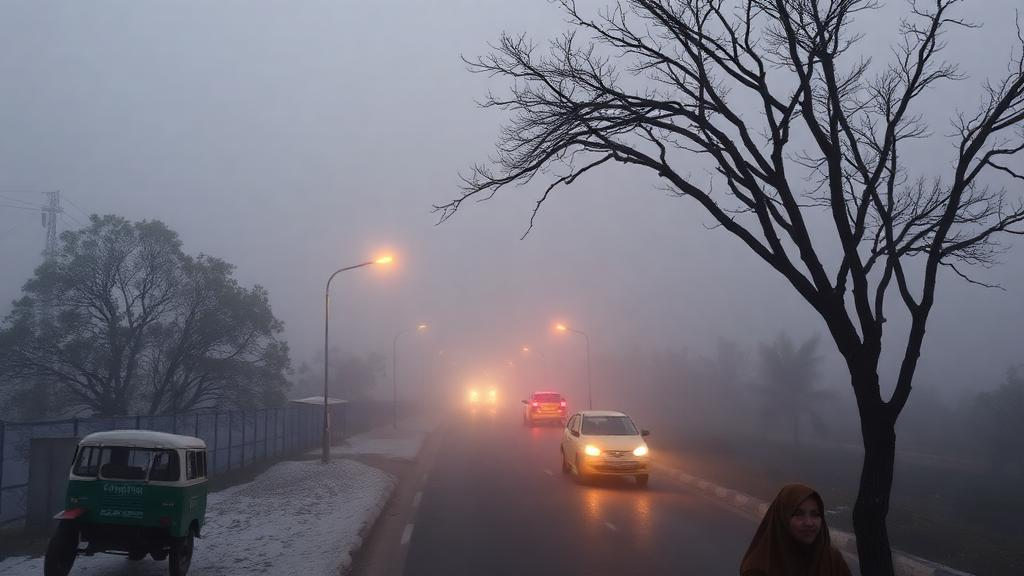
On cold winter mornings over eastern India, the air above Kolkata airport often behaves in a way that meteorologists find both fascinating and troubling: instead of cooling steadily with height, the atmosphere warms for a stretch, trapping cooler air and everything suspended in it beneath a lid of warmer air. A new analysis of more than three decades of wintertime balloon soundings has now quantified, with unusual precision, how this phenomenon — the thermal inversion — is changing over one of India’s busiest aviation hubs. The findings, published in Theoretical and Applied Climatology, reveal that winter inversions over Kolkata are becoming more frequent, structurally shallower, and measurably more intense, with consequences that ripple through air quality, fog formation and flight operations.
The study, carried out by Pravat Rabi Naskar of the Meteorological Watch Office Kolkata at the India Meteorological Department and Gyan Prakash Singh of the Department of Geophysics at Banaras Hindu University, draws on radiosonde and radiowind observations collected at 00 UTC for every winter season from December 1990 through February 2022. These balloon-borne instruments, launched routinely to profile temperature, humidity and wind through the depth of the troposphere, provide one of the longest continuous records of vertical atmospheric structure available anywhere in the region. The authors supplemented this archive with ERA5 reanalysis vertical velocity data from the Copernicus Climate Change Service, allowing them to connect the observed inversion behavior to the large-scale motions of the atmosphere above the Gangetic delta.
Thermal inversions come in several flavors, and distinguishing them matters enormously for forecasting. A surface-based inversion forms on clear, calm nights when the ground radiates heat to space and chills the air in contact with it. A subsidence inversion, by contrast, forms aloft when air in a high-pressure system sinks slowly from above; as the descending air compresses, it warms at a rate faster than the environmental lapse rate, creating a warm layer that floats above the cooler air below. The Kolkata analysis found that the winter inversions between the 1000 and 500 hectopascal pressure levels — a layer stretching from near the surface to roughly five kilometers altitude — are overwhelmingly of the subsidence type, pointing to the dominant role of large-scale atmospheric descent rather than purely local nighttime cooling.
One of the most striking trends the researchers documented concerns multiplicity. The percentage of winter days on which more than one thermal inversion appears within that 1000 to 500 hectopascal column is increasing at a rate of approximately one percent per year. Multiple stacked inversion layers are a well-known signature of complex vertical structure in the lower troposphere, and studies from eastern China and northwest China have linked such multilayer configurations to severe haze episodes, because each warm layer acts as a separate barrier to vertical mixing. Over Kolkata, the steady rise in double-inversion days suggests that the lower troposphere is becoming increasingly stratified in winter, a structural change that could compound the region’s already serious wintertime pollution problems.
The geometry of the inversions is changing too, and in a consistent direction. Over the 33-winter record, the height of the inversion top has been dropping at roughly 28 meters per year, while the base of the inversion has descended at about 20 meters per year. Because the top is falling faster than the base, the inversion layer itself is thinning by approximately 7 meters annually. A thinner inversion layer is not a weaker one; on the contrary, compressing the temperature contrast into a narrower vertical span can sharpen the stability of the layer, making it a more effective lid on the atmosphere beneath. The authors also found that inversion intensity — the temperature difference across the inversion — is increasing, although the inversion gradient, the temperature change per unit height, shows no statistically significant trend, presumably because the intensifying temperature jump is being spread across a shrinking layer.
What physical mechanism could drive this systematic downward migration and intensification? The most likely candidate is a change in the large-scale subsidence pattern over the region, which the ERA5 vertical velocity data were brought in to examine. Sinking motion in the mid-troposphere warms the air through compression, and the altitude at which that warming is strongest determines where the inversion forms. If the descending branch of the regional circulation has shifted lower, or if subsidence has strengthened in the layers just above the boundary layer, the inversion would be expected to form closer to the ground and to grow warmer relative to the air beneath it. Such changes in atmospheric stagnation have been flagged in recent work on Indian air pollution, including studies linking circulation-induced stagnation changes to surface PM2.5 concentrations across the subcontinent.
Perhaps the most consequential finding of the study concerns the planetary boundary layer — the shallow, turbulent skin of the atmosphere that responds directly to the surface and within which nearly all human emissions of pollutants are first released. The researchers found that the planetary boundary layer height over Kolkata airport sits consistently below the base of the subsidence inversion, and that it has been decreasing significantly at a rate of around 5.5 meters per year over the study period. This relationship is physically coherent: a subsidence inversion whose base lies just above the boundary layer suppresses the turbulent entrainment that normally allows the boundary layer to grow during the day. As the inversion base sinks, it effectively presses down on the boundary layer, compressing the volume of air into which vehicle exhaust, industrial emissions and dust are injected.
The implications for air quality are direct and sobering. A lower boundary layer means a smaller mixing volume, so the same quantity of emissions produces higher surface concentrations. A stronger, thinner inversion overhead makes that confinement even more effective by preventing any exchange of air across the stable layer. Research from around the world — from the Sichuan Basin in China to Hanoi, Istanbul, Tehran and the Canary Islands — has repeatedly documented the tight coupling between inversion characteristics and particulate pollution, and a recent national cohort study in China even linked thermal inversion exposure to increased risk of incident cardiovascular disease. For Kolkata, a megacity whose winter air already ranks among the most polluted anywhere, a trend toward stronger and lower inversions represents a slow tightening of the atmospheric vise.
Fog and aviation are equally implicated. The same authors previously documented a dense fog episode over Kolkata airport in January 2025 and traced its synoptic origins, and the present study provides the climatological backdrop against which such events unfold. Inversions trap moisture near the surface overnight, and shallow, intense inversions favor the radiative cooling and moisture convergence that produce dense fog — the single most disruptive weather phenomenon for airport operations in northern and eastern India. A boundary layer that is steadily losing height, capped by an inversion that is steadily losing altitude and gaining strength, is a boundary layer primed for more frequent and more persistent fog, with cascading effects on visibility, flight delays and safety margins during the December-to-February peak travel season.
What makes this study particularly valuable is its length and its focus on a single, operationally critical location. Thirty-three winters of consistent 00 UTC soundings from one site remove much of the noise that afflicts shorter or geographically scattered records, and the airport setting ties the results directly to a real-world stakeholder. The picture that emerges is of a lower troposphere in structural transition over the Bengal delta: inversions multiplying, sinking, thinning and strengthening, while the boundary layer beneath them contracts year by year. Whether these trends are driven by shifting regional circulation, by warming sea surface temperatures in the Bay of Bengal, by aerosol-induced changes in the radiation balance, or by some combination of all three remains an open question — but the direction of change is unambiguous, and it points toward winters in which the air over Kolkata becomes steadily harder for the atmosphere to flush clean.
Subject of Research: Long-term trends in winter thermal inversion characteristics and planetary boundary layer height over Kolkata airport
Article Title: Characteristics of winter thermal inversions over Kolkata airport
Article References: Naskar, P. R., & Singh, G. P. (2026). Characteristics of winter thermal inversions over Kolkata airport. Theoretical and Applied Climatology, 157(10), Article 645. https://doi.org/10.1007/s00704-026-06575-3
Image Credits: AI Generated
DOI: 10.1007/s00704-026-06575-3
Keywords: thermal inversion, Kolkata airport, radiosonde, planetary boundary layer, subsidence, air pollution, fog, ERA5 reanalysis, winter climate, atmospheric stability, India, boundary layer height
Cite Scienmag News
Russell Cooper. (October 5, 2026). Winter Temperature Inversions Over Kolkata Are Sinking, Thinning and Growing Stronger. Scienmag. https://scienmag.com/winter-temperature-inversions-over-kolkata-are-sinking-thinning-and-growing-stronger/
Russell Cooper. "Winter Temperature Inversions Over Kolkata Are Sinking, Thinning and Growing Stronger." Scienmag, 5 October 2026, https://scienmag.com/winter-temperature-inversions-over-kolkata-are-sinking-thinning-and-growing-stronger/. Accessed 5 October 2026.
Russell Cooper. "Winter Temperature Inversions Over Kolkata Are Sinking, Thinning and Growing Stronger." Scienmag. October 5, 2026. https://scienmag.com/winter-temperature-inversions-over-kolkata-are-sinking-thinning-and-growing-stronger/


