


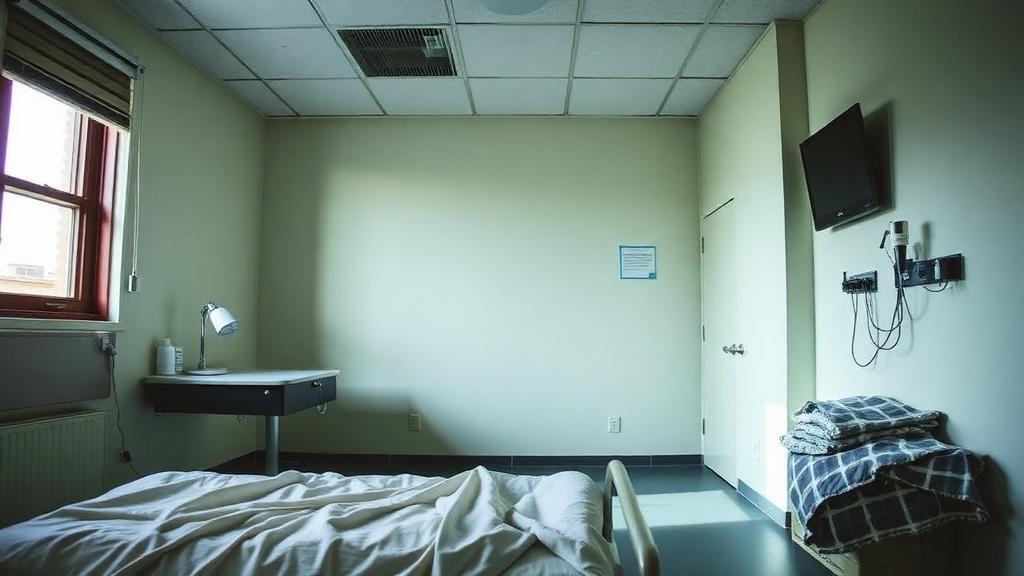
For adolescents with severe anorexia nervosa, involuntary admission to a psychiatric ward can feel less like rescue and more like being dropped into a war zone. That is the striking conclusion of a new qualitative study from Sweden, published in Child Psychiatry & Human Development, in which researchers interviewed seven girls, with a mean age of 15.3 years, about their lived experience of compulsory inpatient care for the eating disorder. The study, led by Hanna Henningsson of Region Skåne and Lund University, used a phenomenological hermeneutic approach to dig beneath the clinical surface of refeeding and weight restoration, asking what it actually means to a teenager to be legally mandated into treatment she does not believe she needs.
The stakes of the question are high. Untreated anorexia nervosa is life-threatening and disabling, carrying the second highest mortality rate of all psychiatric disorders, exceeded only by opioid use disorder, with deaths driven both by medical complications and by suicide. Lifetime prevalence reaches up to four percent among females and 0.3 percent among males, and incidence in adolescents appears to be rising. Roughly half of those affected have psychiatric comorbidity, and depression and high anxiety are linked to poor long-term prognosis. Although outpatient care, particularly family-based treatment, is the recommended first line for adolescents, the most severely ill patients, those with life-threatening weight loss, physiological instability or deterioration despite maximal outpatient efforts, often require inpatient admission, sometimes under Sweden’s Compulsory Psychiatric Care Act, which permits treatment without patient consent.
The researchers recruited participants from the child and adolescent psychiatric emergency unit at University Hospital in Malmö, the only such unit in a region of 1.4 million people, which maintains eight inpatient beds dedicated to severe eating disorders. Of 28 potentially eligible adolescents admitted between January 2021 and December 2023, seven agreed to participate. Their average stay had lasted 18 weeks, ranging from four to 38 weeks, six had experienced multiple treatment periods, and six had been admitted involuntarily, some more than once. On average they had been ill for about ten months before their first admission, and by the time they arrived they could no longer attend school or after-school activities. Interviews, averaging 90 minutes, took place 13 to 24 months after discharge, when all participants were stabilized and in full or partial remission.
The analysis followed three steps: a naïve reading of the transcripts, a structural analysis dividing the text into meaning units and themes, and a final comprehensive understanding discussed by the whole team. To guard against bias, the researchers explicitly discussed their pre-understanding of eating disorders and compulsory treatment, and two participants were invited to review and confirm the structural analysis, which both did. What emerged was a powerful central metaphor: the girls described existing in a power struggle, a battle zone with four distinct fronts. They were fighting, simultaneously, against the healthcare professionals, against the eating disorder itself, against fellow patients, and against their parents.
The battle with staff was the most visible front. Compulsory care for severe starvation involves surveillance, weight control and supervised meals, and the participants described feeling restricted, oppressed and stripped of all autonomy. Some recalled being threatened with feeding tubes and experiencing nutritional support as punishment rather than therapy. They reported mixed signals from staff about rules and restrictions, producing profound insecurity, and they felt mistrusted and monitored while eating. Most painfully, many described being approached as an eating disorder rather than as a person, feeling deprived of their human dignity, inherent value and responsibility for their own actions. One participant put it bluntly: care cannot fight the eating disorder, only she could, and for that she needed personalized treatment rather than a focus on pathology alone.
Uncertainty compounded the distress. The girls said staff did not always explain the rationale behind decisions, leaving them confused and lonely, and in retrospect they recognized that starvation itself had limited their cognitive capacity, deepening their despair. Some described suicidal thoughts during this period. Yet the analysis also identified a theme of surrendering, in which some participants came to accept that total autonomy was not an option while medically unstable, and a few even appreciated being disburdened from the pressure of managing the illness alone. This ambivalence, resentment of coercion alongside recognition of its necessity, runs through the entire study and captures the paradox clinicians face when treating patients who lack insight into their own condition.
The second front, the fight against the disorder itself, began in denial. Participants initially rejected the idea that they were sick and struggled to understand the condition. Staff encouraged them to view the anorexia as an external entity separate from the self, a technique known as externalization that is common in eating disorder treatment. But the girls experienced this dualistically: they felt simultaneously identical to the disorder and subjected to it, and when staff focused narrowly on weight, food intake and forced nutrition, the part that constituted their self went unconfirmed, producing a profound sense of fighting an entirely solitary battle. They endured acute somatic consequences such as hypoglycaemia, nausea and vomiting, and while they accepted somatic care as necessary, they wished staff would support their psychological fight rather than attempting to fight the disorder for them.
The two remaining fronts were quieter but no less corrosive. Among fellow patients, the girls described a silent war of constant observation, monitoring each other’s portions, movements around the ward and feeding tubes, comparisons that triggered panic and, disturbingly, normalized extreme thinness. At the same time they felt empathy and a kind of communion with peers in the same boat. The battle with parents was shaped by the unit’s structure: mothers, who were the primary accompanying caregivers in six of seven cases, slept in the same room, shared meals and participated in monitoring eating, producing situations filled with tension and conflict that eroded trust within the mother-daughter relationship. Fathers were largely absent, and the daughter-father dynamic was described as tense and distanced, suggesting the family, potentially the strongest resource for recovery, was drawn into an unnecessary battle of its own.
Despite the suffering described, the study’s comprehensive understanding is not a condemnation of compulsory care. Within six months to two years after discharge, all participants had become reconciled with the experience, recognizing that the involuntary hospital treatment had been a necessary turning point for their survival, even if the methods remained problematic. They recovered by eventually finding inner motivation and strength, and all had returned to school, friends and family activities. The authors argue that this reconciliation is possible precisely because clinicians can learn from the four-front framework: by acknowledging the power struggle openly with patients and families, confirming the patient’s suffering to restore dignity, strengthening parents to carry out family-based treatment components, and providing the psychological support and peer support that participants repeatedly requested, wards may be able to reduce iatrogenic harm without compromising medical safety.
The authors acknowledge limitations: only girls were included, limiting generalizability to male patients, and the sample was small, though the participant-driven interviews were extensive and the study was judged to have sufficient information power. Recall bias is also possible given the 13-to-24-month interval, although the authors considered this distance valuable for reflection. Methodologically, the study distinguishes the outside, professional perspective on disease from the inside, personal perspective, arguing both are valid and essential for person-centred care, which Swedish national guidelines mandate for all care processes including compulsory psychiatric treatment. The clinical significance of the findings lies in concrete implications for patient empowerment and counselling, psychosocial therapy, in-hospital guidance and the differing ways adolescents learn about their illness. For a disorder whose treatment demands cooperation from patients who cannot yet see why they need it, listening to the narrative and establishing a partnership, the essence of person-centred care, may be the difference between a battle zone and a turning point.
Subject of Research: Adolescents' lived experience of compulsory inpatient care for severe anorexia nervosa
Article Title: Existing in a Battle Zone – The Lived Experience of Adolescents Subjected to Hospital Compulsory Care Due to Severe Anorexia Nervosa
Article References: Henningsson, H., Forsberg, A., Eberhard, S., Johansson, B. A., & Rask, O. (2026). Existing in a Battle Zone – The Lived Experience of Adolescents Subjected to Hospital Compulsory Care Due to Severe Anorexia Nervosa. Child Psychiatry & Human Development. https://doi.org/10.1007/s10578-026-02101-8
Image Credits: AI Generated
DOI: 10.1007/s10578-026-02101-8
Keywords: anorexia nervosa, adolescents, compulsory care, inpatient treatment, eating disorders, qualitative research, phenomenological hermeneutics, person-centred care, psychiatry, family-based treatment, Sweden, mental health
Cite Scienmag News
Glenn Wilkins. (October 5, 2026). Inside the Battle Zone: What Teens Forced Into Hospital for Anorexia Nervosa Really Experience. Scienmag. https://scienmag.com/inside-the-battle-zone-what-teens-forced-into-hospital-for-anorexia-nervosa-really-experience/
Glenn Wilkins. "Inside the Battle Zone: What Teens Forced Into Hospital for Anorexia Nervosa Really Experience." Scienmag, 5 October 2026, https://scienmag.com/inside-the-battle-zone-what-teens-forced-into-hospital-for-anorexia-nervosa-really-experience/. Accessed 5 October 2026.
Glenn Wilkins. "Inside the Battle Zone: What Teens Forced Into Hospital for Anorexia Nervosa Really Experience." Scienmag. October 5, 2026. https://scienmag.com/inside-the-battle-zone-what-teens-forced-into-hospital-for-anorexia-nervosa-really-experience/


