


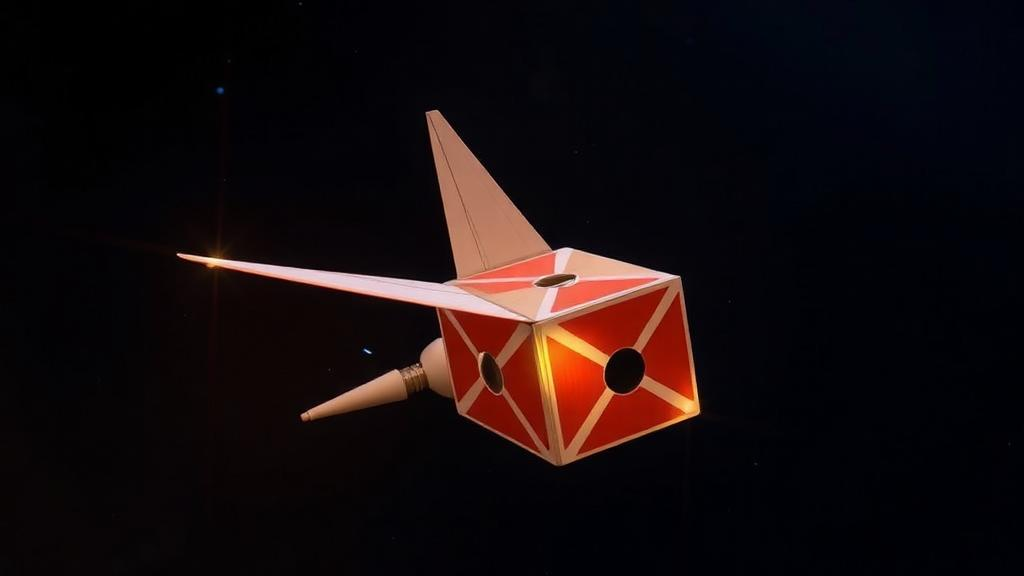
Cornell University’s Space Systems Design Studio has reported successful orbital deployment of free-flying light sails, a milestone that pushes gram-scale spacecraft from laboratory concept into operational reality. Two companion experiments, Alpha CubeSat and Sailing to the Stars, launched to the International Space Station in late 2025 aboard the NG-23 and Crew-11 missions respectively, and both have now completed their major mission objectives. The results, published by the student-led team, describe a class of solar sail slightly larger than a pizza box that carries onboard ChipSats, palm-sized spacecraft weighing only grams, which transform the sail from a passive reflector into an autonomous free-flying vehicle capable of communicating with the ground and steering itself.
The physics behind these sails is deceptively simple but demanding in practice. Photons carry momentum even though they have no mass, and when sunlight reflects off a thin reflective membrane, the momentum transfer exerts a small but continuous force. Unlike chemical rockets that burn out after minutes, a light sail accelerates for as long as it faces a light source, which is why the concept has long been championed for ambitious missions such as Breakthrough Starshot, which envisions laser-driven sails carrying tiny probes to nearby star systems. The challenge has always been engineering: a sail must be extraordinarily light, fold into a tiny launch volume, and deploy reliably in the unforgiving environment of space. Cornell’s approach attacks all three constraints at once by folding the sail origami-style inside a CubeSat and pairing it with ChipSat electronics that weigh a fraction of a conventional satellite bus.
Alpha CubeSat, a 1U CubeSat funded through NASA’s CubeSat Launch Initiative, deployed its light sail in low Earth orbit. The mission’s most striking early result came through the TinyGS network, a distributed array of amateur ground stations around the world, which established contact with the ChipSat riding on the sail. According to Joshua Umansky-Castro, the mission lead and a recent graduate of Cornell’s Aerospace Engineering Ph.D. program, this was the first time a spacecraft this small transmitted complete data packets from orbit to ground. He described the achievement as a huge milestone that advances the state of the art for the ChipSat platform. The sail itself met a quick end, as atmospheric drag at low altitude rapidly decelerated the ultralight structure, but the communications demonstration had already been secured.
Until its deorbit in May 2026, the Alpha CubeSat confirmed successful sail deployment and carried out a remarkable series of secondary technology demonstrations. The spacecraft performed spin stabilization using only magnetorquers, coils that interact with Earth’s magnetic field to control attitude without moving parts or propellant. Its avionics were built entirely from commercial off-the-shelf components, including the first-ever flight of a RockBLOCK Iridium modem, which allows a small satellite to communicate through the Iridium satellite constellation. The chassis was fully 3D-printed, and the mission even carried the first holographic-image message plaques sent to space, part of an effort to embed durable messages on light sails that might one day travel to other stars.
The companion experiment, Sailing to the Stars, took a different approach to the same problem by testing sail deployment inside the microgravity environment of the space station itself. Funded by the ISS National Laboratory in collaboration with Rhodium Scientific, the experiment deployed six of the light sails and captured critical video footage and inertial measurement unit data. This combination gives the student engineers a direct view of how the sails unfurl and how the deployment dynamics behave when gravity does not mask subtle oscillations, snags, or asymmetric release. Understanding these kinematics on the station is far cheaper and safer than discovering them during an orbital deployment that cannot be repeated or repaired.
A particularly inventive aspect of the Sailing to the Stars experiment was the hardware itself. Two different CubeSat-scale deployer designs were tested, both built entirely from 3D-printed modular components the team describes as CubeSat-LEGO. The deployers were spin-stabilized using reaction wheels salvaged from laptop hard disk drives, and they were commanded using ordinary TV remote controls. This deliberate use of consumer hardware reflects a philosophy of radical cost reduction: if a deployment mechanism can be validated with parts costing a few dollars, the barrier to flying many more sail missions drops dramatically. By comparing video and IMU data from both designs, the team assessed which release mechanism produced more stable kinematics, and those insights now feed directly into the design of future missions.
The human story behind the hardware is as notable as the technology. The original concept for Alpha was proposed by a high school student through the Museum of Science Fiction’s International CubeSat Design Competition, and since 2016 more than 150 students have contributed to the spacecraft projects. Over half of those participants have gone on to intern or work in the aerospace industry after graduation. Verena Padres, a member of the class of 2026 who managed the Sailing to the Stars project, said that working on something that would fly in space was her dream going into college, and that she was grateful not only for hands-on spacecraft engineering experience but for the chance to lead the team from mission concept through launch.
What makes the ChipSat-sail combination significant for the broader field is the mass budget it opens up. Traditional solar sails require booms, deployment mechanisms, avionics, and power systems that can add kilograms, and that mass directly reduces the acceleration the sail can achieve for a given area. By making the sail itself the structural carrier and letting a gram-scale ChipSat handle communications and steering, the Cornell design shrinks the total system mass toward the regime where photon pressure becomes genuinely useful for propulsion. The team’s stated roadmap builds on this: future ChipSat-sail launches are planned to demonstrate steering, orbit-raising, and laser propulsion, with longer-term ambitions extending to solar system exploration missions targeting the moon, Mars, and beyond.
The ultimate destination, as the team emphasizes, is interstellar space. Initiatives such as Breakthrough Starshot have argued that sails riding on powerful laser beams could one day propel tiny spacecraft to a significant fraction of the speed of light, reaching nearby star systems within a human lifetime in the search for life beyond Earth. Demonstrating that a sail can deploy reliably in orbit, that a gram-scale spacecraft can close the communications link from orbit to ground, and that deployers can be built from printed modular parts and consumer components are all necessary steps on that path. Each of those boxes has now been checked by a student laboratory.
The Space Systems Design Studio, a lab within Cornell’s Sibley School of Mechanical and Aerospace Engineering run by Professor Mason Peck, focuses on exploiting spacecraft physics to improve space capabilities, and these missions exemplify that philosophy. With both experiments having completed all major objectives, the results published through the Small Satellite Conference proceedings, and a pipeline of students trained on flight hardware, Cornell has established that free-flying light sails are no longer a paper concept. The pizza-box sail and its chip-sized passenger have flown, talked to the ground, and come home with data, and the next generation of sails is already being designed to steer, climb, and eventually ride beams of light far beyond Earth.
Subject of Research: Orbital deployment of free-flying light sails carrying gram-scale ChipSat spacecraft
Article Title: Cornell University successfully deploys free-flying light sails in orbit
Article References: Cornell University successfully deploys free-flying light sails in orbit. (n.d.). Original publication
Image Credits: AI Generated
DOI: Not provided
Keywords: light sails, ChipSats, CubeSat, Alpha CubeSat, Sailing to the Stars, Cornell University, solar propulsion, low Earth orbit, ISS National Laboratory, Breakthrough Starshot, 3D-printed spacecraft, student space missions
Cite Scienmag News
Grant Pearson. (October 5, 2026). Cornell Students Fly Pizza-Box Light Sails Free in Orbit, a First for Chip-Sized Spacecraft. Scienmag. https://scienmag.com/cornell-students-fly-pizza-box-light-sails-free-in-orbit-a-first-for-chip-sized-spacecraft/
Grant Pearson. "Cornell Students Fly Pizza-Box Light Sails Free in Orbit, a First for Chip-Sized Spacecraft." Scienmag, 5 October 2026, https://scienmag.com/cornell-students-fly-pizza-box-light-sails-free-in-orbit-a-first-for-chip-sized-spacecraft/. Accessed 5 October 2026.
Grant Pearson. "Cornell Students Fly Pizza-Box Light Sails Free in Orbit, a First for Chip-Sized Spacecraft." Scienmag. October 5, 2026. https://scienmag.com/cornell-students-fly-pizza-box-light-sails-free-in-orbit-a-first-for-chip-sized-spacecraft/


